Sales, Production & Purchases Budgets (Cambridge (CIE) A Level Accounting): Revision Note
Exam code: 9706

Sales budget
How to prepare a sales budget?
The sales budget is based on selling price and volume of sales
Here is an example of what a sales budget would look like
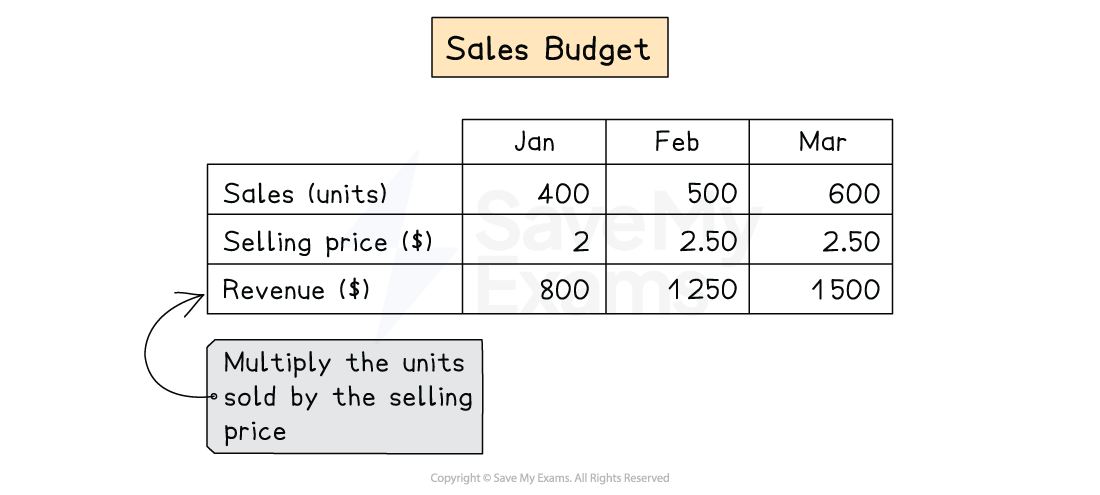
STEP 1
Calculate the selling price relevant to the period neededSTEP 2
Calculate the number of units to be sold for each periodSTEP 3
Calculate the total revenue for the periodRevenue = selling price × units sold
Worked Example
Games Ltd makes games consoles. The following information is provided:
January | February | March | |
|---|---|---|---|
Selling price per unit | $20 | Increase by 10% from January | Increase by a further 5% from February |
Units sold | 10 000 | Reduced by 2% from January | Reduced by a further 8% from February |
Prepare the sales budget for January, February and March
Answer
Calculate the selling price for each month
January = $20
February = $20 + 10% = $22
March = $22 + 5% = $23.10
Calculate the units sold for each month
January = 10 000
February = 10 000 - 2% = 9 800
March = 9 800 - 8% = 9 016
Calculate the revenue for each month
January = 10 000 × $20 = $200 000
February = 9 800 × $22 = $215 600
March = 9 016 × $23.10 = $208 269.60
The answer will be shown as the sales budget:
January | February | March | |
|---|---|---|---|
Units sold | 10 000 | 9 800 | 9 016 |
Selling price $ | 20 | 22 | 23.10 |
Revenue $ | 200 000 | 215 600 | 208 269.60 |
Production budget
How to prepare a production budget?
The production budget is the number of units needed for production for a particular period
Everything in a production budget is calculated in units
Here is an example of what a production budget would look like
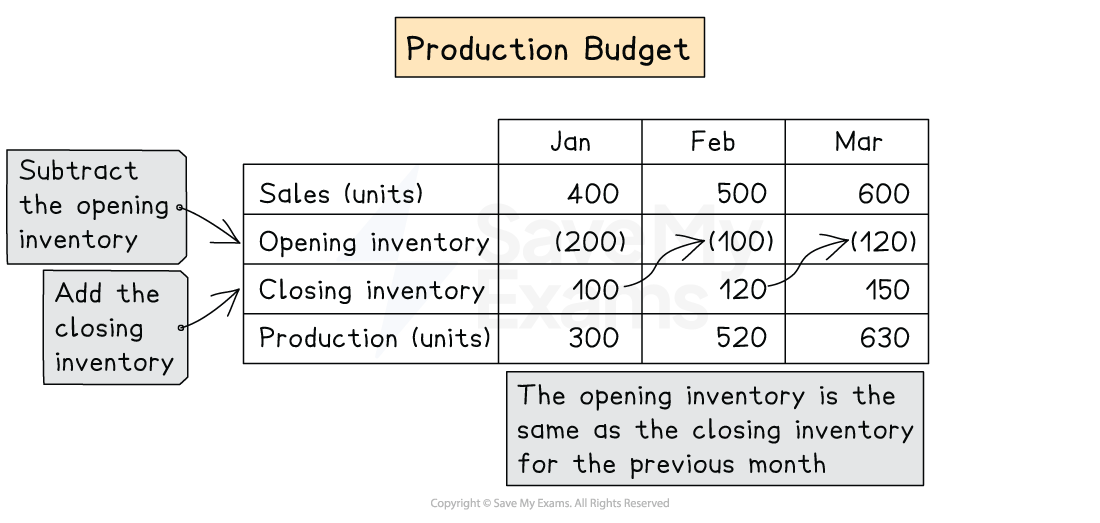
STEP 1
Find the units soldThis is taken from the sales budget
STEP 2
Minus the opening inventory as this is already produced and does not need producingThe opening inventory will be the closing inventory of the last period
STEP 3
Add the closing inventoryThis will depend on what inventory levels are needed
This is usually based on a % of sales of the next period
STEP 4
Calculate the production needed for each periodAdd the sales and closing inventory
Minus the opening inventory
Worked Example
Games Ltd makes games consoles. The following information is provided:
January | February | March | |
|---|---|---|---|
Units sold (based on sales budget) | 10 000 | 9 800 | 9 016 |
Closing inventory | Based on 20% of sales for the next month | Based on 25% of sales for the next month | Based on 18% of sales for the next month |
Additional information
The opening inventory in January is expected to be 2 000 units
The units sold in April is expected to be 9 000 units
Prepare the production budget for January, February and March
Answer
Calculate the closing inventory for each period
January = 9 800 × 20% = 1 960 units
February = 9 016 × 25% = 2 254 units
March = 9 000 × 18% = 1 620 units
Calculate the production for each month
January = 10 000 - 2 000 + 1 960= 9 960 units
February = 9 800 - 1 960 + 2 254 = 10 094 units
March = 9 016 - 2 254 + 1 620= 8 382 units
January | February | March | |
|---|---|---|---|
Units sold | 10 000 | 9 800 | 9 016 |
-Opening inventory | (2 000) | (1 960) | (2 254) |
+Closing inventory | 1 960 | 2 254 | 1 620 |
= Production | 9 960 | 10 094 | 8 382 |
Purchases budget
How to prepare a purchases budget?
The purchases budget is based on the material needed for the units of production
The purchase budget is based on the cost price and volume of material
Here is an example of what a purchases budget would look like
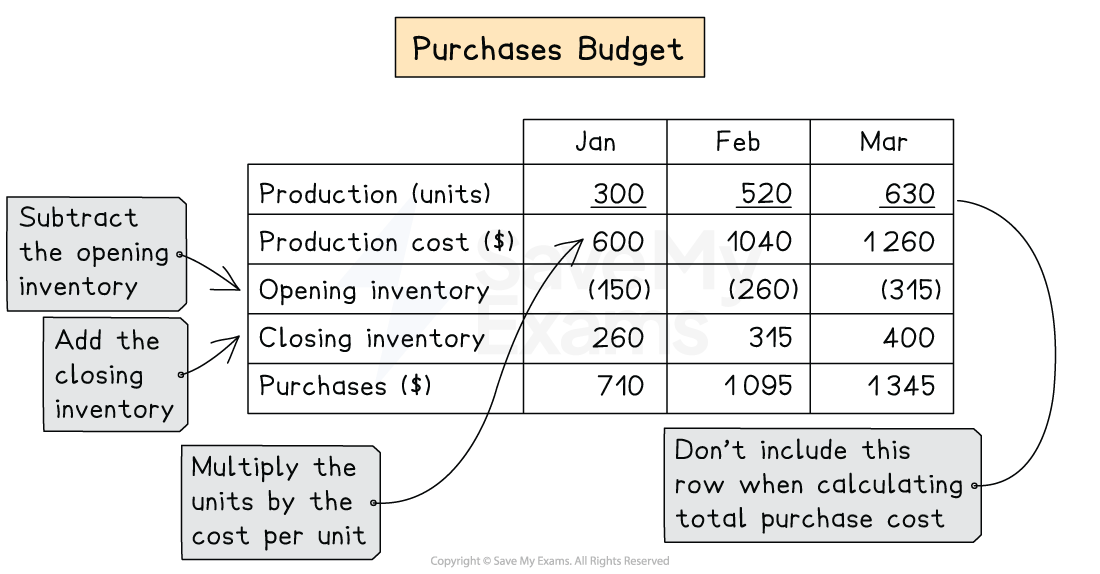
STEP 1
Calculate the cost price relevant for the material for making one unitSTEP 2
Find the production in units for the period neededThis can be taken from the production budget
Multiply the production in units by the material cost price per unit
STEP 3
Find the opening inventory valuationThis will be same as the closing value as the last period
STEP 4
Find the closing inventory valuationThis is usually based on a percentage of inventory the business would like to hold
STEP 5
Find the purchases for the monthStart with the production units
Subtract the opening inventory of materials
Add the closing inventory of materials
Worked Example
Suits Ltd makes fitted suits. The following information is provided:
January | February | March | |
|---|---|---|---|
Production in units | 9 000 | 10 000 | 8 500 |
Each unit of production requires 5kg of material with the cost per kg as $7
Closing inventory for direct material will be based on 20% of production for the next month
Closing inventory is 2 000 units in December
Production is expected to be 9000 in April
Prepare the purchases budget for January, February and March
Answer
Calculate the cost price for each unit
5kg × $7 = $35 per unit
Calculate the production cost for each month
January = 9 000 × $35= $315 000
February = 10 000 × $35 = $350 000
March = 8 500 × $35 = $297 500
Calculate the opening inventory for the first month
January = 2 000 units × $35 = $70 000
Calculate the closing inventory for the first month
January = 10 000 units × 20% = 2 000 x $35 = $70 000
February = 8 500 units × 20% = 1 700 x $35 = $59 500
March = 9 000 units × 20% = 1 800 x $35 = $63 000
The answer will be shown as the purchases budget:
January $ | February $ | March $ | |
|---|---|---|---|
Production | 315 000 | 350 000 | 297 500 |
Less: Opening Inventory | (70 000) | (70 000) | (59 500) |
Add: Closing Inventory | 70 000 | 59 500 | 63 000 |
Purchase | 315 000 | 339 500 | 301 000 |
Examiner Tips and Tricks
When doing the sales, production and purchase budget, it would make it easier to do them in this order:
Sales
Production
Purchases

Unlock more, it's free!
Join the 100,000+ Students that ❤️ Save My Exams
the (exam) results speak for themselves:

Was this revision note helpful?