Statement of Cash Flows (Cambridge (CIE) A Level Accounting): Revision Note
Exam code: 9706

Statements of cash flows
What is a statement of cash flows?
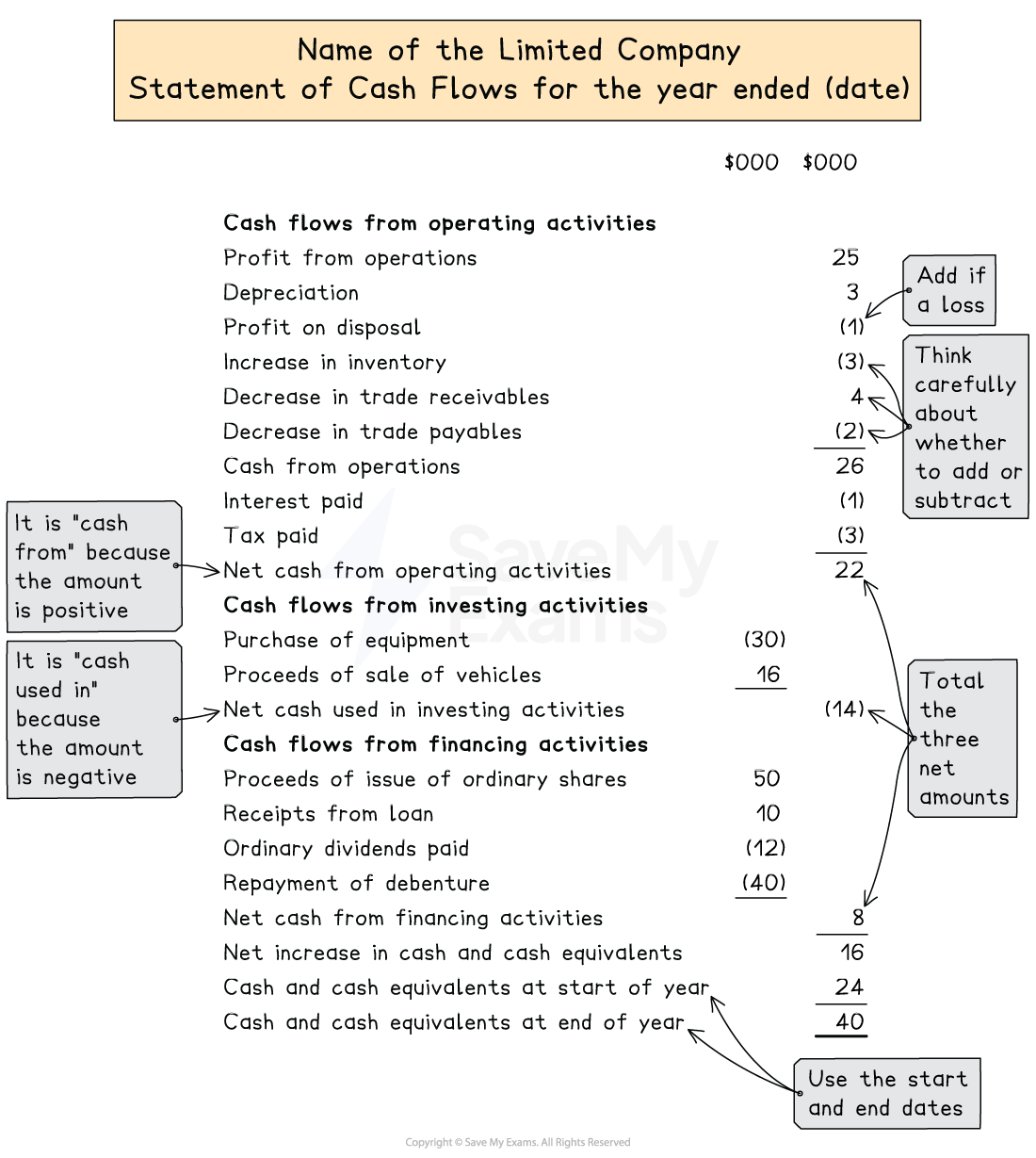
A statement of cash flows shows the movement of cash and cash equivalents during the year
It separates the cash flows into three sections to show the cash from or used in these activities
Cash flows from operating activities
Cash flows from investing activities
Cash flows from financing activities
What are the uses of a statement of cash flows?
To show the amount of money that has entered and left the business during a period
To show why the profit for a period is different to the increase in cash
To show sources of finance during a period
To enable the directors to assess the liquidity of the business
To enable stakeholders to see how well cash has been used
To enable stakeholders to compare the year's cash flow with previous years or with other businesses
How do I prepare a statement of cash flows?
Cash flows from operating activities
Start with the profit from operations
This is the profit before loan interest and tax
Make adjustments for non-cash items included in the calculation for the profit
Add the depreciation charge for the year
Add the loss on disposal of non-current assets
Subtract the profit on disposal of non-current assets
Make adjustments for changes in working capital
Change in inventories
Add if it is a decrease
Subtract if it is an increase
Change in trade receivables
Add if it is a decrease
Subtract if it is an increase
Change in trade payables
Add if it is an increase
Subtract if it is a decrease
This gives the cash from or used in operations
It is cash from operations if it is a positive value
It is cash used in operations if it is a negative value
Subtract the actual amount paid for interest and tax
This gives the net cash from or used in operating activities
Examiner Tips and Tricks
It can be helpful to understand why changes to assets and liabilities are added or subtracted from the cash flows from operating activities.
A decrease to an asset is added to the cash flow because a part of its balance at the beginning of the year has been converted to cash. Whereas, a decrease to a liability is subtracted from the cash flow because the company has paid some of the balance off.
Cash flows from investing activities
Add the sale proceeds from the disposals of non-current assets
Subtract the purchase amounts of non-current assets
The net amount is the net cash from or used in investing activities
It is usually net cash used in investing activities
Cash flows from financing activities
Add the amounts raised to finance the company
Issue of share capital
Money from new debentures or loans
Subtract the amounts paid to investors, lenders and shareholders
Repayment of debentures or loans
Dividends paid
The net amount is the net cash from or used in financing activities
Examiner Tips and Tricks
A bonus issue raises no cash, so it is excluded from the cash flow statement. A rights issue raises cash, so the full amount received (nominal value + share premium) appears as a cash inflow under financing activities.
How do I calculate the profit from operations?
You might be given the profit from operations in the question or you might be required to calculate it
You can calculate the profit or the loss for the year by looking at the change in equity
Calculate the change in retained earnings
Add back the dividends paid
Add back any amounts of retained earnings that were transferred or used in a bonus issue of shares
You can then work backwards from the profit or loss to find the profit from operations
Add back the amount due for finance costs for the year
Add back the amount due for taxation for the year
Examiner Tips and Tricks
The amounts due for interest and tax might not be the amounts that were actually paid. The amounts due are used to calculate the profit from operations. The amounts paid are used to calculate the net cash from operating activities.
Worked Example
W plc's financial year ends on 31 December.
The following information for the year ended 31 December 2025 is available.
The following balances are given.
1 January 2025 $ | 31 December 2025 $ | |
|---|---|---|
Inventory | 29 000 | 21 000 |
Trade receivables | 32 000 | 33 000 |
Trade payables | 27 000 | 30 000 |
Cash and cash equivalents | 11 000 | 17 000 |
Accrued loan interest | - | 1 000 |
Ordinary share capital | 100 000 | 120 000 |
Share premium | 10 000 | 20 000 |
Retained earnings | 30 000 | 34 000 |
Debentures | 20 000 | 20 000 |
The following balances were on 1 January 2025.
$ | |
|---|---|
Non-current assets at cost | 200 000 |
Provision for depreciation | 85 000 |
Office equipment costing $25 000 was sold for $7 000. It had a carrying value of $10 000 at the point of sale. New office equipment was purchased for $105 000. Non-current assets are depreciated at 20% per annum using the straight-line method. A full year's depreciation is charged in the year of purchase but none is charged in the year of disposal.
There was a rights issue of shares during the year.
Loan interest, $1 000, was paid.
Taxation, $2 000, was paid.
Dividends, $12 000, were paid.
(a) Calculate the profit for the year 2025.
(b) Prepare the statement of cash flows for the year ended 31 December 2025.
Answer:
(a)
Calculate the profit
Find the increase in the retained earnings
Add the dividends paid
$ | |
|---|---|
Retained earnings at 31 December 2025 | 34 000 |
Retained earnings at 1 January 2025 | (30 000) |
Dividends paid | 12 000 |
Profit for the year | 16 000 |
Profit for the year was $16 000
(b)
Calculate the loan interest that was due
Add the amount paid to the amount that is still accrued
$1 000 + $1 000 = $2 000
Calculate the profit from operations
$ | |
|---|---|
Profit for the year | 16 000 |
Add: Loan interest | 2 000 |
Add: Tax | 2 000 |
Profit from operations | 20 000 |
Calculate the depreciation charge for the year
Find the total cost of the non-current assets at the end of the year
$200 000 - $25 000 + $105 000 = $280 000
Find 20% of this amount
20% × $280 000 = $56 000
Calculate the loss on sale of equipment
$10 000 - $7 000 = $3 000
Calculate the amount received from the rights issue
Subtract the old share capital from the new share capital
($120 000 + $20 000) - ($100 000 + $10 000) = $30 000
Calculate the change in inventory, trade receivables and trade payables
$ | |||
|---|---|---|---|
Inventory | 29 000 - 21 000 | 8 000 | Decrease |
Trade receivables | 33 000 - 32 000 | 1 000 | Increase |
Trade payables | 30 000 - 27 000 | 3 000 | Increase |
Prepare the statement of cash flows
$000 | $000 | |
|---|---|---|
Cash flows from operating activities | ||
Profit from operations | 20 | |
Depreciation | 56 | |
Loss on sale of equipment | 3 | |
Decrease in inventory | 8 | |
Increase in trade receivables | (1) | |
Increase in trade payables | 3 | |
Cash from operations | 89 | |
Interest paid | (1) | |
Tax paid | (2) | |
Net cash from operating activities | 86 | |
Cash flows from investing activities | ||
Purchase of equipment | (105) | |
Proceeds of sale of equipment | 7 | |
Net cash used in investing activities | (98) | |
Cash flows from financing activities | ||
Proceeds of rights issue of ordinary shares | 30 | |
Dividends paid | (12) | |
Net cash from financing activities | 18 | |
Net increase in cash and cash equivalents | 6 | |
Cash and cash equivalents at 1 January 2025 | 11 | |
Cash and cash equivalents at 31 December 2025 | 17 |

Unlock more, it's free!
Join the 100,000+ Students that ❤️ Save My Exams
the (exam) results speak for themselves:

Was this revision note helpful?