Electrons, Bonding & Structure (OCR AS Chemistry A): Exam Questions

Exam code: H032

3 hours40 questions
1a
3 marks

This question is about how electrons are arranged inside the atom.

State the maximum number of electrons that can be held in each of the first three shells of an atom.

1b
3 marks

From the second shell onwards, p-sub-shells exist. 

i) State how many orbitals there are in a p-sub-shell.

[1]

ii) State how the electrons are arranged if a p-sub-shell is full.

[2]

1c
1 mark

State why the 2s orbitals are filled before the 2p orbitals.

1d
1 mark

Write the full electronic configuration of the Period 2 element, fluorine, Z = 9.

2a
1 mark

This question is about the Group 1 and Group 2 elements. 

The Group 1 and Group 2 metals are also known as s-block elements.

Explain this statement.

2b
1 mark

Write the full electronic configuration of the sodium ion, Na+.

2c
2 marks

Sodium ions and chloride ions form a giant ionic lattice in solid form. Sodium ions are smaller than chloride ions. 

Complete the diagram to show the location of the ions in the lattice of solid sodium chloride.

An unlabelled ionic lattice, with different sized ions represented by circles.
2d
2 marks

Explain the strength of the ionic bond in sodium chloride.

3a
2 marks

This question is about the ionic compound magnesium fluoride.

Magnesium forms a stable ion of Mg2+

i) Identify the noble gas with the same electronic structure as Mg2+.

[1]

ii) Write the electronic structure of the magnesium ion, Mg2+, in full.

[1]

3b
2 marks

Magnesium reacts with fluorine to produce solid magnesium fluoride salt, MgF2

Draw dot-and-cross diagrams for the magnesium ion, Mg2+, and the fluoride ion, F-.

3c
3 marks

Predict the electrical conductivity of magnesium fluoride in each of the following states:

State

Electrical conductivity (Y / N)

Solid


Liquid


Aqueous


3d
2 marks

Explain why it is easier to use aqueous MgF2 than molten MgF2 in a laboratory setting.

4a
2 marks

This question is about covalent compounds.

Define a covalent bond.

4b
2 marks

Oxygen can form single bonds with hydrogen across a number of compounds such as water, H2O, and methanol, CH3OH. 

The average bond enthalpy of an O-H bond is 463 kJ mol-1

Predict, with a reason, whether the enthalpy of the O-H bond in both H2O and CH3OH will be 463 kJ mol-1.

4c
2 marks

Complete the dot-and-cross diagram of methanol, CH3OH. 

Incomplete dot-and-cross diagram of a methanol molecule with overlapping circles representing atoms: C for carbon, O for oxygen, and four H for hydrogen surrounding them.
4d
1 mark

Methanol, CH3OH, can be oxidised to methanal, CH2O, and further oxidised to the methanoic acid, HCOOH. 

Methanoic acid contains a carbonyl bond, C=O, as well as a single carbon oxygen bond, C–O. 

State how the bond enthalpy of the C=O will compare to the bond enthalpy of the C–O.

5a
1 mark

A number of molecules can form dative covalent bonds.

Define what makes a dative covalent bond.

5b
2 marks

Water molecules can form a dative covalent bond with a hydrogen ion, H+, to form the hydroxonium ion, H3O+

Draw a dot-and-cross diagram of H3O+

5c
1 mark

Water is amphoteric and can also act as an acid and donate an H+ to another molecule, leaving an OH- ion behind.

One such example is the reversible reaction of water with ammonia, NH3, to form ammonium hydroxide.

Write a balanced equation for this reaction.

5d
2 marks

State the number and type of covalent bonds present in the ammonium ion, NH4+.

1a
2 marks

Potassium and oxygen can react to form the ionic compound potassium oxide.

Write the full electron configuration for the potassium and oxygen atoms.

1b
3 marks

Electrons are arranged in energy levels. The incomplete diagram below for the electrons in an oxygen atom shows just the two electrons in the 1s level.

Incomplete energy level diagram for oxygen

Complete the diagram by populating the energy levels and adding labels for the sub-shells.

1c
1 mark

Explain how ionic bonding holds the particles together in an ionic compound.

1d
2 marks

Draw a dot-and-cross diagram to show the bonding in potassium oxide, K2O. Show outer electrons only.

2a
1 mark

The melting and boiling points of lithium and some lithium halides are shown below:


Melting point / oC

Boiling point / oC

Lithium

180

1342

Lithium bromide

550

1300

Lithium chloride

605

1382

Lithium fluoride

845

1676

Lithium iodide

469

1171

Identify the pattern, if any, in the melting and boiling points of the lithium halides. 

2b
5 marks

Two students, A and B, are comparing the properties of lithium and lithium chloride.

Student A states that both lithium and lithium chloride will conduct electricity, but Student B states that only lithium will conduct electricity. 

State whether Student A, Student B, or neither student is correct. Explain your answer.

2c
5 marks

Students A and B went on to discuss the solubility of lithium and the lithium halides in water.

Student A states that both lithium and all of the lithium halides will be soluble in water, but Student B states that only lithium bromide and lithium iodide will be soluble in water.

State which student, if any, is correct. Explain your answer. 

2d
3 marks

Describe the bonding process that forms lithium halides, with respect to electrons.

3a
3 marks

Phosphorous trichloride, PCl3, bonds covalently.

Draw a dot-and-cross diagram to show the bonding in PCl3. Show the outer electrons only.

3b
4 marks

Compare the bonding in phosphorous trichloride and ammonia.

3c
2 marks

Boron trifluoride reacts with ammonia to form the trifluoroborane-ammonia complex.

Describe the type of bond that forms between the boron trifluoride and ammonia molecules.

3d
2 marks

Draw a displayed formula showing the bonding for the trifluoroborane-ammonia complex, F3BNH3.

4a
2 marks

Combustion of carbon compounds is responsible for global warming, breathing and respiratory problems.

Write balanced symbol equations to show the complete and incomplete combustion of propane, C3H8.

4b
2 marks

Draw a dot-and-cross diagram for a carbon dioxide molecule.

4c
3 marks

Draw a dot-and-cross diagram for carbon monoxide.

4d
3 marks

State the number of lone pairs and different types of bond in a carbon monoxide molecule.

4e
1 mark

The average bond enthalpy for the carbon-oxygen bond is shown.

Molecule

Bond enthalpy/ kJ mol-1 

Carbon monoxide 

+ 1077

Carbon dioxide

+ 805

Explain why the average bond enthalpy value for the carbon-oxygen bond found in carbon monoxide is higher than the carbon dioxide value.

5a
1 mark

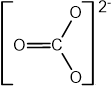
The displayed formula of a carbonate ion, CO32-, is shown below.

Diagram of a carbonate ion with a central carbon atom double-bonded to an oxygen atom and single-bonded to two others, carrying a 2- charge.

Draw the dot-and-cross diagram for the carbonate ion.

5b
1 mark

The nitrate, NO3-, ion is a polyatomic ion.

Draw a valid displayed formula for the nitrate ion that satisfies the octet rule for all atoms.

5c
2 marks

When magnesium oxide is added to warm dilute nitric acid, a reaction takes place forming a solution containing ions.

Write an equation for this reaction, including state symbols.

5d
2 marks

Solid magnesium oxide does not conduct electricity. When magnesium oxide reacts with dilute nitric acid, the solution formed does conduct electricity.

Explain the difference in the electrical conductivity of the magnesium oxide and the solution formed. 

1a
6 marks

The Periodic Table is shaped by patterns in physical and chemical properties. The electronic configuration is key to understanding these patterns.

Describe how the shape of the Periodic Table is linked to the electronic structure, with particular reference to sub-shell structure.

1b
2 marks

Elements can be identified using their location within the Periodic Table. 

i) Identify the name and block of the sixth element in the fourth period.

[1]

ii) Write out the full electronic configuration of this element.

[1]

1c
3 marks

Suggest why there are three possible p-sub-shells but only one possible s-sub-shell in an atom.

1d
3 marks

Justify why hydrogen is positioned in the middle of the Periodic Table and not as the first element in Group 1.

2a
2 marks

This question is about ionic bonding and structure.

The strength of ionic bonding in different compounds can be compared by using the amount of energy required to separate the ions, as shown in Table 1.

Table 1

Fluoride compound

Amount of energy needed to separate the ions/ kJ mol-1

LiF

1031

NaF

787

MgF2

2962

Using the data in Table 1, explain how changing the cation affects the bond strength in an ionic compound.

2b
3 marks

Coal often contains traces of iron(II) disulfide, FeS2, also known as pyrite or 'fool's gold'.

FeS2 is an ionic compound made of Fe2+ and S22- ions.

i) Describe the bonding in an S22- ion.

[1]

ii) Draw a dot-and-cross diagram for FeS2. Show outer shell electrons only.

[2]

2c
5 marks

Silver chloride, AgCl, is a chloride compound that has uses in photography films as well as having antiseptic properties. Silver chloride also has a high melting point. 

i) Draw a diagram of a silver chloride lattice to show the arrangement of the ions.

[2]

ii) Explain, with reference to structure and bonding, why silver chloride has such a high melting point.

[3]

2d
4 marks

Aluminium chloride, Al2Cl6, does not conduct electricity when molten but aluminium oxide, Al2O3, does. Explain this in terms of the structure and bonding of the two compounds.

3a
2 marks

The nitrate (V) ion, NO3-, is a polyatomic ion, bonded by covalent bonds. 

Draw a valid Lewis structure (dot-and-cross diagram) for the nitrate (V) ion, NO3-, that satisfies the octet rule for all atoms. Show outer electrons only.

3b
2 marks

An ionic compound has the empirical formula H4N2O3

Suggest the formulae of the ions present in this compound.

3c
2 marks

Cyanide is a fast-acting chemical, which can be found in various forms and can have toxic effects on the body.

Draw the dot-and-cross structure for a CN- ion. Show the outer electrons only.

3d
2 marks

Compare the average bond enthalpy in the cyanide ion to the average bond enthalpy of the C-N bond in methylamine, CH3NH2. Explain your answer.

4a
2 marks

Ethyne, C2H2, is a hydrocarbon which can be used in the artificial ripening of fruits. It can be synthesised by a two-step process.

Firstly, calcium oxide and coal react together to form calcium carbide (CaC2) and carbon monoxide. The second step involves calcium carbide reacting with water to form calcium hydroxide and ethyne, C2H2.

Write equations to represent the two-step process forming ethyne, C2H2. State symbols are not required.

4b
1 mark

Draw a dot-and-cross diagram of the ethyne molecule, C2H2.

4c
4 marks

Describe the bonding in calcium carbide, CaC2.

4d
3 marks

Compare and contrast the expected physical properties of calcium oxide and calcium carbide.

5a
4 marks

The table below shows the melting points for the oxides of two Period 3 elements.

Compound

Melting point / ℃

SO2

-72

MgO

2852

Describe the structure and bonding in MgO and SO2 and use this to explain the large difference in their melting points.

5b
3 marks

Sulfur can bond with oxygen to form the SO2 molecule. One valid dot-and-cross diagram for SO2 involves a single dative covalent bond.

Draw this dot-and-cross diagram for SO2.