Physical Chemistry Practicals (OCR AS Chemistry A): Exam Questions

Exam code: H032

3 hours39 questions
1a
1 mark

A student planned an experiment to determine the empirical formula of magnesium oxide by heating magnesium and recording the resulting change in mass.

Some of the equipment the student used is shown in the diagram below.
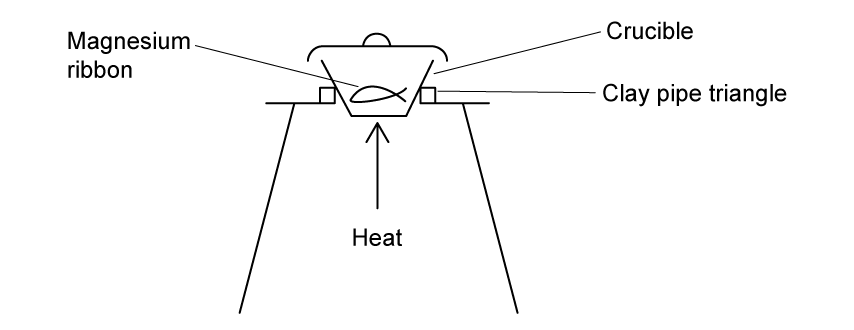
Diagram of a crucible held on a clay pipe triangle, heating a magnesium ribbon. An arrow indicates heat directed upwards towards the crucible.

Suggest one other piece of essential laboratory equipment the student must use to determine the empirical formula of magnesium oxide.

1b
2 marks

The method the student used is shown below.

  1. Measure the mass of the crucible together with its lid

  2. Coil a 10 cm strip of magnesium ribbon and place into the crucible

  3. Reweigh the crucible and lid

  4. Heat the crucible strongly using the apparatus in the diagram in part (a)

  5. Use the tongs to lift the crucible lid slightly during heating

  6. As it nears completion, place the crucible on a heat-proof mat

  7. Allow the crucible to cool and reweigh the crucible and lid

i) Explain the purpose of Step 5.

[1]

ii) How could you be sure that the reaction had gone to completion?

[1]

1c
Sme Calculator
3 marks

The student obtained the following results.

Mass of crucible and lid / g

25.68

Mass of magnesium, crucible and lid / g 

27.01

Mass of magnesium oxide, crucible and lid / g 

27.81

Using the results in the table above, calculate the empirical formula of magnesium oxide.

Show your working.

1d
2 marks

Another student carries out the same experiment. During Step 6, the student taps the residue with tongs to break it up.

i) Suggest one reason why the student breaks up the residue.

[1]

ii) Suggest how breaking up the residue would affect the calculated empirical formula of magnesium oxide.

[1]

2a
4 marks

Acid A is a monobasic acid. A student carried out a titration to determine the molar mass of acid A

They prepared two solutions:

  • a standard solution of 0.100 mol dm-3 NaOH

  • a 250 cm3 solution prepared from 2.00 g of acid A

The student titrates 25.0 cm3 samples of the solution of acid A with the 0.100 mol dm-3 NaOH in the burette. The student carries out a trial titration, followed by three further titrations.

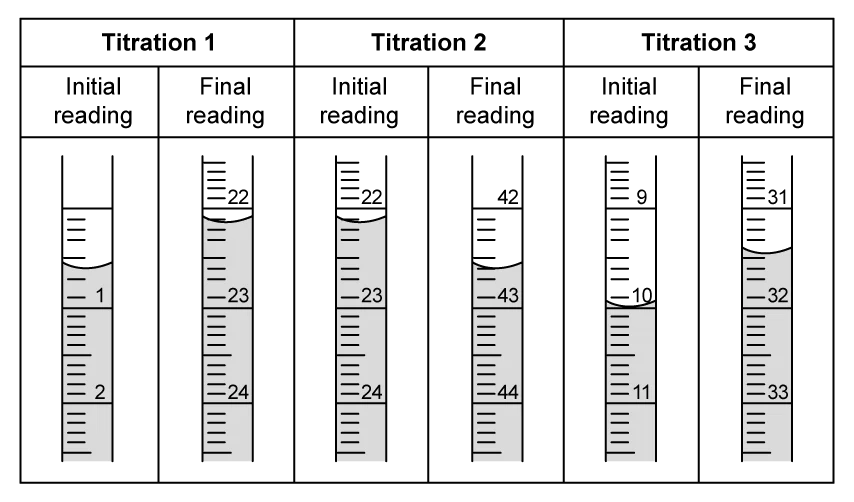
The diagrams below show the initial and final burette readings for the three further titrations.

Titration results showing initial and final readings for three trials. Readings are marked on a scale with liquid levels and measurement units.

Record the student’s readings and the titres in the table below.

Calculate the mean titre, to the nearest 0.05 cm3, that the student should use for analysing the results.

Titration

Trial

Titration 1

Titration 2

Titration 3

Final burette reading / cm3

21.75


Initial burette reading / cm3

0.05


Titre / cm3

21.70


mean titre = .......... cm3

2b
Sme Calculator
1 mark

The uncertainty of each burette reading the student took was ±0.05 cm3.

Calculate the percentage uncertainty in the titre obtained in titration 3. Give your answer to 2 decimal places.

2c
3 marks

The student prepares the standard solution of 0.100 mol dm−3 NaOH by adding water to completely fill the volumetric flask, rather than to the graduation line.

State and explain the effect this would have on the mean titre.

2d
2 marks

The student washes the conical flask containing the solution of acid A between each titration with distilled water, leaving some residual water in the flask.

State whether this would affect the titre. Explain your answer.

3a
1 mark

This question is about finding the enthalpy change of neutralisation of aqueous hydrochloric acid and aqueous sodium hydroxide.

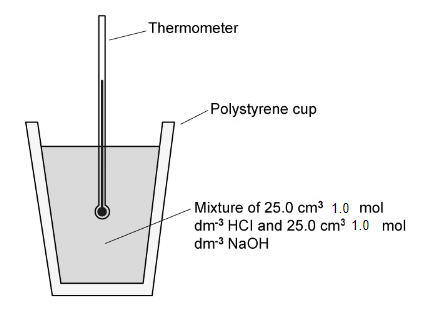
A student reacted 25.0 cm3 of 1.0 mol dm-3 aqueous hydrochloric acid and 25.0 cm3 of 1.0 mol dm-3 aqueous sodium hydroxide and monitored the temperature change using the apparatus shown in the diagram.

Diagram of a polystyrene cup containing a thermometer and a mixture of hydrochloric acid and sodium hydroxide, each 25.0 cm³ and 1.0 mol/dm³.

State the piece of apparatus that would be most suitable to measure 25.0 cm3 of the two solutions accurately.

3b
Sme Calculator
4 marks

The student places the aqueous hydrochloric acid into the polystyrene cup and measures the temperature every minute for three minutes. At the fourth minute, the student adds the aqueous sodium hydroxide, stirs the mixture, and continues to measure the temperature every minute from the fifth minute.

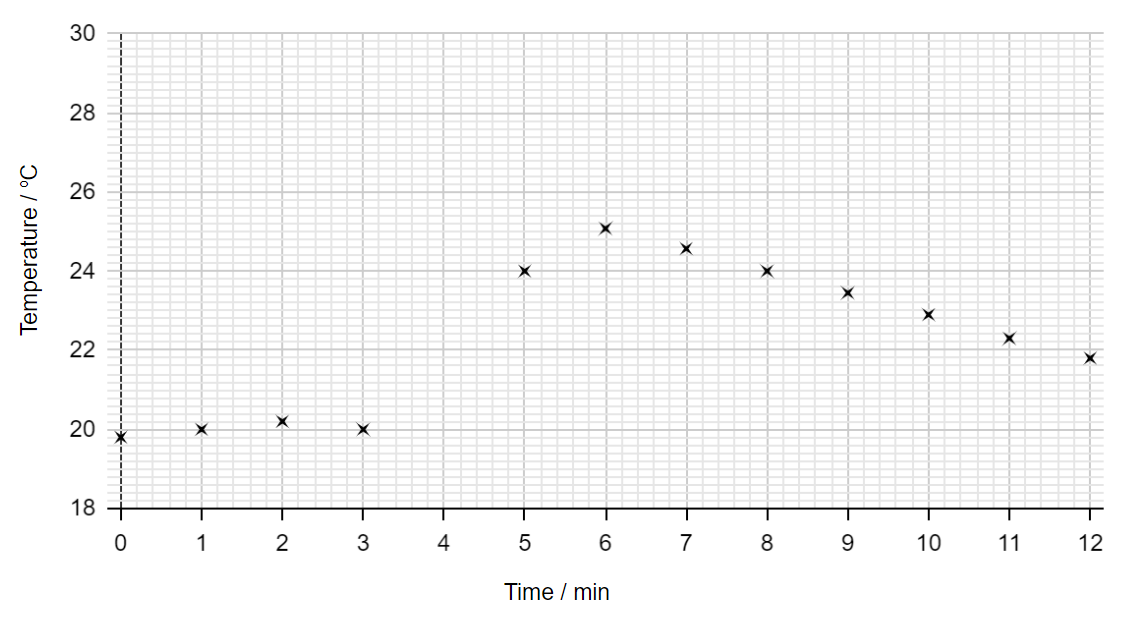
The student plots their results on the graph below.

Graph showing temperature rising from 20°C to 25°C over 6 minutes, then decreasing to 21°C over the next 6 minutes; time on x-axis, temperature on y-axis.

i) The student concludes that the maximum temperature change is 5.1 °C. Explain why this value does not give an accurate value for the true maximum temperature increase.

[2]

ii) Use the graph to determine the accurate maximum temperature change at 4 minutes. Show your working on the graph.

temperature change = .................................................. °C

[2]

3c
Sme Calculator
5 marks

Calculate the enthalpy change of neutralisation, ΔHneut​, in kJ mol−1.

Use your answer to (b).

Assume that the density of the mixture is 1.00 g cm−3 and that the specific heat capacity, c, of the mixture is 4.18 J g−1 K−1.

Give your answer to an appropriate number of significant figures. Show your working.

Δ​Hneut = .................... kJ mol-1

3d
3 marks

The literature value for this enthalpy change is –57.0 kJ mol–1.

Suggest one modification to the apparatus that would improve the accuracy of the results. Explain your answer.

4a
1 mark

When copper oxidises in air, it forms copper(II) carbonate basic, CuCO3·Cu(OH)2​.

A student carries out an experiment to find the percentage of CuCO3​ in a sample of CuCO3·Cu(OH)2​. The student reacts the sample with an excess of sulfuric acid and calculates the amount of carbon dioxide produced.

The student collects the carbon dioxide gas over water using the apparatus shown below.

Diagram of a gas collection setup with a conical flask, rubber stopper, delivery tube, and 250 cm³ measuring cylinder submerged in water.

Suggest a different piece of apparatus that could be used to collect the gas over water to improve the accuracy of the volume measured.

4b
2 marks

There are other ways of measuring the volume of gas produced, rather than collecting the gas over water as shown in (a).

Draw a labelled diagram to show the apparatus that could be used to collect the gas by another method.

4c
2 marks

Carbon dioxide is slightly soluble in water.

State and explain how the method to collect gas using the apparatus shown in part (a) will affect the results.

4d
2 marks

The measuring cylinder used in part (a) has graduations every 2 cm3. The volume of gas collected is 156 cm3.

i) Calculate the percentage uncertainty in the volume of gas collected.

percentage uncertainty = .................... %

[1]

ii) The student does not calculate the percentage uncertainty in the volume of sulfuric acid. Suggest why.

[1]

5a
3 marks

Hess' law can be used to determine enthalpy changes for reactions that cannot be determined experimentally.

A student investigates the temperature change in the reactions of potassium carbonate, K2CO3, and potassium hydrogencarbonate, KHCO3, with hydrochloric acid. The student uses used their results to determine the enthalpy change for the thermal decomposition of potassium hydrogencarbonate.

The student follows the method below.

  1. Measure 30 cm3 of 1.0 mol dm-3 hydrochloric acid into a polystyrene cup

  2. Weigh a weighing boat containing 2.5 g K2CO3

  3. Add the K2CO3 to the acid

  4. Stir the mixture and record the highest or lowest temperature reached

  5. Reweigh the weighing boat

  6. Repeat the method using 3.2 g of KHCO3

i) The student has missed a step in the method. State the missing step that the student must complete to be able to calculate the enthalpy changes of the reactions.

[1]

ii) Explain the purpose of step 5.

[2]

5b
3 marks

During the reactions, carbon dioxide gas is produced, causing effervescence (fizzing) in the reaction mixture.

i) Suggest how this effervescence could be a source of error in the method.

[1]

ii) Explain the effect this error would have on the calculated energy change, q, for the reaction.

[2]

5c
2 marks

To determine the enthalpy change of reaction, the student first calculates the energy change, q, using the equation q=mcΔT.

State two assumptions made about the reaction mixture when using this equation.

5d
2 marks

The literature value for the enthalpy change of thermal decomposition of KHCO3​ is +95.0 kJ mol−1. The student determines the experimental value to be +88.5 kJ mol−1.

Suggest two reasons why the experimental value is different from the literature value.

1a
4 marks

A student is asked to plan and carry out a practical to determine the molar mass of magnesium by reacting it with dilute hydrochloric acid at room temperature and pressure (RTP).

Describe how the student would carry out this experiment and the measurements they should record. In your answer, identify the apparatus the student should use.

1b
2 marks

Write an equation for this reaction. Include state symbols.

1c
Sme Calculator
3 marks

The student reacts 0.11 g of magnesium ribbon with an excess of 1.0 mol dm-3 hydrochloric acid. The reaction produces 110 cm3 of hydrogen gas at room temperature and pressure (RTP).

Calculate the molar mass of magnesium to 1 decimal place. Show your working.

1d
2 marks

Another student carries out the same procedure using 0.11 g of magnesium powder but only records a volume of 92.0 cm3.

Suggest one reason why the student records a volume lower than expected. Explain your answer.

2a
4 marks

Lactic acid, C3H6O3, is a chemical by-product of anaerobic respiration. Bacteria in yoghurt produce it, as do bacteria in our stomach. Bacteria in beer also ferment glucose, producing lactic acid by anaerobic respiration. The increase in lactic acid decreases the pH of the beer and gives it its characteristic sour taste.

A student devises an experiment to investigate the concentration of lactic acid in a sample of beer.

  1. Transfer 15.0 cm3 of beer to a 250.0 cm3 volumetric flask using a pipette.

  2. Make up the volume to 250.0 cm3 with distilled water.

  3. Use a pipette to take a 25.0 cm3 portion and add it to a conical flask.

  4. Swirl the conical flask and place on the bench.

  5. Add a few drops of phenolphthalein indicator to the solution in the conical flask.

  6. Titrate 25.0 cm3 portions of this solution with 0.0750 mol dm-3 sodium hydroxide solution.

Complete the following table, stating how each improvement to the procedure could be achieved:

Improvement

Method to achieve improvement

Reduce the percentage uncertainty in the titre

Improve the chance of obtaining concordant results

Improve accuracy of titrations by rinsing the pipette with...

Rinse burette with ... for the final rinse

2b
Sme Calculator
3 marks

The student's incomplete results table is shown below:

Titration

Rough

1

2

3

Final reading (cm3)

23.20

24.10

42.20

Start reading (cm3)

0.15

0.05

15.70

Titre (cm3)

23.10

23.90

i) Complete the student's results table.

[1]

ii) Calculate the mean titre to 2 decimal places.

[2]

2c
Sme Calculator
2 marks

The burette used by the student has an error of ±0.05 cm3. It was used to determine the initial reading, final reading, and the end point.

Calculate the maximum percentage uncertainty in using this burette, using your mean titre from part (b).

2d
6 marks

Another student is required to prepare 250.0 cm3 of an aqueous solution containing a known mass of lactic acid. The student is provided with a sample bottle containing the lactic acid.

Describe the method, including apparatus and practical details, that the student should use to prepare this solution.

3a
4 marks

The enthalpy of combustion of an unknown liquid fuel can be determined by carrying out a calorimetry experiment.

i) Draw a labelled diagram of the apparatus required to carry out this experiment.

[3]

ii) State one way to reduce uncertainties in this experiment.

[1]

3b
2 marks

A student used the following procedure to carry out a calorimetry experiment.

Procedure

  1. Measure 100 cm3 of water into a calorimeter using a measuring cylinder.

  2. Record the initial temperature of the water using a thermometer.

  3. Heat the water using the flame from the burning fuel and record the final temperature.

  4. Measure the final mass of the spirit burner with the liquid fuel.

The student has missed a step in the method. State the missing step and explain why it is necessary.

3c
Sme Calculator
4 marks

The student obtained the following results:

  • Mass of water in calorimeter = 350 g

  • Initial temperature of water = 9 °C

  • Final temperature of water = 36 °C

  • Mass of liquid fuel burned = 3.15 g

i) Calculate the energy transferred to the water, q, in joules.

[1]

ii) Calculate the amount, in mol, of liquid fuel burned. The molar mass of the liquid fuel is 63.2 g mol-1.

[1]

iii) Calculate the enthalpy of combustion, ΔHc, of the liquid fuel. Give your answer in kJ mol-1.

[2]

3d
2 marks

The actual value of ΔHc of the unknown liquid is greater in magnitude than the experimental value calculated above.

Give two reasons for this.

4a
2 marks

A student wanted to determine the formula of hydrated magnesium sulfate, MgSO4·xH2O.

The student used the following procedure to determine the water of crystallisation.

Procedure

  1. Using a two-decimal place balance, record the mass of an empty crucible.

  2. Add a small amount of hydrated magnesium sulfate to the crucible, re-weigh and record the mass.

  3. Gently heat the crucible for 2 minutes.

  4. Allow the crucible to cool, re-weigh and record the mass.

Suggest two modifications to the method that would reduce the percentage uncertainty in the mass of the water removed.

4b
2 marks

Explain how heating until a constant mass is reached will improve the accuracy of the student's results.

4c
Sme Calculator
2 marks

Two other students carry out the same experiment.

Student A uses 50.0 g of MgSO4·xH2O.

Student B uses 0.01 g of MgSO4·xH2O.

Explain why both of these masses are likely to lead to an inaccurate value of x.

4d
Sme Calculator
3 marks

The student's results are shown in the table below.

Mass / g

Empty crucible

3.89

Crucible + hydrated magnesium sulfate

7.10

Crucible + anhydrous magnesium sulfate

5.46

Calculate the value of x in MgSO4·xH2O. Show your working.

x = ...............

1a
Sme Calculator
3 marks

When copper oxides in air, it forms copper(II) carbonate basic, CuCO3·Cu(OH)2 (s), which is a dull green colour. The percentage by mass of CuCO3 in a sample of copper(II) carbonate basic can be found by reacting copper(II) carbonate basic with acid and measuring the volume of carbon dioxide evolved.

Diagram of a gas collection setup using a conical flask with a stopper connected to a submerged measuring cylinder in a water-filled container.

A student put exactly 0.50 g of copper(II) carbonate basic to the flask and added 50.0 cm3 of 1.00 mol dm-3 sulfuric acid, which was in excess in the flask. They replaced the bung and collected the gas using the apparatus shown above. They collected 48.0 cm3 of carbon dioxide gas in the 250 cm3 measuring cylinder, which had graduations every 2 cm3.

Another student repeated the experiment but used an inverted burette graduated to 0.1 cm3 instead of the measuring cylinder.

Which method of gas collection has the lower percentage uncertainty associated with it?

Assume the same volume of gas is collected using the inverted burette.

1b
2 marks

Without changing the apparatus used, explain how the student could reduce the percentage uncertainty in using the measuring cylinder to measure the volume of gas collected.

1c
3 marks

The student realises that the percentage by mass of copper(II) carbonate in copper(II) carbonate basic should be given to two significant figures.

i) Why should the results be given to two significant figures?

[2]

ii) Suggest how the student might vary the method, without altering the apparatus, which would give a result that could be accurately reported to three significant figures. Explain your answer.

[1]

1d
5 marks

Suggest two errors in the method that could cause the calculated value for percentage by mass of copper(II) carbonate in copper(II) carbonate basic to be inaccurate.

For each error, state and explain the effect on the calculated value of percentage by mass and how the method could be altered to reduce the inaccuracy in the value.

2a
6 marks

A student performed a titration to identify an unknown Group 1 metal carbonate.

The student prepared 250 cm3 of a standard solution using 3.00 g of the unknown metal carbonate. They then used 25.0 cm3 of this solution and titrated it with 0.250 mol dm-3 of hydrochloric acid.

Describe how the student prepared the standard solution of the unknown metal carbonate.

2b
1 mark

The student records their measurements and chemicals used. They write the concentration of hydrochloric acid used as 0.25 mol dm-3 instead of 0.250 mol dm-3.

Explain why the two concentrations do not mean the same.

2c
Sme Calculator
3 marks

The student's results are shown in the table below.

Trial

Titration 1

Titration 2

Titration 3

Final burette reading / cm3

18.15

35.55

17.6

35.02

Initial burette reading / cm3

0.05

18.15

0.15

17.45

Titre / cm3

18.10

17.4

17.45

17.57

Mean titre / cm3

17.47

Identify any errors in their results table.

2d
5 marks

The student used the following steps to perform the titration:

  1. Measure 25.0 cm3 of the unknown metal carbonate solution using a volumetric pipette and transfer into a conical flask

  2. Add 3 to 4 drops of methyl orange

  3. Place the conical flask onto a white tile

  4. Rinse the burette with distilled water

  5. Using a funnel, fill the burette with 0.250 mol dm-3 hydrochloric acid

  6. Titrate the metal carbonate solution with the hydrochloric acid, constantly swirl until the solution turns from yellow to orange — this is the rough titration

  7. Repeat the titration until two results are concordant, but add the hydrochloric acid drop-by-drop as the end point is approached

Identify any errors in the method.

State and explain their effect on the unknown metal's calculated relative atomic mass.

3a
2 marks

The enthalpy change for the following reaction is known as the enthalpy change of hydration of anhydrous copper(II) sulfate. It is an exothermic reaction.

CuSO4 (s) + 5H2O (l) → CuSO4⋅5H2O (s)

The enthalpy change cannot be measured directly. Suggest why not.

3b
1 mark

The enthalpy change of the hydration of copper(II) sulfate can be determined experimentally using Hess' law. This involves recording the temperature change that occurs when both anhydrous copper(II) sulfate and hydrated copper(II) sulfate are dissolved in an excess of water.

The equations for the reactions are shown below, where nH2O represents an excess of water.

CuSO4 (s) + nH2O → CuSO4 (aq)

CuSO4·5H2O (s) + nH2O → CuSO4 (aq)

Explain why an excess of water is used.

3c
3 marks

The method below is used to determine the temperature change when anhydrous and hydrated copper(II) sulfate is added to water. The measured temperatures are then used to determine the enthalpy change of the reactions.

  1. Measure 50 cm3 of water and add to a polystyrene cup placed inside a 250 cm3 glass beaker

  2. Accurately weigh a weighing bottle containing approximately 5.0 g of anhydrous copper(II) sulfate

  3. Measure and record the temperature of the water

  4. Add the anhydrous copper(II) sulfate to the water, and continually stir. Measure and record the highest or lowest temperature

  5. Reweigh the weighing bottle

  6. Repeat steps 1 to 5 using 7.8 g hydrated copper(II) sulfate

A student suggests that the experiment should be altered to record the mass of the empty polystyrene cup before adding the water and then again at the end of the reaction.

Discuss if this alteration could have any effect on the calculated enthalpy changes.

3d
Sme Calculator
1 mark

The reaction scheme for the formation of hydrated copper sulfate from its anhydrous form is shown below.

Hess cycle diagram showing CuSO4 with water forming hydrated CuSO4·5H2O, with enthalpy changes ΔHr, ΔH1, and ΔH2 for reaction paths.

Use the reaction scheme, Hess' law and the data provided in the table below to calculate the enthalpy of hydration for anhydrous copper(II) sulfate.

Δ*H* / kJ mol^-1^

Enthalpy change, ΔH1

-66.1

Enthalpy change, ΔH2

+ 11.0

4a
2 marks

A student investigated the enthalpy change of combustion of different liquid fuels using a spirit burner and the apparatus shown below.

Diagram of a laboratory setup with a spirit burner heating methanol beneath a beaker of water with a thermometer, held by a clamp.

They used the following method:

  1. Weigh the spirit burner and methanol

  2. Measure 150 cm3 of water and pour into the beaker

  3. Record the initial temperature of the water

  4. Place the spirit burner under the beaker and light

  5. Use the thermometer to stir the water

  6. After about 5 minutes, extinguish the flame and record the maximum temperature reached by the water

  7. Reweigh the spirit burner and methanol

The student repeated the method using ethanol and propanol.

When analysing the results, the student noticed that when the mass of the three fuels burnt was the same, the resulting temperature increase was different. Suggest why.

4b
1 mark

The measured temperature increase is used to calculate the energy transferred in the experiment. The student thought that if they used the same initial temperature and final temperature in each experiment, the energy transferred in each experiment would be the same.

State the assumption that the student must make for this to be the case.

4c
3 marks

After extinguishing the flame after the final temperature was recorded, the student tidied their equipment away before reweighing the spirit burner.

State and explain the effect, if any, on the calculated value of the enthalpy change of combustion.

4d
3 marks

When performing the experiment using another fuel, the student accidentally spilt some of the water when transferring it to the beaker.

State and explain the effect, if any, on the calculated value of the enthalpy change of combustion.

5a
6 marks

This question is about hydrated aluminium sulfate, Al2(SO4)3·xH2O (s).

Describe how the amount of water of crystallisation, x, in the formula of hydrated aluminium sulfate can be determined experimentally.

5b
2 marks

In one experiment, the student did not remove all of the water of crystallisation.

Explain how their calculated value of the number of moles of water of crystallisation, x, would differ from the actual value of x.

5c
3 marks

In another experiment, the student heated the hydrated aluminium sulfate very strongly for 30 minutes.

i) Give a reason why this may cause their calculated value of x to be incorrect.

[1]

ii) State if their calculated value of x would be greater or smaller than the actual value of x. Explain your answer.

[2]

5d
3 marks

The student decided to start with a larger mass of hydrated aluminium sulfate as they said that this would reduce the percentage uncertainty in their calculated value of x.

i) Explain why this would reduce the percentage uncertainty.

[2]

ii) Give a reason why using a larger initial mass of hydrated aluminium sulfate may produce anomalous results.

[1]