Introduction to CAS (DP IB Creativity, Activity, Service): Revision Note

What is CAS and why is it important?
The nature of CAS
CAS—Creativity, Activity, Service—is one of the three mandatory core components of the International Baccalaureate (IB) Diploma Programme (DP)
CAS is central to the philosophy of the programme and is intended to educate the whole person
The programme emphasises holistic learning—an approach to education that addresses the physical, social, emotional and cognitive well-being of the student
It develops essential Approaches to Learning (ATL) skills, including thinking, research, social, communication and self-management skills
Why CAS is essential
CAS is about personal growth, finding a healthy balance in life and engaging with the community
It is not about achieving exam grades, but rather focuses on reflection—the process of thoughtfully considering your ideas and experiences—to support personal development
The programme is designed to encourage self-discovery
It provides a "spirit" of action where students must act on their beliefs rather than just thinking or writing about them
The focus remains on the process of growth and learning rather than the activity itself, as participation alone does not guarantee learning
Assessment and consequences
CAS is a pass/fail component of the IB Diploma
Successful completion is a mandatory requirement for the award of the Diploma
If CAS is not successfully completed, the IB Diploma is not awarded (even if your subject grades are strong)
While it is not formally assessed or graded with a mark, students must provide evidence of their progress and achievements
Examiner Tips and Tricks
The most common reason students run into CAS problems is leaving reflections/evidence until the end. If you log experiences and reflect little-and-often, CAS stays simple and stress-free.
What are students expected to do in CAS?
Participation and timeframes
Students must participate in a variety of CAS experiences—specific events or series of events where you engage with one or more of the CAS strands
The programme formally begins at the start of the Diploma Programme and must continue regularly for at least eighteen months
SCAS should continue regularly, ideally on a weekly basis to maintain a reasonable balance between the three strands
A student's programme must be individualised based on their own interests, skills, values and background
The three CAS strands
Students must participate in experiences across all three strands of CAS:
Creativity: Exploring and extending ideas that lead to an original or interpretive product or performance
Activity: Physical exertion that contributes to a healthy lifestyle and physical well-being
Service: Collaborative and reciprocal engagement with the community in response to an authentic need. Service experiences are unpaid, and should be planned with (and not just for) the community/partner
The CAS project and stages
Students must undertake at least one CAS project which must last for a minimum of one month
A CAS project is a collaborative series of sequential experiences that requires collaboration and sustained teamwork, with opportunities for leadership and shared responsibility
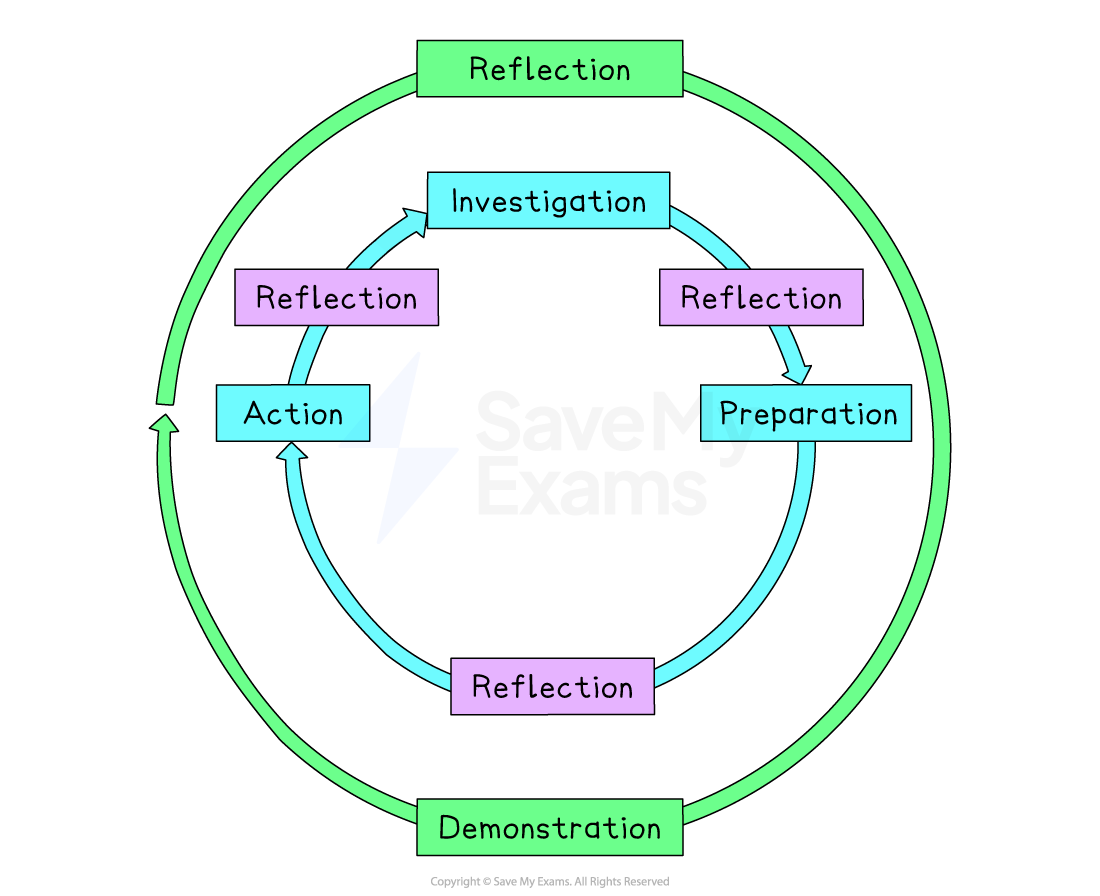
Students should use the CAS stages—investigation, preparation, action, reflection and demonstration—as a framework for their experiences and projects
Examiner Tips and Tricks
A CAS project is not a single event. It must be collaborative, planned, and run over at least one month (from planning to completion). If it’s a one-off day, it’s usually a CAS experience, not a CAS project
Documentation and learning outcomes
All students are expected to maintain a CAS portfolio—a collection of evidence such as photos, files or journals that showcases their journey
The portfolio is used to document what you do and provide evidence that all seven learning outcomes (LOs) have been achieved
Learning outcomes are specific goals that describe what a student is able to do at some point during the programme
You must demonstrate that you have met each of the seven outcomes at least once
Outcomes do not need to be met separately in each strand, and a single outcome can be achieved multiple times across different experiences
Examiner Tips and Tricks
Not every experience needs to hit a learning outcome. What matters is that, across your whole CAS programme, you can show evidence of achieving each learning outcome at least once
A simple 18-month CAS timeline (DP1 start → ongoing experiences and reflection → Interview 1 → ongoing experiences and reflection → Interview 2 (late DP1) → ongoing experiences → Interview 3 (DP2) → completion)
A student checklist for CAS | ||||
|---|---|---|---|---|
Creativity | Activity | Service | ||
Exploring and extending ideas leading to an original or interpretive product or performance | Physical exertion contributing to a healthy lifestyle | Collaborative and reciprocal community engagement in response to an authentic need | ||
My CAS programme | Y/N? | Notes | Date | |
Evidence of planning of a CAS programme |
|
|
| |
Regular commitment over at least 18 months to CAS |
|
|
| |
Understanding and ability to use the CAS stages when planning CAS experiences |
|
|
| |
Balance between creativity, activity and service |
|
|
| |
At least one planned project undertaken over at least one month |
|
|
| |
Evidence of achieving all seven learning outcomes |
|
|
| |
• Evidence of identification of strengths and areas for personal growth (LO1) |
|
|
| |
• Evidence of undertaking new challenges and developing new skills in the process (LO2) |
|
|
| |
• Evidence of initiating and planning a CAS experience (LO3) |
|
|
| |
• Evidence of commitment and perseverance in CAS experiences (LO4) |
|
|
| |
• Evidence of demonstrating the skills and recognizing the benefits of working collaboratively (LO5) |
|
|
| |
• Evidence of engagement with issues of global significance (LO6) |
|
|
| |
• Evidence of recognizing and considering the ethics of choices and actions (LO7) |
|
|
| |
Reflections completed on significant CAS experiences |
|
|
| |
Supervisor reports supplied where necessary |
|
|
| |
CAS interview 1 completed |
|
|
| |
CAS interview 2 completed |
|
|
| |
CAS interview 3 completed |
|
|
| |
CAS portfolio completed |
|
|
| |

Unlock more, it's free!
Join the 100,000+ Students that ❤️ Save My Exams
the (exam) results speak for themselves:

Was this revision note helpful?