Skills You Need To Demonstrate (Cambridge (CIE) IGCSE Economics): Revision Note
Syllabus Edition
First teaching 2025
First exams 2027
Exam code: 0455 & 0987

An introduction to the skills
The IGCSE Economics exams test three key skills:
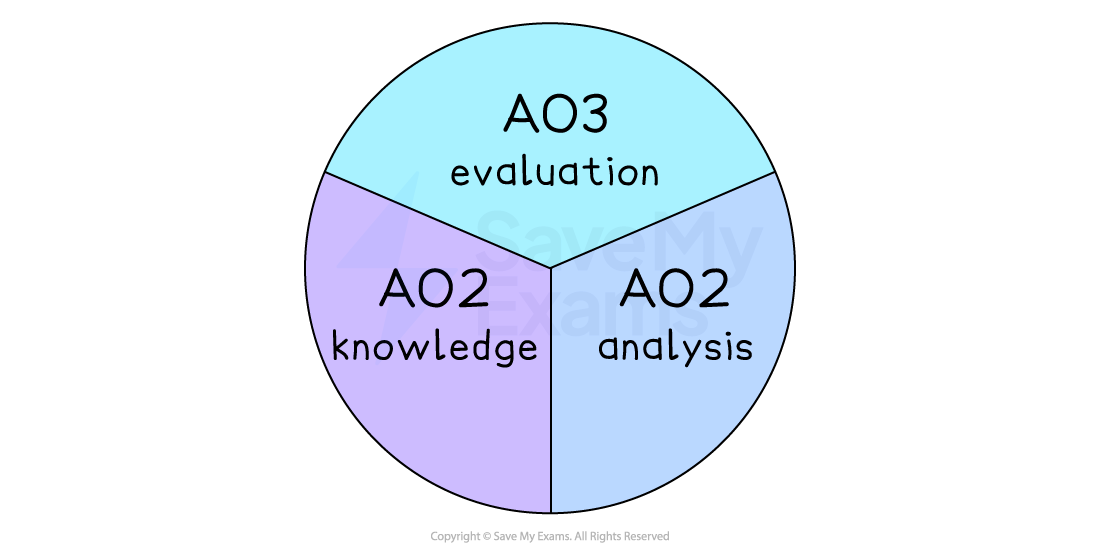
You will use these skills across both papers, but they are most heavily rewarded in Paper 2, where written explanations, diagrams and data analysis are required
The exams assess your ability to:
Recall definitions and core economic concepts
Apply concepts to real-world contexts
Analyse diagrams, tables and written scenarios
Perform simple calculations
Explain cause–effect relationships
Make reasoned, balanced economic judgements
Each of these skills must be demonstrated clearly and separately in longer answers
AO1 Knowledge and Understanding
AO1 is the foundation of every Economics question
To score well in other skills, AO1 must be secure
You gain AO1 marks for:
Recognising, recalling and stating key economics terms
Giving precise definitions (e.g., opportunity cost, inflation, PED)
Identifying characteristics, causes, features or effects
Selecting the correct formula for a calculation
Drawing accurate, fully labelled diagrams
Using appropriate terminology (scarcity, equilibrium, elasticity, productivity etc)
Economic diagrams fall under AO1 only when they are drawn and labelled correctly
Worked Example
Define opportunity cost
“Opportunity cost is the next best alternative foregone when a choice is made.”
“Next best alternative”
“Foregone”
Both elements must be present for full AO1 marks
AO2 Analysis
AO2 tests your ability to use economic concepts to explain real-world situations, and to show cause-effect relationships
AO2 is the skill used most frequently in 4-mark and 6-mark questions
You gain AO2 analysis marks for:
Making developed explanations rather than simple statements
Showing chains of reasoning (“because… therefore… leading to…”)
Applying economics to:
data extracts
context paragraphs
diagrams
Using diagrams to support an explanation (e.g., explaining why a curve shifts)
Interpreting data from tables, charts or numerical information
Explaining why an event occurs or how one variable affects another
Worked Example
Explain why a fall in interest rates may increase consumer spending
A strong AO2 explanation will show:
A cause →
A direct effect →
A final economic impact
For example
Lower interest rates reduce the cost of borrowing for households →
this makes loans and credit more affordable → leading to higher consumer spending in the economy.
This chain of reasoning demonstrates AO2 clearly
AO2 using diagrams
When diagrams appear in Paper 2, AO2 marks are awarded for:
Explaining what the diagram shows
Explaining the economic reasoning behind a shift or movement
Linking the diagram to the context of the question
The diagram itself is AO1, but the explanation of it is AO2
AO3 Evaluation
AO3 is tested only in Paper 2, usually in 8-mark “Discuss” questions
Evaluation means making:
Judgements
Comparisons
Trade-offs
Balanced reasoning
Considerations of “it depends” factors
Short-run vs long-run differences
Contextual decisions
In the official Cambridge mark scheme, AO3 is credited through “levels of response”
In Save My Exams resources, AO3 is made clearer using the defined-mark structure - where students develop two arguments on each side
You gain AO3 marks for:
Considering both sides of an economic issue
Judging which side is stronger and why
Referencing context (where relevant)
Recognising limitations of arguments
Showing conditions under which a policy or outcome may change
There is no need to write a full conclusion
Worked Example
Discuss whether an increase in income tax will reduce income inequality.
Evaluation may include points such as:
It depends on the progressiveness of the tax system
Effectiveness depends on how tax revenue is used
Higher income tax may reduce incentives to work (counter-effect)
If tax avoidance is high, inequality may not fall
Short-run impact may differ from long-run impact
Here is an example of a 'discuss' response
Putting the skills together
In most longer Paper 2 answers, you are expected to use two or more skills in the same response:
AO1 provides the definition, diagram or basic concept
AO2 develops explanations and shows cause–effect
AO3 weighs arguments and makes judgements
For example, in an 8-mark “Discuss” question:
AO1 = the economic concepts used
AO2 = the two developed explanations on each side
AO3 = the balanced discussion across both sides
Correctly combining the skills leads to full marks

Unlock more, it's free!
Join the 100,000+ Students that ❤️ Save My Exams
the (exam) results speak for themselves:

Was this revision note helpful?
