GCSE Grades Explained For Students: 9–1 Grade Guide

Written by: Katie Walker
Reviewed by: Angela Yates
Last updated
Contents
- 1. Key Takeaways
- 2. What Is the GCSE 9–1 Grading System?
- 3. 9–1 GCSE Grade Equivalents to the A*–G System
- 4. What Is a Pass in GCSE?
- 5. What Is a Fail in GCSE?
- 6. How Do GCSE Grade Boundaries Work?
- 7. GCSE Results 2025 vs 2024
- 8. GCSE Grades in Wales and Northern Ireland
- 9. Do Universities and Sixth Forms Care About GCSE Grades?
- 10. What If You Don’t Get the GCSE Grades You Need?
- 11. Frequently Asked Questions
- 12. Final Thoughts
GCSE results can feel confusing. You often hear talk about passes, grade boundaries, and target grades, but it’s not always clear what the numbers actually mean or how much they matter for the future.
The 9–1 grading system introduced new terminology and raised new questions. What counts as a good grade? What happens if you do not get the results you hoped for? And how do GCSE grades affect sixth form, college or apprenticeship choices?
In this guide, you’ll find GCSE grades explained clearly and simply. We’ll break down how the grading system works, what different grades mean in practice, how grade boundaries are set, and what your results mean for your next steps.
Key Takeaways
GCSEs in England use a numerical grading scale from 9 (highest) to 1 (lowest).
A grade 4 is a standard pass, and a grade 5 is a strong pass.
Grades 1–3 are not failures, but students must usually resit English and Maths if they do not achieve a grade 4.
A U means ungraded, which counts as a fail.
Grade boundaries change every year because exam difficulty and student performance vary.
What Is the GCSE 9–1 Grading System?
GCSEs in England are graded using a numerical scale from 9 to 1.
Grade 9 is the highest grade and represents exceptional performance.
Grade 1 is the lowest awarded grade.
A U (Ungraded) means a student did not reach the minimum standard required for a GCSE grade.
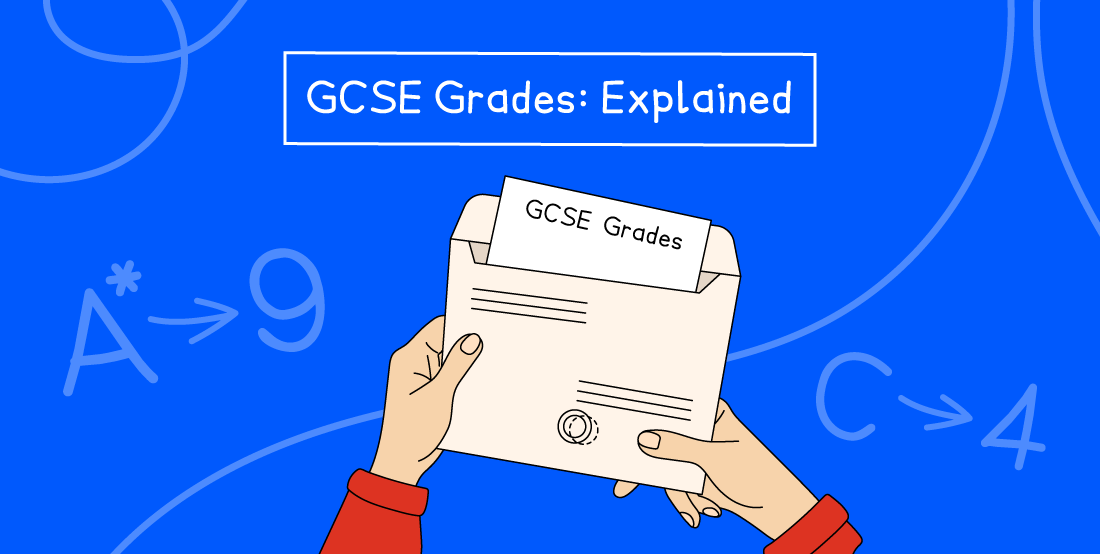
The numerical system replaced the old A–G grading scale between 2017 and 2020. It introduced numbered grades to provide clearer differentiation between levels of performance while maintaining links to the previous grading standards.
To help comparisons with the previous system, certain grades act as anchor points:
Grade 7 aligns roughly with an old Grade A
Grade 4 aligns roughly with an old Grade C
Grade 1 aligns roughly with an old Grade G
These anchor points allow sixth forms, colleges, and employers to understand how new GCSE grades compare with older qualifications.
Why Did GCSE Grades Change from A*–G to 9–1?
The GCSE grading system changed as part of wider education reforms introduced in the UK from 2017 onwards.
The new system aimed to:
Better differentiate between high-performing students
Reflect more demanding course content and exams
Increase academic rigour across GCSE subjects
Align English qualifications more closely with high-performing international education systems
Although grading looks different, overall outcomes remain broadly similar. Roughly the same proportion of students achieve grades equivalent to the old A, C, and G standards each year.
However, grade 9 was introduced as a new top grade. Awarded to fewer students than the old A*, it is more challenging to achieve.
9–1 GCSE Grade Equivalents to the A*–G System
The table below shows how the 9–1 grading scale compares to the old A*–G system.
New GCSE Grade | Old GCSE Grade Equivalent | What It Means |
9 | High A* | Exceptional performance |
8 | Low A* / High A | Excellent performance |
7 | A | Strong performance |
6 | High B | Very good pass |
5 | High C / Low B | Strong pass |
4 | C | Standard pass |
3 | D / High E | Below standard pass |
2 | E – F | Low attainment |
1 | G | Lowest graded result |
U | U | Ungraded (no pass awarded) |
The table shows how grades broadly compare across the two systems. The next section explains what these grades mean in practice.
What Is a Pass in GCSE?
Technically, any grade from 1 to 9 is a GCSE grade. However, in practice, two pass levels matter most.
Standard Pass: Grade 4
The government officially recognises a grade 4 as a pass.
Students who do not achieve a grade 4 in GCSE English Language or Maths must usually continue studying these subjects and resit them until age 18.
Many colleges and sixth forms require at least a grade 4 for entry onto courses.
Strong Pass: Grade 5
A grade 5 is called a strong pass.
Some sixth forms and competitive courses ask for grade 5s or higher, particularly in subjects you plan to study at A level.
Always check the entry requirements for your chosen course or college.
What Is a Fail in GCSE?
A common misconception is that grades 1–3 are failures. They are not.
Grades 1, 2, and 3 still show achievement and subject knowledge. However, they are below the standard pass level expected for progression in English and Maths.
What Does a U Mean?
A U (Ungraded) means the minimum standard for a GCSE grade was not reached.
If you receive a U, speak to your school or college about resits or alternative pathways.
How Do GCSE Grade Boundaries Work?
Grade boundaries are the minimum number of marks needed to achieve each grade in an exam.
For example, if the boundary for a grade 7 is 120 marks, you must achieve at least 120 marks to receive that grade.
Grade boundaries are set after exams are marked, not before.
Senior examiners from each exam board review:
The difficulty of the exam paper
How students performed overall
Results from previous years
A grade 6 should represent the same level of performance each year, even if one exam paper is harder than another.
See our complete guide to GCSE grade boundaries for more detail.
Why Do Grade Boundaries Change Each Year?
Grade boundaries change because exams are never identical.
Several factors influence them:
Some exam papers are slightly harder or easier
Student cohorts perform differently each year
Small adjustments maintain national standards over time
This means the percentage needed for a grade is not fixed. Scoring 70% might be a grade 7 one year and a grade 6 another.
Learn more in our guide to GCSE grade boundaries .
When Are GCSE Grade Boundaries Published?
Exam boards publish official grade boundaries on GCSE Results Day.
Schools receive them at the same time students receive their results. Looking at past boundaries can still be helpful when setting revision targets, but they are only rough guides.
What Grade Is 80% in GCSE?
Grade boundaries for GCSE exams change depending on:
The exam board
The subject
The year
The grade boundaries
Roughly speaking, 80% is usually a high grade on Higher-tier papers (often around grades 7–8 depending on the subject and year). On Foundation-tier papers, high percentages typically sit near the top available grade, usually grade 5.
However, it’s always best to check specific past papers and official grade boundaries to estimate what grade a particular percentage might achieve.
GCSE Results 2025 vs 2024
According to Ofqual (opens in a new tab), GCSE results in 2025 remained very similar to 2024, showing that grading standards have now stabilised following the return to normal exams after the pandemic.
National statistics show only small year-to-year changes:
67.1% of entries achieved grade 4 or above in 2025, compared with 67.4% in 2024.
21.8% of entries achieved grades 7 or above, slightly up from 21.6% in 2024.
The average GCSE grade remained broadly unchanged at 4.82, similar to both 2024 results and pre-pandemic outcomes.
This means GCSE grading is now considered fully back to normal, with results no longer influenced by pandemic grading arrangements.
What This Means for Students
Small changes in national results happen every year and do not mean exams have suddenly become easier or harder.
Exam boards adjust grade boundaries so that:
a grade 4 represents a similar level of achievement each year
higher grades remain challenging but consistent over time
Recent trends suggest:
Overall pass rates are stable
Top grades have risen slightly
GCSE standards are now consistent from year to year
In short, your grade reflects your performance against national standards, not how easy or difficult a single exam paper felt.
GCSE Grades in Wales and Northern Ireland
GCSE grading is not identical across the UK. While students in England receive grades using the 9–1 numerical system, Wales and Northern Ireland mainly continue to use letter grades.
This doesn’t mean qualifications are harder or easier in different parts of the UK. The systems simply present results in different formats, and universities, colleges, and employers understand how to compare them.
The table below shows how GCSE grades broadly align across England, Wales, and Northern Ireland.
England (9–1) | Wales (A–G)* | Northern Ireland (CCEA) | What It Means |
9 | A* | A* | Exceptional performance |
8 | A* | A* | Excellent performance |
7 | A | A | Strong performance |
6 | B | B | Very good pass |
5 | C | C* | Strong pass |
4 | C | C | Standard pass |
3 | D | D | Below standard pass |
2 | E-F | E-F | Low attainment |
1 | G | G | Lowest graded result |
U | U | U | Ungraded |
Wales
In Wales, most GCSEs still use the traditional A–G grading scale. A grade C is generally recognised as a pass and is broadly comparable to a grade 4 in England.
Northern Ireland
Northern Ireland uses a mixed system. Students may take GCSEs from English exam boards (AQA, OCR, or Edexcel), which use the 9–1 scale, or from the Northern Irish exam board CCEA (Council for the Curriculum, Examinations and Assessment), which uses letter grades.
CCEA introduced an additional grade called C* to align more closely with England’s grading system. The C* grade sits between a traditional C and B and is roughly equivalent to a grade 5, often described as a strong pass.
What This Means for Students
Although grading systems look different, GCSE qualifications across the UK are designed to represent comparable levels of achievement. Admissions teams regularly compare grades from all UK nations, so students are not disadvantaged by studying under a different grading system.
Do Universities and Sixth Forms Care About GCSE Grades?
GCSE grades are important because they help schools, colleges, universities, and employers understand your academic strengths and readiness for the next stage of education or training.
Sixth Form and College Entry Requirements
Most sixth forms and colleges set minimum GCSE grade requirements for A level or vocational courses.
Typically, you will need:
Grade 4 or above in English Language and Maths
Higher grades (often 5 or 6) in subjects you want to study at A level
For example, many schools require at least a grade 6 in GCSE Maths to study A level Maths, or a grade 6 in Science for A level Biology, Chemistry, or Physics.
Always check entry requirements carefully for the sixth form or college you intend to apply to, as they do vary between schools and courses.
University Applications
Universities mainly focus on A level or equivalent qualifications, but GCSE grades still play a role.
GCSE results may be used to:
Check you meet minimum English and Maths requirements
Compare applicants with similar predicted A level grades
Demonstrate consistent academic performance over time
Highly competitive universities and courses sometimes look closely at GCSE profiles, but strong A level results and personal achievement remain the most important factors.
Apprenticeships and Employment
Many apprenticeships and employers expect applicants to have at least a grade 4 in English and Maths. These subjects are particularly important because they demonstrate essential communication and numeracy skills.
For competitive apprenticeships, stronger GCSE grades can help your application stand out, especially alongside work experience or practical skills.
What If You Don’t Get the GCSE Grades You Need?
If you’re concerned about not getting the grades you hoped for, don’t worry. While it will undoubtedly feel disappointing, it doesn’t mean you have to shelve your plans. Every year, thousands of students successfully adjust their next steps after results day.
There are plenty of options, and lots of advice available to help you navigate them.
Speak to Your School or College
Start by talking to:
your teachers
sixth form or college admissions staff
a careers adviser
Schools and colleges often have flexibility, especially if you were close to the required grade or performed strongly in related subjects.
You may still be offered:
a place on your chosen course
an alternative course leading to the same pathway
a one-year programme that allows progression later
Consider GCSE Resits
If you do not achieve a grade 4 in English Language or Maths, you will normally need to continue studying these subjects until age 18. Read more about retaking GCSE Maths and retaking GCSE English Language.
Many students improve their grades through resits because they:
understand exam expectations better
focus on weaker areas
gain confidence with experience
Resits usually take place the following November or summer.
Request a Review or Appeal
If your result feels unexpected, speak to your school about a review of marking.
Schools can request:
a clerical check (checking marks were added correctly)
a review of marking by another examiner
Your teachers can advise whether this is worthwhile based on your exam performance.
Explore Alternative Pathways
There are many successful routes after GCSEs, including:
vocational qualifications such as BTECs or T Levels
apprenticeships combining work and study
college courses with different entry requirements
Changing direction does not mean falling behind. Many students discover pathways that suit them better after results day. Learn more about your options after GCSEs in our Learning Hub.
Frequently Asked Questions
Is a Grade 5 in GCSEs Good?
Yes. A grade 5 is known as a strong pass and is above the national standard pass level. Many sixth forms and colleges prefer grade 5s or higher for competitive courses, so achieving this grade keeps a wide range of options open.
Is Grade 3 a Pass In GCSE?
A grade 3 is technically a graded result, but it is below the standard pass level. Students who receive a grade 3 in English or Maths usually need to continue studying and resit the subject alongside further education.
Do You Have to Resit GCSE Maths and English?
Yes, if you do not achieve at least a grade 4 in GCSE English Language or Maths, you are normally required to continue studying these subjects until age 18. Resits give many students the chance to improve their grades and strengthen future opportunities.
How Hard Is It to Get a Grade 9?
Grade 9 is awarded to a small percentage of students each year and represents exceptional performance. Achieving a grade 9 usually requires strong subject knowledge, accurate exam technique, and consistent high-level performance across all exam papers.
Final Thoughts
The most important factor in understanding GCSE grades is this: your results are a stepping stone, not a final judgement of your ability or future.
The 9–1 grading system helps schools, colleges, and employers understand your achievements. But whatever your results, there are always multiple pathways forward and many opportunities to keep progressing and building your skills.
Whether you move on to sixth form, college, apprenticeships, or resits, focus on your own journey and try not to compare yourself to others. Make sure your goals are realistic and that you’re moving forward in a way that feels right for you.
If you’re preparing for exams, Save My Exams offers expert-designed exam-board-specific GCSE resources, including revision notes, topic questions, past papers, and flashcards designed to help you revise with confidence and achieve your best results.
Good luck with your GCSE journey.
References:
Ofqual | GCSE and level 1 and 2 results 2025 at a glance (opens in a new tab)
Was this article helpful?
Sign up for articles sent directly to your inbox
Receive news, articles and guides directly from our team of experts.

Share this article













 written revision resources that improve your