Forms of Business (AQA A Level Business): Exam Questions

Exam code: 7132

2 hours16 questions
1
1 mark

In which of these business forms could the owner/owners be required to sell personal assets to pay for business liabilities?

  • Private limited companies and public limited companies

  • Private limited companies and sole traders

  • Public limited companies only

  • Sole traders only

2
1 mark

Statement 1: ‘If a limited company stops trading, the shareholders will be expected to sell personal assets to pay the company’s debts.’

Statement 2: ‘If a limited company stops trading, the business will always pay its payables in full.’

Read statements 1 and 2 and select the correct option from the following:

  • Statement 1 is true. Statement 2 is true.

  • Statement 1 is true. Statement 2 is false.

  • Statement 1 is false. Statement 2 is true.

  • Statement 1 is false. Statement 2 is false.

3
9 marks

Analyse why non-profit organisations set financial objectives.

4
2 marks

Case Study

Ocado venture with M&S

Marks & Spencer (M&S) started to sell its popular food range online for the first time in September 2020, by forming a venture (also known as a joint venture) with Ocado. Ocado is a solely online supermarket that has well-established distribution networks and market-leading advanced technology.

M&S funded its part of the £1.5bn venture by selling £600m of shares to existing shareholders and by cutting shareholder dividends by 40%.

M&S stated that it had always believed M&S branded food should be available online and combining with Ocado was a ‘win-win’ situation that would drive long-term growth of both businesses.

Following the announcement of the venture, Ocado’s share price rose by 3%.

The launch of the venture followed over a year of hard work and required senior managers from both businesses to work together to make it happen.

What is meant by the term shareholder dividend?

5
4 marks

Case Study

Ocado venture with M&S

Marks & Spencer (M&S) started to sell its popular food range online for the first time in September 2020, by forming a venture (also known as a joint venture) with Ocado. Ocado is a solely online supermarket that has well-established distribution networks and market-leading advanced technology.

M&S funded its part of the £1.5bn venture by selling £600m of shares to existing shareholders and by cutting shareholder dividends by 40%.

M&S stated that it had always believed M&S branded food should be available online and combining with Ocado was a ‘win-win’ situation that would drive long-term growth of both businesses.

Following the announcement of the venture, Ocado’s share price rose by 3%.

The launch of the venture followed over a year of hard work and required senior managers from both businesses to work together to make it happen.

Explain why the Ocado share price rose following the announcement of the venture.

6
1 mark

After five years of trading, the value of a company’s initial ordinary share capital is identical to the value of its market capitalisation. No further shares have been issued during this period.

These two values will only be identical if:

  • all of its profit has been distributed to shareholders.

  • all of its profit has been retained in the business.

  • it has made a total profit of zero over the five years.

  • the current market price of the shares is the same as the initial share price.

7
3 marks

Case Study

Banking on change

The UK banking industry is dominated by the ‘Big 5’ banks. These banks have had costly networks of physical branches. Recently they have closed many branches, particularly in rural areas.

New technology and changes to government rules have opened the market to competition from relatively new entrants called ‘challengers’. Challenger banks target a niche and aim to provide better customer service.

Metro Bank, like other challengers, has grown fast, but unfortunately it had to declare losses after a major accounting error in early 2019.

Appendix A Examples of types of challenger bank

Bank(s)

Type of service

Monzo, Starling

Fully online bank (this type includes 90% of challengers)

Tesco, M&S

Bank linked to retailer brand

Metro Bank

City branches open 12 hours a day

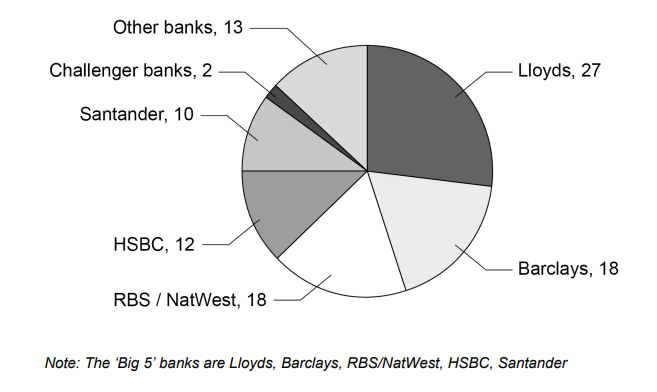
Appendix B Market share of banks in UK, 2019 (%)

Pie chart showing UK bank market share: Lloyds 27%, Barclays 18%, RBS/NatWest 18%, HSBC 12%, Santander 10%, Other banks 13%, Challenger banks 2%.

Appendix C Selected share price and market capitalisation box information

22 February 2019

6 March 2020

Metro Bank share price (pence)

1430.0

128.0

Metro Bank market capitalisation (£)

N/A

218.8m

Barclays Bank market capitalisation (£)

N/A

16 850m

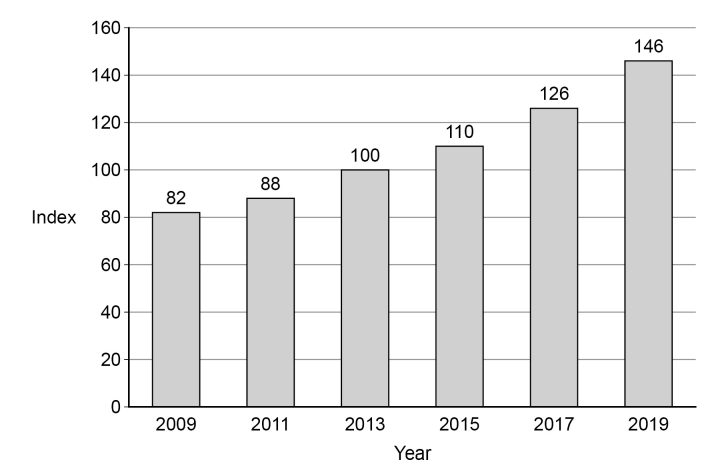
Appendix D People using online banking (2009–2019)
(Index: base year 2013)

Bar chart showing index increase from 82 in 2009 to 146 in 2019, with increments at 2011, 2013, 2015, and 2017.

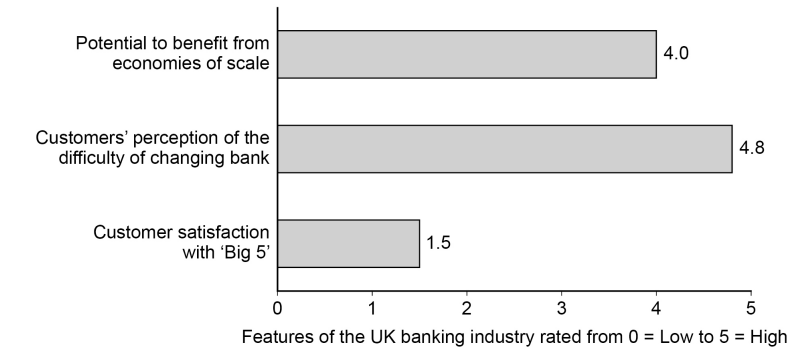
Appendix E Analysis of UK banking industry (2019)

Bar chart of UK banking features: economies of scale rated 4.0, difficulty changing bank 4.8, customer satisfaction with 'Big 5' 1.5, scale 0-5.

Using the data in Appendix C, calculate how many shares Metro Bank plc had issued, as of 6 March 2020.

8
4 marks

Case Study

Banking on change

The UK banking industry is dominated by the ‘Big 5’ banks. These banks have had costly networks of physical branches. Recently they have closed many branches, particularly in rural areas.

New technology and changes to government rules have opened the market to competition from relatively new entrants called ‘challengers’. Challenger banks target a niche and aim to provide better customer service.

Metro Bank, like other challengers, has grown fast, but unfortunately it had to declare losses after a major accounting error in early 2019.

Appendix A Examples of types of challenger bank

Bank(s)

Type of service

Monzo, Starling

Fully online bank (this type includes 90% of challengers)

Tesco, M&S

Bank linked to retailer brand

Metro Bank

City branches open 12 hours a day

Appendix B Market share of banks in UK, 2019 (%)

Pie chart showing UK bank market share: Lloyds 27%, Barclays 18%, RBS/NatWest 18%, HSBC 12%, Santander 10%, Other banks 13%, Challenger banks 2%.

Appendix C Selected share price and market capitalisation box information

22 February 2019

6 March 2020

Metro Bank share price (pence)

1430.0

128.0

Metro Bank market capitalisation (£)

N/A

218.8m

Barclays Bank market capitalisation (£)

N/A

16 850m

Appendix D People using online banking (2009–2019)
(Index: base year 2013)

Bar chart showing index increase from 82 in 2009 to 146 in 2019, with increments at 2011, 2013, 2015, and 2017.

Appendix E Analysis of UK banking industry (2019)

Bar chart of UK banking features: economies of scale rated 4.0, difficulty changing bank 4.8, customer satisfaction with 'Big 5' 1.5, scale 0-5.

Explain one possible reason for the change in the share price of Metro Bank plc shown in Appendix C.

9
9 marks

Case Study

Bell Ltd

Bell Ltd is a UK-based food manufacturer with 27 branded products in three main markets:

  • sweets

  • snacks

  • drinks.

The company has been very successful over many years, increasing its market share in each market. It has responded to market changes by investing in the development of new products such as low-sugar and vegetarian ranges. It monitors the sales and costs associated with each of its brands.

100% of shares in Bell Ltd are owned by four members of the Bell family who also have management roles in the business. The owners feel long-term strategic decision making at the company is more effective than if it was a public limited company.

Bell Ltd actively manages the trade credit offered to retailers who buy its products, such as chasing any overdue payments and minimising the period of credit it offers to them. By building long-term relationships with suppliers, it has secured favourable credit terms from them.

Speckles is produced by Bell Ltd and used to be a leading brand of sweets in the UK. In terms of the Boston Matrix, Speckles is now a ‘dog’. It was recently announced that Speckles would be discontinued. A social media campaign against this decision claimed that Speckles was an iconic brand from people’s childhoods and should be saved.

Table 1 Financial data for the Speckles brand

Year

2019

2020

Sales revenue (£’000)

40

20

Cost of sales (£’000)

25

16

Gross profit (£’000)

15

4

Analyse how the ownership structure of Bell Ltd might have contributed to the success of its strategic decision making.

10
25 marks

‘Limited liability benefits all stakeholders of a public limited company.’

Do you agree? Justify your view.

11
12 marks

Read the case study in the Insert (opens in a new tab).

Analyse the benefits to stakeholders of the rise in the share price of Sunport PLC.

12
9 marks

Case Study

WeRide plc

WeRide (WR) is a taxi business. It has an app that allows its passengers to find and book the nearest driver themselves. WR has grown quickly and its service is now available in over 400 cities in 60 countries. It employs its taxi drivers on flexible employment contracts.

Stricter laws are threatening WR’s growth in the taxi market in some locations. For example, several cities have:

  • imposed limits on the number of new licences for all taxis in order to reduce congestion and pollution

  • banned WR because of concerns that its vehicles do not meet new safety regulations.

In 2018, WR announced a change to its future strategy. Instead of trying to grow its taxi business further, WR intends to invest several million pounds in developing a rental service for electric bicycles. This will be delivered through its app.

WR’s Chief Executive said that individual methods of transport, such as electric bicycles, were better suited to travelling around cities than cars these days. She recognises that the move into the rental of electric bicycles might damage short-term profits, but thinks it is the right long-term strategy for the business.

Although the profit margin on an electric bicycle ride will be less than a taxi ride, WR’s Chief Executive believes that the profits from electric bicycles will eventually be higher than from taxis. However, some investors are concerned about the impact on dividends of the decision to move into electric bicycles.

WR has made a strategic decision to move into electric bicycle rentals.

Analyse the possible impact of this on the market capitalisation of the company.

13
1 mark

Statement box 1: ‘Sole traders are usually private sector organisations.’
Statement 2: ‘Public limited companies are usually public sector organisations.’

Read statements 1 and 2 and select the correct option from the following:

  • Statement 1 is true. Statement 2 is true.

  • Statement 1 is true. Statement 2 is false.

  • Statement 1 is false. Statement 2 is true.

  • Statement 1 is false. Statement 2 is false.

14
3 marks

Case Study

Marks and Spencer plc is one of the UK’s leading retailers. It provides its own-brand food, clothing and home products in 1433 stores worldwide and online.

Appendix A Extracts from Marks and Spencer plc’s published financial accounts

Balance sheet as at 1 April 2017

£ million

Assets

Non-current assets

6 569

Current assets

1 723

Liabilities

Current liabilities

2 368

Non-current liabilities

2 774

Net assets

3 150

Equity

Total equity

3 150

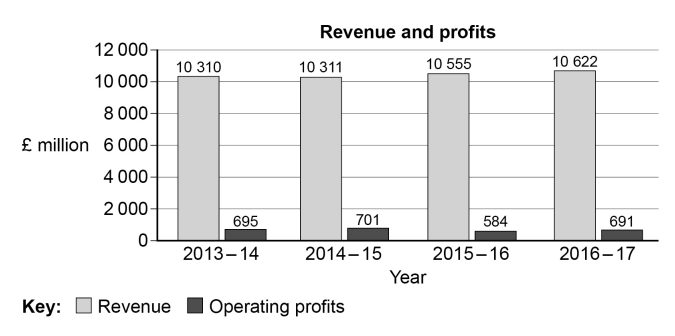
Appendix B Marks and Spencer plc’s revenue and operating profit 2013–14 to 2016–17

Bar chart of revenue and operating profits from 2013 to 2017. Revenue ranges from £10,310m to £10,622m, profits from £584m to £701m. Key included.

Appendix C Marks and Spencer plc customer data for financial year ending 1 April 2017

Total number of customers

Percentage change on previous year

Average number of times a year a customer buys from Marks & Spencer

Percentage change on previous year

Food

20.5 million

+2.0%

22.5

0%

Clothing and home

24.6 million

0%

7.2

–5.3%

Appendix D Marks and Spencer plc online data

2016–17

Percentage change on previous year

Total online revenue

£836.3 million

+5.6%

Weekly site visits

8.3 million

+11%

Appendix E Information on Marks and Spencer plc’s Board of Directors in 2017

International experience: directors come from the following countries

China

Germany

Hong Kong

India

Japan

Italy

UK

Spain

Netherlands

Poland

South Africa

USA

Gender diversity: 70% of directors are male, 30% female

Industry sector experience of directors: retail 90%, consumer 100%, finance 60%, e-commerce and technology 40%

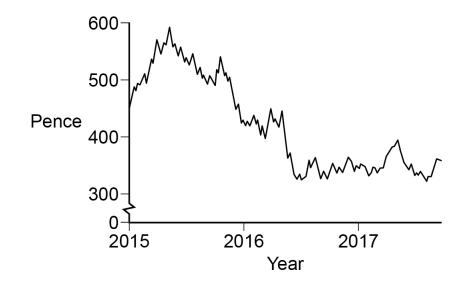
Appendix F Marks and Spencer plc’s share price
Line graph showing a downward trend in stock price from 600 pence in 2015 to below 300 pence, stabilising with fluctuations between 2016 and 2017.

Explain one possible reason why the share price of Marks and Spencer plc fell between mid-2015 and the end of 2017.

15
6 marks

Case Study

Marks and Spencer plc is one of the UK’s leading retailers. It provides its own-brand food, clothing and home products in 1433 stores worldwide and online.

Appendix A Extracts from Marks and Spencer plc’s published financial accounts

Balance sheet as at 1 April 2017

£ million

Assets

Non-current assets

6 569

Current assets

1 723

Liabilities

Current liabilities

2 368

Non-current liabilities

2 774

Net assets

3 150

Equity

Total equity

3 150

Appendix B Marks and Spencer plc’s revenue and operating profit 2013–14 to 2016–17

Bar chart of revenue and operating profits from 2013 to 2017. Revenue ranges from £10,310m to £10,622m, profits from £584m to £701m. Key included.

Appendix C Marks and Spencer plc customer data for financial year ending 1 April 2017

Total number of customers

Percentage change on previous year

Average number of times a year a customer buys from Marks & Spencer

Percentage change on previous year

Food

20.5 million

+2.0%

22.5

0%

Clothing and home

24.6 million

0%

7.2

–5.3%

Appendix D Marks and Spencer plc online data

2016–17

Percentage change on previous year

Total online revenue

£836.3 million

+5.6%

Weekly site visits

8.3 million

+11%

Appendix E Information on Marks and Spencer plc’s Board of Directors in 2017

International experience: directors come from the following countries

China

Germany

Hong Kong

India

Japan

Italy

UK

Spain

Netherlands

Poland

South Africa

USA

Gender diversity: 70% of directors are male, 30% female

Industry sector experience of directors: retail 90%, consumer 100%, finance 60%, e-commerce and technology 40%

Appendix F Marks and Spencer plc’s share price
Line graph showing a downward trend in stock price from 600 pence in 2015 to below 300 pence, stabilising with fluctuations between 2016 and 2017.

Using Appendix E , explain two potential benefits to Marks and Spencer plc of the diversity of its Board of Directors.

16
9 marks

Case Study

Lego

The Lego Group is one of the largest manufacturers and retailers of play material in the world. It is a private limited company based in Denmark that is wholly owned by the Kristiansen family. The company’s product range includes Lego, Lego Duplo, Lego Star Wars and Lego Friends.

Lego has been investing heavily in recent years; this has reduced the funds available for dividends. It is building new facilities in China and Mexico as part of its strategy to locate production nearer its markets. The company also invests significantly in attempts to spot consumer trends through market research and in new product development. Each year, new product launches account for approximately 60% of the company’s sales.

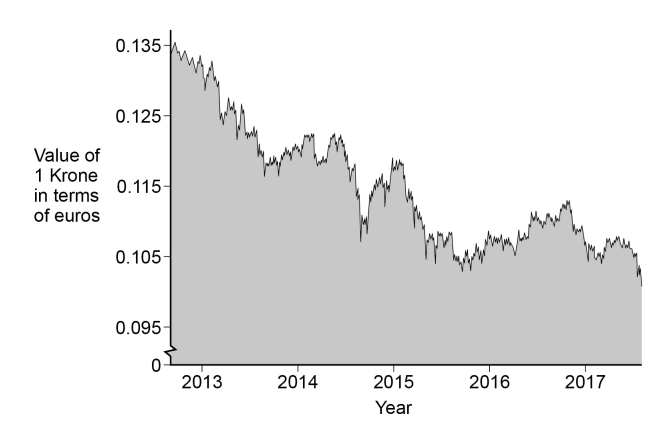
The company’s profits are calculated in the Danish currency, the Krone. Given that it is a global business selling in over 130 countries and buying resources from around the world, the company’s profits depend partly on exchange rates. A significant proportion of its sales are in Europe.

Line graph showing the value of 1 Krone in euros from 2013 to 2017, with a general decline from 0.135 to 0.095.

The company’s mission statement is to ‘Inspire and develop the builders of tomorrow’. Its culture is based on openness, trust and its core values of ‘Creativity, Imagination, Fun, Learning, Quality and Care’. Lego’s managers say that its continued success is made possible by the culture of the business and that it is important to take actions to help ensure employees share this culture.

Lego is a private limited company. Analyse how the decisions its managers make might be different if it was a public limited company.