1
25 marks
Will the introduction of lean production always lead to lower unit costs?
Justify your view.
Was this exam question helpful?
Exam code: 7132
Will the introduction of lean production always lead to lower unit costs?
Justify your view.
Was this exam question helpful?
A business starts to use ‘kaizen’.
This should lead to
external, disruptive change.
external, incremental change.
internal, disruptive change.
internal, incremental change.
Was this exam question helpful?
AJS plc
AJS plc is a manufacturer of non-recyclable packaging. This packaging is widely used by takeaway food outlets. AJS plc plans to invest £500 000 in new technology to increase capacity and make its factory more capital intensive.
Appendix A Data on proposed investment (produced by AJS plc’s operations manager)
Year | Annual net cash flow | Discount factor |
0 | (500) | 1.00 |
1 | (50) | 0.91 |
2 | 250 | 0.83 |
3 | 600 | 0.75 |
Appendix B UK market for non-recyclable takeaway food packaging
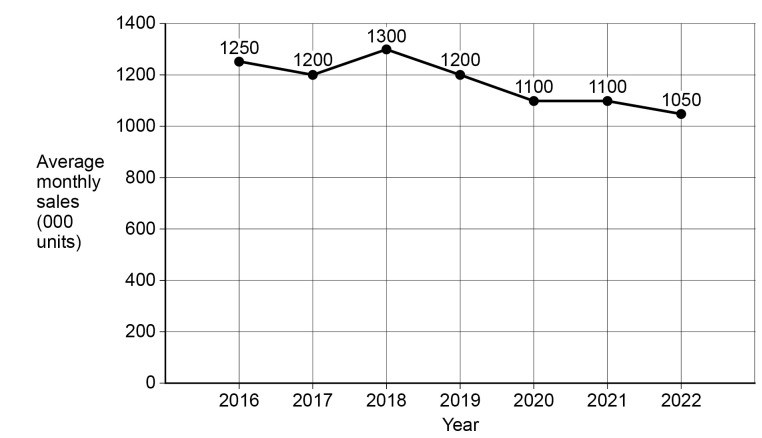
Appendix C UK market for recyclable takeaway food packaging
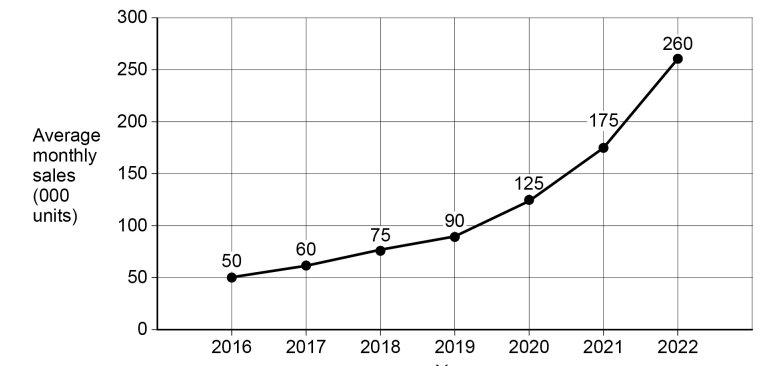
Appendix D Selected Human Resource data 2022
AJS plc | Industry average | |
Average salary | £22 000 | £26 000 |
Salary costs as a percentage of turnover (%) | 40 | 35 |
Labour turnover (%) | 15 | 4 |
Working days lost through industrial action | 24 | 5 |
Average number of applicants for vacancies | 14 | 55 |
Appendix E Selected Financial data for AJS plc
2022 | |
Current assets | £550 000 |
Current liabilities | £550 000 |
Non-current liabilities | £4m |
Operating profit | £3m |
Gearing | 22% |
Change in the share price of AJS plc over the year | –15% |
Change in the share price of the top 100 UK companies over the year | +8% |
Analyse why AJS plc has decided to become more capital intensive.
Was this exam question helpful?
Analyse why a business might choose to use labour intensive processes rather than capital intensive processes.
Was this exam question helpful?
Read the case study in the Insert (opens in a new tab).
AM plc will use a ‘Just in Time’ system at its new factory.
To what extent do you agree that this is a good idea?
Was this exam question helpful?
Statement 1: ‘Lean production should reduce unit costs because it involves a business buying raw materials in greater bulk.’
Statement 2: ‘Lean production should reduce unit costs because it reduces wastage of raw materials.’
Read statements 1 and 2 and select the correct option from the following options.
Statement 1 is true. Statement 2 is true.
Statement 1 is true. Statement 2 is false.
Statement 1 is false. Statement 2 is true.
Statement 1 is false. Statement 2 is false.
Was this exam question helpful?
Nari
Nari is a mobile phone manufacturer based in Asia. Although its brand name is not as strong as the Apple iPhone, Nari’s phones sell at much lower prices which make them competitive. Nari adds new features to its phones and develops new models every few months. The company has an objective of 95% of sales from products launched in the last year. It has relatively low profit margins but high sales volumes.
To win business, Nari promises the retailers that sell its phones a lead time of 48 hours; any delay results in a major discount for the retailers on the products they have ordered.
To achieve low prices and still be profitable, the company focuses on being more efficient than its rivals. The company has a ‘Just in Time' approach to manufacturing. It has a global supply chain with hundreds of different suppliers of components based in more than 50 countries. These components are delivered using a variety of transportation methods every few hours from all over the world to its assembly factories in China.
Some of Nari’s suppliers have factories based in emerging economies. The managers of a number of these suppliers use Taylor’s motivation theory to motivate their employees.
The company invests heavily in projects to help local communities where it is based. It contributes some of its profits every year to charities and provides significant finance for initiatives to protect the environment.
Nari has recently experienced protectionism in its European markets as governments have limited the number of phones it can sell in their countries.
Regional breakdown of Nari’s global sales in 2019
% | |
USA | 5 |
Asia | 55 |
Europe | 30 |
Rest of the world | 10 |
Nari uses a ‘Just in Time’ approach to manufacturing.
Analyse the ways in which this might affect Nari’s profits.
Was this exam question helpful?
A business replaces some of its workforce with machinery. This leads to a 10% increase in capacity and output and a 5% increase in unit costs. This is an example of
more capital intensive production and economies of scale.
more capital intensive production and diseconomies of scale.
more labour intensive production and economies of scale.
more labour intensive production and diseconomies of scale.
Was this exam question helpful?
Read the case study in the Insert.
In 2010 Mike introduced a new approach to operations in response to competitive pressures (lines 34–40).
Using data from Appendix B and the other information provided, evaluate the extent to which this new approach has been successful.
Was this exam question helpful?