Changes in the External Environment (AQA A Level Business): Exam Questions

Exam code: 7132

2 hours20 questions
1
1 mark

The exchange rate for the £ increases.

This will lead to which one of the following outcomes?

Costs of imports to UK

Demand for UK exports

A

Decrease

Decrease

B

Decrease

Increase

C

Increase

Decrease

D

Increase

Increase

    2
    9 marks

    A UK manufacturer is highly geared and exports 60% of its output.

    Analyse the impact of a significant increase in UK interest rates on this business.

    3
    16 marks

    Case Study

    WWH Ltd

    WWH Ltd manufactures and sells a single model of wood-burning stove. Rising energy prices mean that gas and electric heating is expensive to run. Wood-burning stoves are a cheaper and increasingly popular alternative source of heating in homes. This has led to an increase in demand for WWH Ltd’s wood-burning stoves. WWH Ltd is profitable and owns its buildings.

    WWH Ltd uses demand forecasts to estimate how many wood-burning stoves to make. Once manufactured, the stoves are stored in WWH Ltd’s warehouse until they are needed. When a customer places an order, they pay a 25% deposit and the remaining 75% when the stove is fitted in the customer’s home. The production department has been able to increase manufacturing to keep up with the growing demand. However, lead time for fitting by WWH Ltd’s expert fitters has been increasing and is currently two months.

    Looking to the future, WWH Ltd’s directors are concerned. The government has introduced legislation to set environmental standards for wood-burning stoves. News media continue to run stories that the sale of wood-burning stoves may be banned completely in the future. This uncertainty means that banks are not willing to lend WWH Ltd any more money.

    Up until now, WWH Ltd’s directors have seen the focus on a single product as a strength which has allowed them to keep a simple organisational design:

    • no need for research and development and new product development

    • functional structure with department responsibilities unchanged since the business set up

    • relatively flat structure which helps to keep costs under control.

    Now, the directors want to grow the business and are considering recruiting more staff and developing a portfolio of new products. Developing newer models of wood-burning stoves may enable WWH Ltd to keep ahead of ever-increasing government environmental standards. Alternatively, developing unrelated products could reduce dependence on a market with increasing government regulation.

    ‘Legislation to protect the environment is always damaging to business.’

    To what extent do you agree this is true for all businesses?

    4
    1 mark

    Statement 1: ‘According to Blake Mouton, a country club leader has a greater concern for production than a produce or perish leader.’

    Statement 2: ‘According to Blake Mouton, a team leader has a greater concern for production than a middle of the road leader.’

    Read statements 1 and 2 and select the correct option from the following:

    • Statement 1 is true. Statement 2 is true.

    • Statement 1 is true. Statement 2 is false.

    • Statement 1 is false. Statement 2 is true.

    • Statement 1 is false. Statement 2 is false.

    5
    1 mark

    Which government policy is most likely to increase both GDP and inflation?

    • Higher interest rates

    • Higher tax on goods

    • Lower income taxes

    • More open trade

    6
    3 marks

    Case Study

    Homeworking

    Homeworking (or teleworking) is the action of working from home, using the Internet, email and the telephone to link the employee and the business remotely.

    The number of people working from home has been rising steadily for several years as communications technology has improved.

    Table 1 UK labour market data

    2019

    2020

    Number of people in employment (millions)

    32.6

    32.5

    Number of people working at least partly from home (millions)

    8.7

    Some businesses now adopt homeworking as the normal practice. For example, several financial institutions have reduced the amount of office space they own or rent in city centres. The wider impact of the change has been seen through fewer commuting journeys.

    There have been some concerns over increased homeworking due to a reduction in face-to-face communication between employees. There has also been a decline in sales for businesses, such as coffee shops, that rely on office staff as customers.

    Some sectors, such as transportation and wholesale, provide few opportunities for people to work from home. Other sectors, such as IT, finance and insurance, provide more homeworking opportunities to staff.

    Of people in employment, 36% worked at least partly from home in 2020.

    Using Table 1, calculate the percentage change in the number of people working at least partly from home between 2019 and 2020.

    7
    1 mark

    Case Study

    Simply Bake plc

    Palm oil is a cheap oil ingredient used in the manufacture of many everyday items. Production of palm oil often involves farmers clearing rainforests. The destruction of this habitat has led to the loss of many animal species, including half of the world’s orangutans.

    Powerful campaign groups with many members, such as Greenpeace and the World Wildlife Foundation, have highlighted the issue. As a result, consumers are increasingly aware of the environmental impact of using palm oil.

    Simply Bake plc is a supplier of cakes to supermarkets, who then retail them as their ‘own brand’ products. For many years, palm oil has been an important ingredient in Simply Bake plc’s products, allowing it to meet the demand for cheap food.

    In 2018, a small campaign group, Action against Palm Oil (APO), criticised Simply Bake plc. APO had carried out a survey using a sample of 100 of its 400 members to represent the views of UK consumers. The survey found that 67% of respondents wanted the government to ban the use of palm oil.

    High-profile media campaigns have increasingly drawn attention to the issue of palm oil production. By 2019, supermarkets had noticed increasing numbers of enquiries from their customers about palm oil and environmental damage.

    Finding alternative ingredients is difficult and expensive, but in 2020 Simply Bake plc announced that it will have changed all its recipes to remove palm oil by 2025.
    ‘Businesses will never act in a socially responsible way unless they are forced to do so by governments.’

    To what extent is this true for all businesses?

    8
    4 marks

    Case Study

    Disrupted supply

    DT is a UK-based business manufacturing circuit boards which it sells to other businesses. All of DT’s output is exported to Europe. The components that DT uses are sourced in the UK.

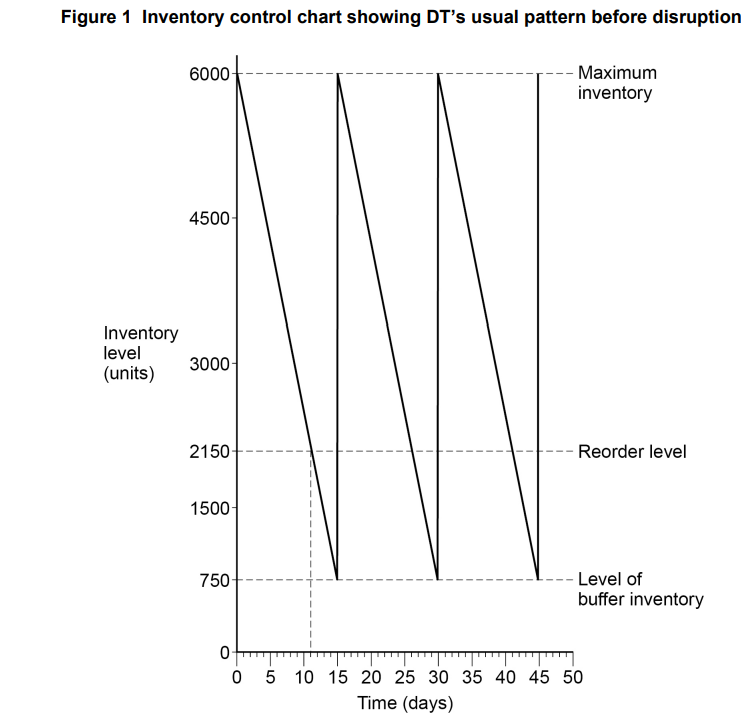
    The supplier of a vital component closed suddenly in early 2020 disrupting DT’s supply chain. DT’s usual pattern of inventory control for this component is shown in Figure 1.

    DT was forced to buy this component from a new and more expensive supplier.

    DT stated: ‘We had no contingency plan. It was impossible for us to find alternative supplies quickly enough to fulfil all our existing orders. The new supplies had higher levels of defects.’

    Inventory control chart showing inventory levels over 50 days. Peaks at 6000 units, troughs near zero, with labels for maximum, reorder, and buffer levels.

    Explain one impact of a fall in the value of the pound on DT’s sales.

    9
    1 mark

    Table 3 below shows data on GDP and exchange rates for Country X in 2019 and 2020.

    The currency of Country X is the peso.

    Table 3 GDP and exchange rates for Country X

    2019

    2020

    Index of GDP

    200

    210

    Value of peso in US $

    $1.00

    $1.10

    A business manufactures and sells its products in Country X, but imports raw materials from the United States of America (US).

    Analyse the possible impact of the changes in these data on the profitability of this business.

    10
    3 marks

    Case Study

    Nari

    Nari is a mobile phone manufacturer based in Asia. Although its brand name is not as strong as the Apple iPhone, Nari’s phones sell at much lower prices which make them competitive. Nari adds new features to its phones and develops new models every few months. The company has an objective of 95% of sales from products launched in the last year. It has relatively low profit margins but high sales volumes.

    To win business, Nari promises the retailers that sell its phones a lead time of 48 hours; any delay results in a major discount for the retailers on the products they have ordered.

    To achieve low prices and still be profitable, the company focuses on being more efficient than its rivals. The company has a ‘Just in Time' approach to manufacturing. It has a global supply chain with hundreds of different suppliers of components based in more than 50 countries. These components are delivered using a variety of transportation methods every few hours from all over the world to its assembly factories in China.

    Some of Nari’s suppliers have factories based in emerging economies. The managers of a number of these suppliers use Taylor’s motivation theory to motivate their employees.

    The company invests heavily in projects to help local communities where it is based. It contributes some of its profits every year to charities and provides significant finance for initiatives to protect the environment.

    Nari has recently experienced protectionism in its European markets as governments have limited the number of phones it can sell in their countries.

    Regional breakdown of Nari’s global sales in 2019

    %

    USA

    5

    Asia

    55

    Europe

    30

    Rest of the world

    10

    Nari operates on the highest level of Carroll’s Corporate Social Responsibility pyramid.

    Explain how the information provided supports this view.

    11
    5 marks

    Case Study

    Nari

    Nari is a mobile phone manufacturer based in Asia. Although its brand name is not as strong as the Apple iPhone, Nari’s phones sell at much lower prices which make them competitive. Nari adds new features to its phones and develops new models every few months. The company has an objective of 95% of sales from products launched in the last year. It has relatively low profit margins but high sales volumes.

    To win business, Nari promises the retailers that sell its phones a lead time of 48 hours; any delay results in a major discount for the retailers on the products they have ordered.

    To achieve low prices and still be profitable, the company focuses on being more efficient than its rivals. The company has a ‘Just in Time' approach to manufacturing. It has a global supply chain with hundreds of different suppliers of components based in more than 50 countries. These components are delivered using a variety of transportation methods every few hours from all over the world to its assembly factories in China.

    Some of Nari’s suppliers have factories based in emerging economies. The managers of a number of these suppliers use Taylor’s motivation theory to motivate their employees.

    The company invests heavily in projects to help local communities where it is based. It contributes some of its profits every year to charities and provides significant finance for initiatives to protect the environment.

    Nari has recently experienced protectionism in its European markets as governments have limited the number of phones it can sell in their countries.

    Regional breakdown of Nari’s global sales in 2019

    %

    USA

    5

    Asia

    55

    Europe

    30

    Rest of the world

    10

    Nari is experiencing protectionism in its European markets.

    Explain how Nari’s marketing managers might respond to this protectionism.

    12
    24 marks

    Read the case study in the Insert (opens in a new tab).

    To what extent does a commitment to Corporate Social Responsibility decrease profit for all businesses?

    13
    1 mark

    Decreasing government subsidies on a country’s agriculture would be

    • fiscal policy which encourages more open trade.

    • fiscal policy which increases protectionism.

    • monetary policy which encourages more open trade.

    • monetary policy which increases protectionism.

    14
    1 mark

    Case Study

    WeRide plc

    WeRide (WR) is a taxi business. It has an app that allows its passengers to find and book the nearest driver themselves. WR has grown quickly and its service is now available in over 400 cities in 60 countries. It employs its taxi drivers on flexible employment contracts.

    Stricter laws are threatening WR’s growth in the taxi market in some locations. For example, several cities have:

    • imposed limits on the number of new licences for all taxis in order to reduce congestion and pollution

    • banned WR because of concerns that its vehicles do not meet new safety regulations.

    In 2018, WR announced a change to its future strategy. Instead of trying to grow its taxi business further, WR intends to invest several million pounds in developing a rental service for electric bicycles. This will be delivered through its app.

    WR’s Chief Executive said that individual methods of transport, such as electric bicycles, were better suited to travelling around cities than cars these days. She recognises that the move into the rental of electric bicycles might damage short-term profits, but thinks it is the right long-term strategy for the business.

    Although the profit margin on an electric bicycle ride will be less than a taxi ride, WR’s Chief Executive believes that the profits from electric bicycles will eventually be higher than from taxis. However, some investors are concerned about the impact on dividends of the decision to move into electric bicycles.

    Stricter laws have affected WR’s taxi business.

    To what extent do you think that legal changes create more threats than opportunities for businesses?

    15
    1 mark

    Lower UK interest rates are likely to lead to an increase in the volume of UK exports because they probably lead to

    • a rise in costs of UK businesses and a rise in the exchange rate of the pound.

    • a rise in costs of UK businesses and a fall in the exchange rate of the pound.

    • a fall in costs of UK businesses and a rise in the exchange rate of the pound.

    • a fall in costs of UK businesses and a fall in the exchange rate of the pound.

    16
    25 marks

    To what extent do you think that UK businesses will experience a fall in profit if governments limit free trade by adopting more protectionist policies?

    17
    25 marks

    Are demographic factors now more significant than economic factors in influencing the performance of UK businesses? Justify your view.

    18
    23 marks

    Read the information below and then answer the questions that follow.

    Case Study

    Lego

    The Lego Group is one of the largest manufacturers and retailers of play material in the world. It is a private limited company based in Denmark that is wholly owned by the Kristiansen family. The company’s product range includes Lego, Lego Duplo, Lego Star Wars and Lego Friends.

    Lego has been investing heavily in recent years; this has reduced the funds available for dividends. It is building new facilities in China and Mexico as part of its strategy to locate production nearer its markets. The company also invests significantly in attempts to spot consumer trends through market research and in new product development. Each year, new product launches account for approximately 60% of the company’s sales.

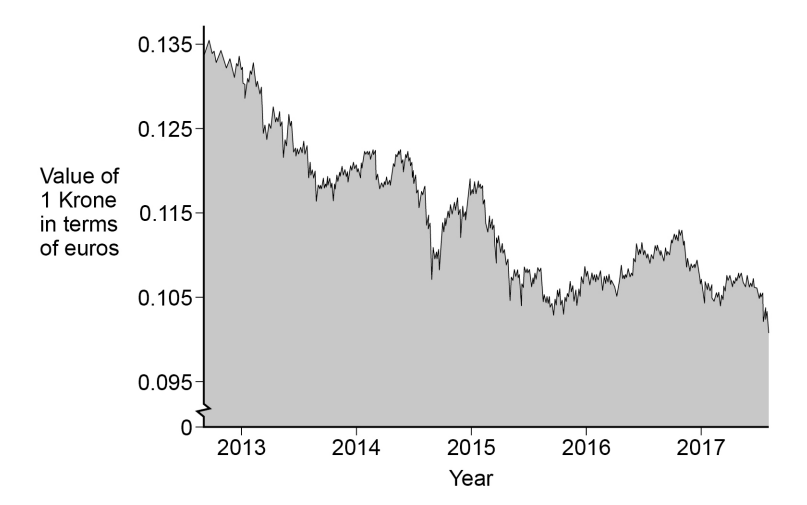
    The company’s profits are calculated in the Danish currency, the Krone. Given that it is a global business selling in over 130 countries and buying resources from around the world, the company’s profits depend partly on exchange rates. A significant proportion of its sales are in Europe.

    Line graph showing the value of 1 Krone in euros from 2013 to 2017, starting at 0.135, decreasing to 0.105 by 2017 with fluctuations.

    The company’s mission statement is to ‘Inspire and develop the builders of tomorrow’. Its culture is based on openness, trust and its core values of ‘Creativity, Imagination, Fun, Learning, Quality and Care’. Lego’s managers say that its continued success is made possible by the culture of the business and that it is important to take actions to help ensure employees share this culture.

    Lego’s profits depend partly on exchange rate changes. To what extent do you think box managers of all businesses need to worry about the impact of exchange rates on profits?

    19
    1 mark

    Options A to D below show four different combinations of monetary and fiscal policy. Which combination is most likely to lead to an increase in sales for a company that builds houses? Assume there are no other changes.

    • Decreasing interest rates and decreasing taxation

    • Decreasing interest rates and increasing taxation

    • Increasing interest rates and decreasing taxation

    • Increasing interest rates and increasing taxation

    20
    1 mark

    A business helps its local community with a view to improving the quality of life of nearby residents. In Carroll's pyramid of corporate social responsibility, this is most likely to be an example of

    • economic responsibility.

    • ethical responsibility.

    • legal responsibility.

    • philanthropic responsibility.