1
20 marks
Read the case study in the Insert (opens in a new tab).
Sanjay is considering two options for the growth of Speed-e-Puds Ltd.
Would you advise him to choose Option 1 or Option 2?
Justify your answer.
Was this exam question helpful?
Exam code: 7132
Read the case study in the Insert (opens in a new tab).
Sanjay is considering two options for the growth of Speed-e-Puds Ltd.
Would you advise him to choose Option 1 or Option 2?
Justify your answer.
Was this exam question helpful?
A food manufacturer buys two businesses: a direct competitor and a food wholesaler.
What is this an example of?
Backward vertical integration and forward vertical integration
Conglomerate integration
Horizontal integration and backward vertical integration
Horizontal integration and forward vertical integration
Was this exam question helpful?
Is it inevitable that large, growing businesses will eventually experience rising unit costs? Justify your view.
Was this exam question helpful?
h
Was this exam question helpful?
Read the case study in the Insert (opens in a new tab).
Logger Boards Ltd’s growth has been organic rather than external.
Analyse why Bodhi may have preferred organic growth to external growth.
Was this exam question helpful?
A business is able to reduce unit costs because of lessons learned throughout the period in which it has existed. This is known as:
economies of scale.
economies of scope.
synergy.
the experience curve.
Was this exam question helpful?
Ocado venture with M&S
Marks & Spencer (M&S) started to sell its popular food range online for the first time in September 2020, by forming a venture (also known as a joint venture) with Ocado. Ocado is a solely online supermarket that has well-established distribution networks and market-leading advanced technology.
M&S funded its part of the £1.5bn venture by selling £600m of shares to existing shareholders and by cutting shareholder dividends by 40%.
M&S stated that it had always believed M&S branded food should be available online and combining with Ocado was a ‘win-win’ situation that would drive long-term growth of both businesses.
Following the announcement of the venture, Ocado’s share price rose by 3%.
The launch of the venture followed over a year of hard work and required senior managers from both businesses to work together to make it happen.
Are ventures a good way for all businesses to grow?
Justify your view.
Was this exam question helpful?
The leadership crisis occurs at the end of which of Greiner’s stages of growth?
Growth through collaboration
Growth through creativity
Growth through delegation
Growth through direction
Was this exam question helpful?
Statement 1: ‘External growth requires a business to integrate with another business that is located in a different country.’
Statement 2: ‘Organic growth requires a business to use its own resources to expand its size.’
Read statements 1 and 2 and select the correct option from the following options.
Statement 1 is true. Statement 2 is true.
Statement 1 is true. Statement 2 is false.
Statement 1 is false. Statement 2 is true.
Statement 1 is false. Statement 2 is false.
Was this exam question helpful?
Zani
Zani PLC is a jewellery retailer. Its products include rings, necklaces and bracelets that are made with precious metals and gemstones. Zani PLC has a strong brand reputation for unique designs. The company targets high-income earners. The price elasticity of demand for Zani PLC’s products is estimated to be –0.4.
Zani PLC was established in 2005 by Ted Zani. Ted had previously worked for a big multinational jewellery business but left because he wanted to be his own boss. He set up the business with venture capital. In its early years, with Ted in charge, the company had a power culture (according to Handy’s model). Shareholders felt a change of culture was necessary as the business got bigger and so Ted was replaced as Chief Executive in 2013.
Zani PLC set up 16 of its own stores in its first eight years. The company has continued to grow since then by selling 150 franchises around the world.
Zani PLC has grown by selling franchises.
To what extent is selling franchises a good way for any business to grow?
Was this exam question helpful?
Which one of the following statements is true?
Backward vertical integration is impossible for a retailer.
Conglomerate integration narrows the product range.
Forward vertical integration allows a business better access to its raw materials.
Horizontal integration should give a business an immediate increase in market share.
Was this exam question helpful?
Marks and Spencer plc is one of the UK’s leading retailers. It provides its own-brand food, clothing and home products in 1433 stores worldwide and online.
Appendix A Extracts from Marks and Spencer plc’s published
financial accounts
Balance sheet as at 1 April 2017
£ million | |
Assets | |
Non-current assets | 6 569 |
Current assets | 1 723 |
Liabilities | |
Current liabilities | 2 368 |
Non-current liabilities | 2 774 |
Net assets | 3 150 |
Equity | |
Total equity | 3 150 |
Appendix B Marks and Spencer plc’s revenue and operating profit
2013–14 to 2016–17
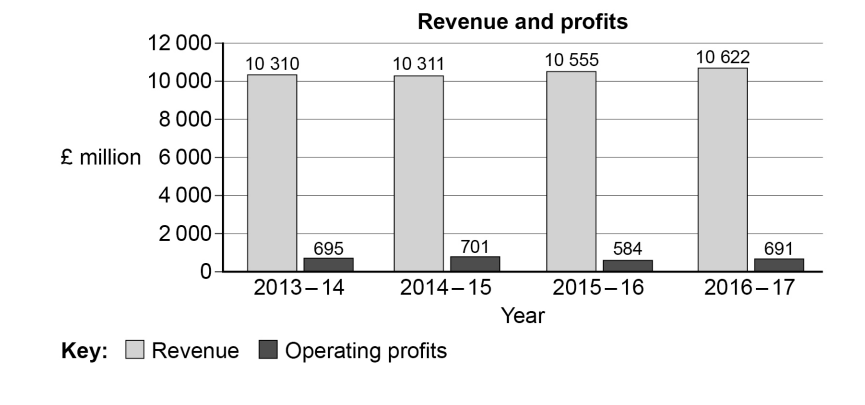
Appendix C Marks and Spencer plc customer data for financial
year ending 1 April 2017
Total number of customers | Percentage change on previous year | Average number of times a year a customer buys from Marks & Spencer | Percentage change on previous year | |
Food | 20.5 million | +2.0% | 22.5 | 0% |
Clothing and home | 24.6 million | 0% | 7.2 | –5.3% |
Appendix D Marks and Spencer plc online data
2016–17 | Percentage change on previous year | |
Total online revenue | £836.3 million | +5.6% |
Weekly site visits | 8.3 million | +11% |
Appendix E Information on Marks and Spencer plc’s Board of
Directors in 2017
International experience: directors come from the following
countries
China Germany Hong Kong India Japan Italy
UK Spain Netherlands Poland South Africa USA
Gender diversity: 70% of directors are male, 30% female
Industry sector experience of directors: retail 90%, consumer 100%, finance 60%, e-commerce and technology 40%
Appendix F Marks and Spencer plc’s share price
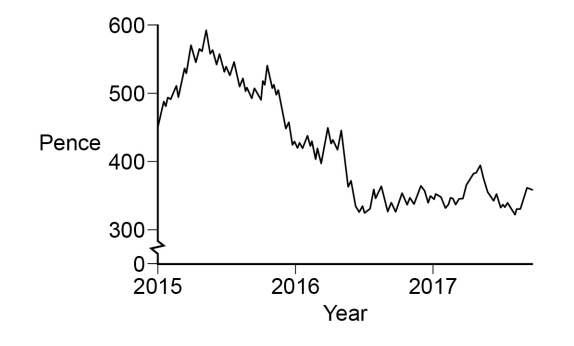
In April 2017 a rival business was considering taking over Marks and Spencer plc. box How useful do you think the data provided in Appendices A to F might have been to this rival business when deciding whether to make a take-over bid? Justify your answer.
Was this exam question helpful?
Read the case study in the Insert.
Jack plans to grow his business rapidly over the next few years. To what extent is it possible for businesses to overcome the problems caused by rapid growth?
Was this exam question helpful?
A farmer takes over a retailer in order to sell its produce. This is an example of
horizontal integration.
backward vertical integration.
forward vertical integration.
conglomerate integration.
Was this exam question helpful?
Which type of crisis is most likely to occur at point 3 of Greiner’s model of growth shown below?
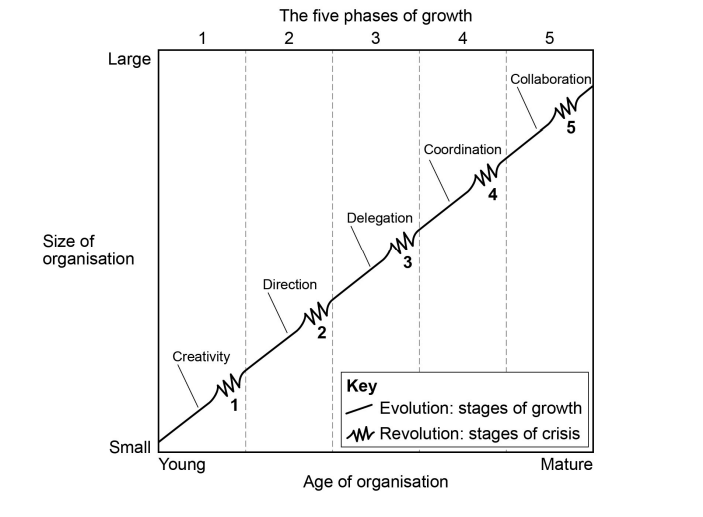
Leadership crisis
Autonomy crisis
Red tape crisis
Control crisis
Was this exam question helpful?