Globalisation and Internationalisation (AQA A Level Business): Exam Questions

Exam code: 7132

2 hours11 questions
1
1 mark

Statement 1: ‘Cheaper resources overseas would discourage a UK business which has a low-cost positioning strategy from re-shoring production.’

Statement 2: ‘Political instability overseas would discourage a UK business from re-shoring production.’

Read statements 1 and 2 and select the correct option from the following:

  • Statement 1 is true. Statement 2 is true.

  • Statement 1 is true. Statement 2 is false.

  • Statement 1 is false. Statement 2 is true.

  • Statement 1 is false. Statement 2 is false.

2
25 marks

‘Emerging economies are beneficial to UK businesses, but only as potential markets to help UK businesses to achieve growth.’

Do you agree? Justify your view.

3
1 mark

A business that trades abroad changes its strategy because:

  • The pressure for global integration changes from low to high.

  • The pressure for local responsiveness changes from low to high.

Based on Bartlett and Ghoshal’s model, the business should change its strategy:

  • from a global strategy to a multi-domestic strategy.

  • from a global strategy to a transnational strategy.

  • from an international strategy to a multi-domestic strategy.

  • from an international strategy to a transnational strategy.

4
25 marks

An understanding of Hofstede’s model of national cultures is vital to the success of a business that is entering an overseas market.

Do you agree? Justify your view.

5
24 marks

Read the case study in the Insert (opens in a new tab).

In recent years many businesses that off-shored manufacturing have reviewed their decision to produce abroad and are re-shoring production.

To what extent do you agree that all businesses that moved manufacturing abroad should now move production back to the UK?

6
1 mark

A business’s competitive advantage is based on innovation. Hofstede’s national box cultures model includes indices for uncertainty avoidance (UAI) and power distance (PD).

Based only on Hofstede’s national cultures, this business would benefit most from locating in a country with

  • a high UAI index and a high PD index.

  • a high UAI index and a low PD index.

  • a low UAI index and a high PD index.

  • a low UAI index and a low PD index.

7
12 marks

Read the case study in the Insert (opens in a new tab).

Using Appendix B and Appendix C , analyse why Sunport PLC chose a multi-domestic strategy for its food divisions.

8
1 mark

The grid below refers to two of the factors that Hofstede included in his view of national cultures.

Low UAI (Uncertainty Avoidance Index)

High UAI (Uncertainty Avoidance Index)

High LTO (Long-term Orientation)

A

B

Low LTO (Long-term Orientation)

C

D

A business locates in a country where people take risks and look for immediate results. According to Hofstede, the culture of this country is shown by segment

  • A

  • B

  • C

  • D

9
1 mark

A UK-based manufacturer plans to enter international markets.

In order to keep control of production and reduce the risks of future currency fluctuations affecting the prices of its goods and services sold abroad, its best option is

  • direct investment.

  • exporting.

  • forming alliances.

  • licensing.

10
9 marks

Read the information below and then answer the questions that follow.

Case Study

Kento Cola

Carbonated soft drinks (CSDs), such as cola, are non-alcoholic, fizzy beverages containing flavourings, sweeteners and other ingredients. CSDs have been criticised by some commentators for contributing to an obesity crisis. The World Health Organisation is encouraging more governments to place a tax on CSDs.

Kento Cola is a drinks manufacturer based in the UK. It is presently reviewing its portfolio within Europe, which traditionally has been its biggest market. Recently the company has also been investing more money into markets outside of Europe. For example, it is set to invest £2.4 billion in Africa by 2020. Last month Kento announced a planned merger with one of South Africa’s largest bottled water and still drinks producers.

Whilst other economies are in decline or experiencing slow growth, Africa is continuing to achieve high growth rates. Consumer spending, already rising, is expected to boom between now and 2024 reaching £1.7 trillion per year in 2030. However, trying to grow in any international market brings its challenges and the many countries within Africa differ significantly – for example, socially, politically, culturally and economically as well as in terms of their competitive environment.

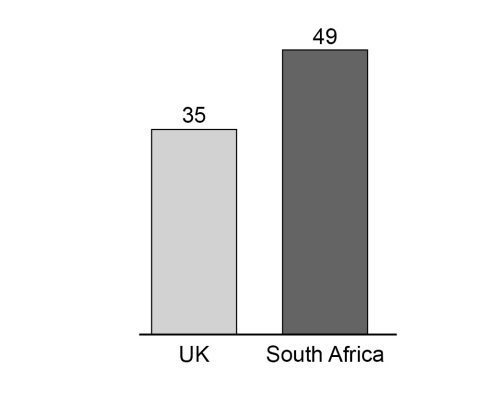
Figure 7: A comparison of Power Distance index, one of Hofstede’s cultural dimensions, between the UK and South Africa.

The rating is an index number out of 100.

Bar chart comparing two countries: UK with a value of 35 in light grey, and South Africa with a value of 49 in dark grey.

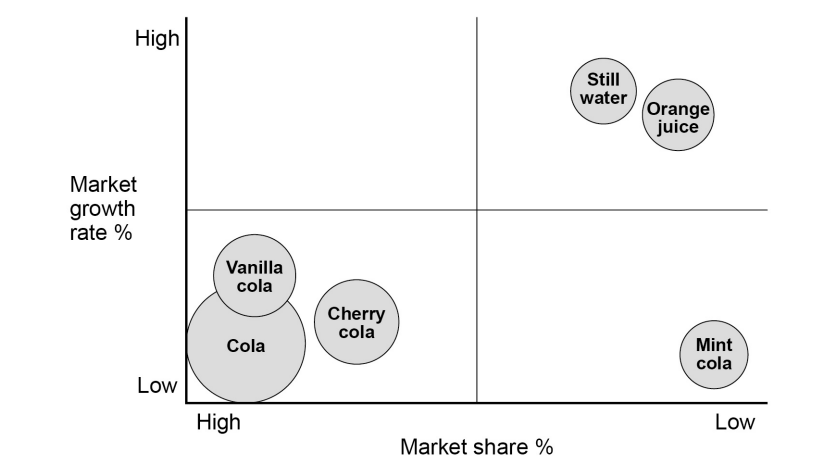
Figure 8: Kento’s products in Europe

Bubble chart showing market growth rate vs market share. Cola, Vanilla and Cherry cola are low growth, high share. Still water and Orange juice are high growth, low share. Mint cola is low in both.

The area of the circle represents the product’s revenue.

Figure 9: A comparison of Africa and Europe in 2016

Africa

Europe

Population

1 218 million

738 million

Annual population growth

2.53%

0.06%

% population that is urban

40%

74%

Average age

19.5 years old

41.9 years old

Average annual income per person

£1 400

£29 200

A manager from the UK is moving to South Africa to lead a team of local staff. Explain how the difference in Hofstede’s cultural dimension of ‘Power Distance’ shown in Figure 7 might affect her management style.

11
16 marks

Read the information below and then answer the questions that follow.

Case Study

Kento Cola

Carbonated soft drinks (CSDs), such as cola, are non-alcoholic, fizzy beverages containing flavourings, sweeteners and other ingredients. CSDs have been criticised by some commentators for contributing to an obesity crisis. The World Health Organisation is encouraging more governments to place a tax on CSDs.

Kento Cola is a drinks manufacturer based in the UK. It is presently reviewing its portfolio within Europe, which traditionally has been its biggest market. Recently the company has also been investing more money into markets outside of Europe. For example, it is set to invest £2.4 billion in Africa by 2020. Last month Kento announced a planned merger with one of South Africa’s largest bottled water and still drinks producers.

Whilst other economies are in decline or experiencing slow growth, Africa is continuing to achieve high growth rates. Consumer spending, already rising, is expected to boom between now and 2024 reaching £1.7 trillion per year in 2030. However, trying to grow in any international market brings its challenges and the many countries within Africa differ significantly – for example, socially, politically, culturally and economically as well as in terms of their competitive environment.

Figure 7: A comparison of Power Distance index, one of Hofstede’s cultural dimensions, between the UK and South Africa.

The rating is an index number out of 100.

Bar chart comparing two countries: UK with a value of 35 in light grey, and South Africa with a value of 49 in dark grey.

Figure 8: Kento’s products in Europe

Bubble chart showing market growth rate vs market share. Cola, Vanilla and Cherry cola are low growth, high share. Still water and Orange juice are high growth, low share. Mint cola is low in both.

The area of the circle represents the product’s revenue.

Figure 9: A comparison of Africa and Europe in 2016

Africa

Europe

Population

1 218 million

738 million

Annual population growth

2.53%

0.06%

% population that is urban

40%

74%

Average age

19.5 years old

41.9 years old

Average annual income per person

£1 400

£29 200

To what extent is Africa an attractive market for all businesses wanting to sell their products internationally?