Equity, Equality & Efficiency (Cambridge (CIE) A Level Economics): Revision Note
Exam code: 9708

Distinction between equality and equity
Equality means that economic outcomes are the same for all individuals regardless of their circumstances - everyone receives an identical share
Equity means that economic outcomes are fair, but fairness is a normative concept based on value judgements rather than objective facts, and is therefore contested
Equality and equity are not the same thing:
A policy can achieve equality without equity
Giving every student identical educational support treats everyone equally but may not be fair if some have greater needs
A policy can achieve equity without equality
Giving more support to disadvantaged students produces unequal outcomes but may be considered fairer
The goal of redistribution policy is typically equity rather than strict equality - governments aim for fairness, not identical outcomes
International examples
Progressive taxation across most OECD countries reflects equity - higher earners pay a higher proportion of income in tax, which is considered fairer even though outcomes are unequal
Affirmative action policies in South Africa, India and Brazil pursue equity by treating historically disadvantaged groups differently to correct past inequalities - unequal treatment in pursuit of fairer outcomes
Examiner Tips and Tricks
Never treat equity and equality as synonyms. Equality means identical outcomes; equity means fair outcomes. A policy can achieve one without the other.
Always frame equity as a normative concept — what is fair is a matter of value judgement and differs across cultures and political traditions.
Evaluate every redistribution policy against both criteria: does it improve equity, and at what efficiency cost?
The equity-efficiency trade-off
Efficiency means obtaining the maximum possible output and welfare from available resources
Equity focuses on the fairness of distribution — these two objectives frequently conflict
Free markets tend to maximise efficiency by responding to price signals
They distribute income and wealth unequally, as rewards flow to those with the most productive resources
Government intervention to improve equity typically reduces efficiency:
Progressive taxes reduce the incentive to work, invest and innovate at the margin
Means-tested benefits can create poverty traps - where individuals lose benefits as they earn more, reducing the incentive to work
Price controls and subsidies distort price signals, reducing allocative efficiency
Examiner Tips and Tricks
This trade-off creates a fundamental policy dilemma: the more aggressively a government pursues equity, the greater the potential efficiency cost
Illustrating the trade-off
Policy | Equity effect | Efficiency effect |
|---|---|---|
Progressive income tax |
|
|
Universal basic income |
|
|
Means-tested benefits |
|
|
Free state education |
|
|
Minimum wage |
|
|
Case Study
Bolsa Família and inequality in Brazil
The context
Brazil has one of the most unequal income distributions in the world, rooted in colonial history and land concentration. In 2003, President Lula da Silva launched Bolsa Família
This was a conditional cash transfer programme providing monthly payments to low-income families on the condition that children attended school and received vaccinations
Actions taken
At its peak the programme reached over 14 million households - approximately 25% of the Brazilian population
Expanded and rebranded several times, most recently restored as Bolsa Família in 2023 with increased payment levels
Outcomes
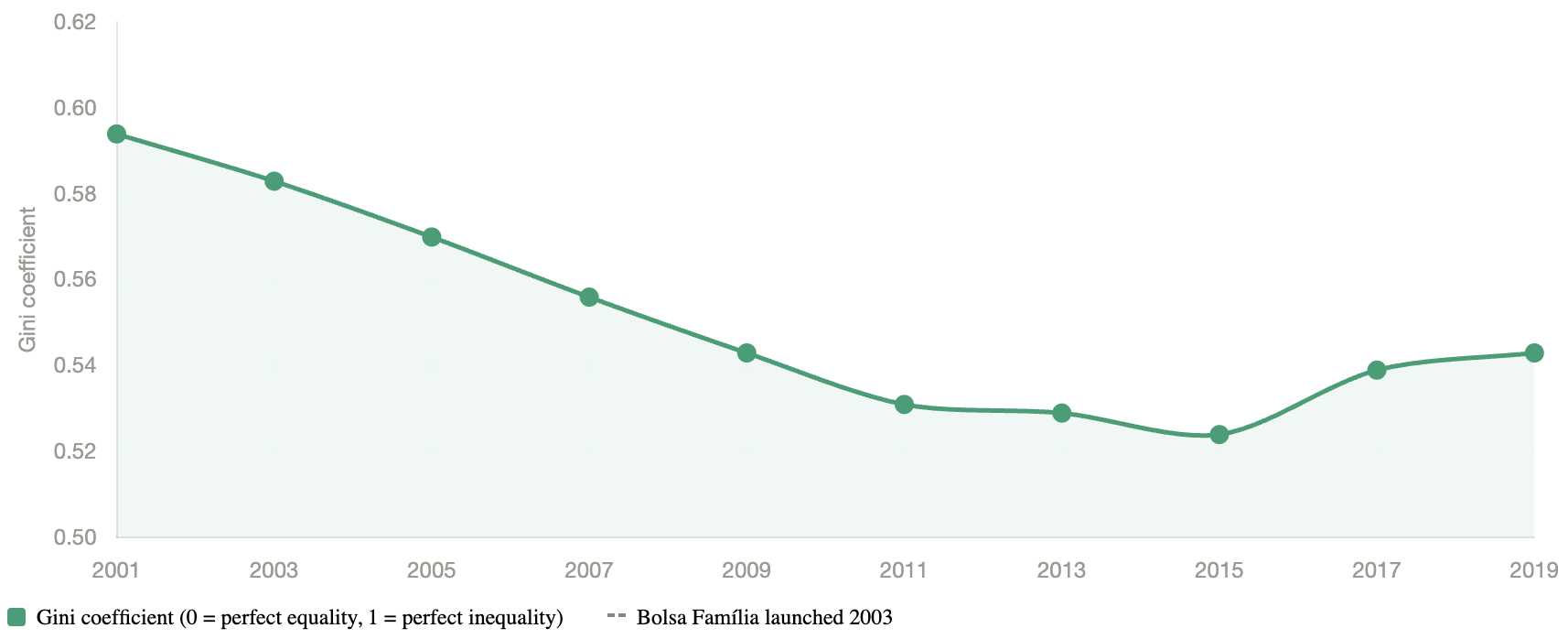
Brazil's Gini coefficient fell from 0.59 in 2001 to 0.52 by 2015 - meaningful progress, though still among the highest in the world.
However, improvement stalled as growth slowed after 2015, and structural inequalities in land ownership, education and racial disadvantage were largely untouched by cash transfers alone
This illustrates that targeted redistribution can reduce but not eliminate deep-rooted inequality.

Unlock more, it's free!
Join the 100,000+ Students that ❤️ Save My Exams
the (exam) results speak for themselves:

Was this revision note helpful?
