Provision of Information, Behavioural Insights & Nudge Theory (Cambridge (CIE) A Level Economics): Revision Note
Exam code: 9708

Provision of information, behavioural insights and nudge theory
A key cause of market failure is asymmetric information - where one party in a transaction has more or better information than the other
This leads to:
Under-consumption of merit goods
consumers underestimate private and external benefits (e.g. vaccination, education)
Over-consumption of demerit goods
consumers underestimate private and external costs (e.g. tobacco, sugar)
Adverse selection
buyers and sellers make suboptimal decisions based on incomplete information
Governments can correct this market failure through three related but distinct approaches:
Provision of information: making accurate information available to consumers
Behavioural insights: using psychology and economics to understand why people make poor decisions
Nudge theory: designing the choice architecture to steer people towards better decisions without restricting freedom of choice
1. Provision of information
Occurs when the government provides or mandates the provision of accurate information to correct the information failure between producers and consumers
This works by shifting consumers' perceived marginal private benefit (MPB) or marginal private cost (MPC) towards the true social values, moving consumption closer to the socially optimal level
Two main approaches:
Government provision: the government directly funds and distributes information campaigns
Mandated disclosure: governments require firms to provide information to consumers - shifting the cost of information provision onto producers
Case Study
Plain Tobacco Packaging in Australia
The context
Tobacco markets suffer from a severe information failure
Consumers systematically underestimate the health costs of smoking, with branded packaging actively reinforcing this by making cigarettes appear aspirational
Actions taken
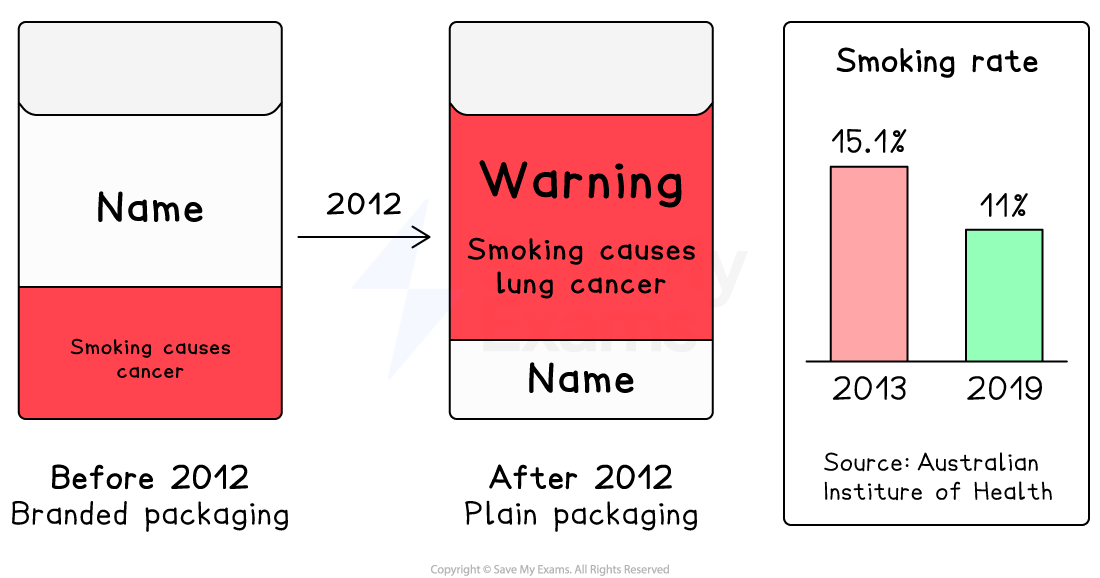
Australia became the first country to introduce standardised plain packaging in December 2012, removing all branding and replacing it with graphic images of smoking-related diseases.
All tobacco products sold in identical olive-brown packaging with graphic health warnings covering 75% of the front and 90% of the back
Tobacco firms launched significant WTO legal challenges, which ultimately ruled in Australia's favour in 2018
The policy inspired subsequent adoption across Latin America, Asia and Africa
Outcomes
Australian smoking rates fell from 15.1% in 2013 to 11% by 2019
However, isolating the impact of plain packaging from simultaneous tax increases is methodologically difficult
Illicit tobacco markets expanded during the same period, partially undermining the policy's effectiveness
Evaluating provision of information
Advantages | Disadvantages |
|---|---|
|
|
|
|
|
|
|
|
2. Behavioural insights
Behavioural economics combines psychology and economics to explain why people systematically make decisions that appear irrational from a traditional economic perspective
Traditional economics assumes consumers are rational utility maximisers
They process all available information and make decisions in their long-run best interest
Behavioural economics identifies systematic cognitive biases that cause consumers to deviate from this rational model:
Present bias
Individuals place excessive weight on immediate costs and benefits relative to future ones - explaining why people under-save for retirement or over-consume addictive goods
Status quo bias
Individuals tend to stick with the default option even when alternatives would make them better off
Loss aversion
Individuals feel the pain of a loss more strongly than the pleasure of an equivalent gain - meaning framing choices as avoiding losses is more effective than framing them as making gains
Social norms
Individuals are strongly influenced by what they perceive others to do - making social norm information a powerful behavioural tool
These biases mean that provision of information alone is insufficient
Even fully informed consumers may still make suboptimal decisions
Governments and firms can use knowledge of these biases to design interventions that improve decision-making
This is the foundation of nudge theory
3. Nudge theory
Nudge theory, developed by economists Richard Thaler and Cass Sunstein (2008), argues that choice architecture — the way options are presented — powerfully influences decisions, and that small, low-cost changes to this architecture can steer people towards better outcomes without restricting freedom of choice
A nudge is any intervention that:
Alters the choice environment to make a beneficial option more likely to be chosen
Does not ban any options
Does not significantly change financial incentives
Nudges work by exploiting cognitive biases rather than assuming rational behaviour
Types of nudge and international examples
Default options (exploiting status quo bias)
Setting the socially desirable option as the default that individuals must actively opt out of, rather than opt into
Organ donation: Wales (2015), Spain, Austria and France operate opt-out organ donation systems - presumed consent dramatically increases donor rates by exploiting status quo bias. Spain's opt-out system gives it one of the highest donor rates in the world
Social norm information (exploiting social influence)
Informing individuals about what most people in their situation do, exploiting the tendency to conform to perceived social norms
Tax compliance: HMRC in the UK and tax authorities in Guatemala and Costa Rica have sent letters to late taxpayers stating that "most people in your area have already paid their taxes" - significantly increasing compliance rates at very low cost
Simplification (exploiting information overload)
Presenting information more simply or prominently to make the most important factors understandable at the point of decision
Traffic light food labelling: adopted across the EU, Chile and Ecuador — presenting nutritional information as simple red/amber/green signals rather than complex numbers reduces cognitive load and improves food choices
Framing effects (exploiting loss aversion)
Presenting the same information in terms of losses rather than gains to increase uptake of beneficial behaviours
Health screening: framing cancer screening as "avoiding death" rather than "improving health" has been shown to increase uptake across multiple countries, including Japan and South Korea, where screening rates were previously low
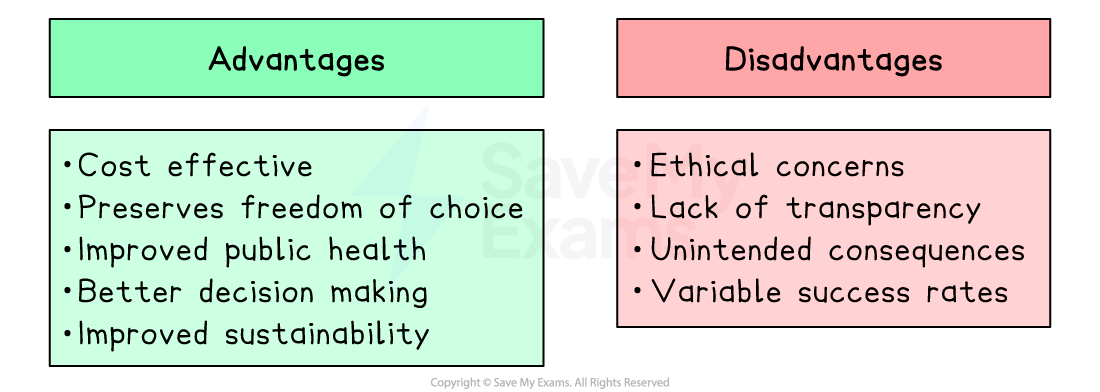
Evaluating nudge theory
Advantages | Disadvantages |
|---|---|
|
|
|
|
|
|
|
|
|
|
Comparing the three approaches
Feature | Provision of information | Behavioural insights | Nudge theory |
|---|---|---|---|
Mechanism |
|
|
|
Assumes rational consumers |
|
|
|
Restricts freedom of choice |
|
|
|
Cost to government |
|
|
|
Addresses root cause |
|
|
|
Key limitation |
|
|
|
International example |
|
|
|
Examiner Tips and Tricks
Always distinguish between the cause (asymmetric information) and the policy responses (information provision, nudge theory). Treating them as the same thing is a common error.
Nudge theory's strongest advantage is preserving freedom of choice - unlike taxes, regulation or prohibitions which restrict options or raise costs.
The strongest point against nudges is the autonomy concern - they exploit cognitive biases individuals are unaware of, raising questions about consent and paternalism. Connect this to the key concept of the role of government and equality and equity.
Link all three policies to the margin and decision-making: each changes the information or context at the decision margin rather than using price instruments or bans.

Unlock more, it's free!
Join the 100,000+ Students that ❤️ Save My Exams
the (exam) results speak for themselves:

Was this revision note helpful?
