Causes & Consequences of Imbalances (Cambridge (CIE) A Level Economics): Revision Note
Exam code: 9708

Causes of imbalances in the current account
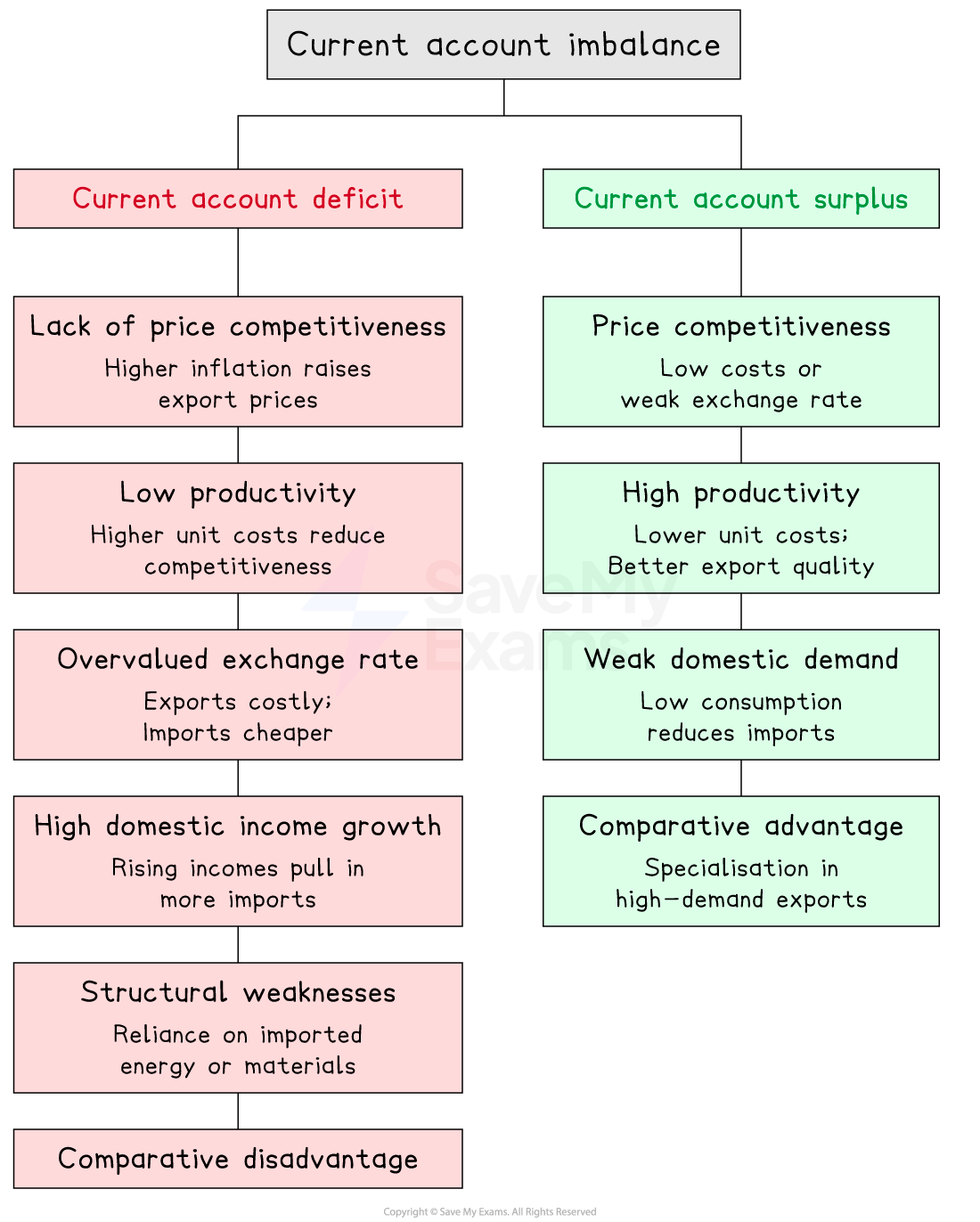
Causes of a current account deficit
Lack of price competitiveness
If domestic inflation is persistently higher than that of trading partners, export prices rise relative to foreign competitors, reducing export demand and increasing demand for cheaper imports
Low productivity
If domestic firms produce less efficiently than foreign competitors, unit costs are higher, making exports less price-competitive in world markets
Overvalued exchange rate
An appreciation makes exports more expensive abroad and imports cheaper domestically, worsening both the trade in goods and trade in services balances
High domestic income growth
Rising incomes increase demand for imports, particularly if the marginal propensity to import is high; if trading partners grow more slowly, export demand does not rise to match
Structural weaknesses
A lack of manufacturing capacity or over-dependence on imported energy and raw materials creates a structural tendency towards deficit that cannot be corrected by price adjustments alone
Comparative disadvantage
If a country lacks comparative advantage in traded goods, it will persistently import more than it exports in those sectors
Causes of a current account surplus
Price competitiveness
Low unit labour costs or a weak exchange rate makes exports cheap in world markets and imports relatively expensive, boosting net exports
High productivity
Efficient production lowers unit costs and improves export quality, raising demand for exports in world markets
Weak domestic demand
If domestic consumption is low, fewer imports are demanded; combined with strong export performance this generates a surplus - Germany and China are key examples
Comparative advantage in traded goods
Specialisation in goods for which world demand is strong and income-elastic generates persistent export surpluses
Worked Example
What is most likely to cause a current account deficit?
A .- a recession in the domestic economy
B. - a relatively high rate of inflation
C. - an undervalued exchange rate
D. - high labour productivity
Answer: B
High inflation makes exports more expensive in world markets and imports relatively cheaper - export demand falls and import demand rises, worsening the current account towards deficit
Worked solution
Option A is the trap - recession feels like economic weakness so students assume it causes a deficit, but falling incomes reduce import spending, which actually improves the current account
Option C is incorrect - an undervalued exchange rate makes exports cheaper and imports dearer, improving the current account towards surplus
Option D is incorrect - high productivity lowers unit costs, raising export competitiveness and improving the current account
Consequences of imbalances in the current account
The consequences of a current account imbalance affect both the domestic economy (growth, employment, inflation, policy) and the external economy (exchange rates, trading partners, international relations)
Consequences of a current account deficit
Consequence | Domestic economy | External economy |
|---|---|---|
Exchange rate |
|
|
Financing the deficit |
|
|
Policy response |
|
|
Productive capacity |
|
|
Foreign exchange reserves |
|
|
Consequences of a current account surplus
Consequence | Domestic economy | External economy |
|---|---|---|
Exchange rate |
|
|
Accumulation of assets |
|
|
Domestic demand |
|
|
Inflationary pressure |
|
|
International pressure |
|
|
Worked Example
A government succeeds in changing a current account deficit into a current account surplus. Why might this current account surplus increase the country's inflation rate?
A. - it raises aggregate demand
B. - it raises production costs
C. - it reduces the exchange rate
D. - it reduces the money supply
Answer: A
A surplus means net exports (X-M) are positive and rising - since AD = C + I + G + (X-M), rising net exports increase AD, creating demand-pull inflationary pressure near full capacity
Worked solution
Option C is the trap - students know depreciation causes inflation through higher import costs and may select this, but a surplus increases demand for the domestic currency, which appreciates rather than reduces the exchange rate
Option B is incorrect - a surplus does not directly raise production costs
Option D is incorrect - export revenue inflows increase the money supply, not reduce it
Examiner Tips and Tricks
Always distinguish between all four components of the current account - a deficit on trade in goods has different causes and implications from a deficit on primary income; never treat the current account as synonymous with trade in goods alone.
When evaluating consequences, address both the domestic economy (growth, employment, inflation, policy responses) and the external economy (exchange rate movements, trading partner reactions, retaliation risk) as the syllabus requires.
A current account deficit is not always harmful - if financed by productive FDI that raises long-run productive capacity it may be sustainable; always consider the cause and method of financing before evaluating severity.

Unlock more, it's free!
Join the 100,000+ Students that ❤️ Save My Exams
the (exam) results speak for themselves:

Was this revision note helpful?
