Inclusive Economic Growth (Cambridge (CIE) A Level Economics): Revision Note
Exam code: 9708

What is inclusive economic growth?
Inclusive economic growth is growth that creates opportunities for all groups and shares the benefits fairly across society
It goes beyond raising real GDP and focuses on who benefits
Key features: broad-based gains, equality of opportunity, rising participation in formal employment
Impact of economic growth on equity and equality
Growth does not automatically improve equity or equality
The outcome depends on the type of growth
Positive impacts | Negative impacts |
|---|---|
|
|
|
|
|
|
|
|
The Kuznets curve hypothesises inequality first rises then falls as economies develop
The empirical evidence to support this is mixed
Policies to promote inclusive growth
Policy | Mechanism | Key limitation |
|---|---|---|
Investment in education and healthcare |
|
|
Progressive taxation and transfers |
|
|
National minimum wage |
|
|
Financial inclusion (banking, microfinance, mobile money) |
|
|
Regional and rural development |
|
|
Case Study
Bangladesh's garment sector
From the 1980s, Bangladesh's ready-made garment (RMG) sector grew to employ around 4 million workers by 2023, roughly 60% women. The sector generates over 80% of export earnings.
Inclusive outcomes
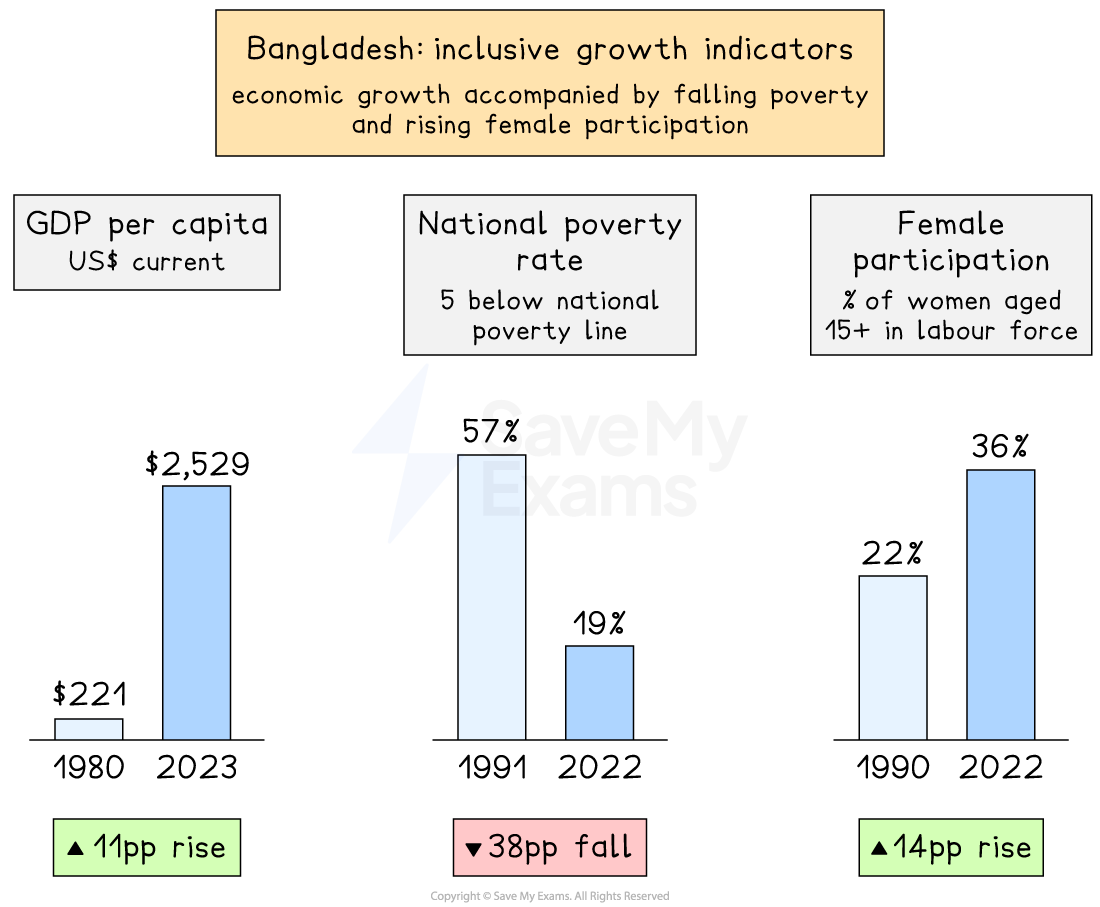
Female labour force participation rose from 22% in 1990 to 36% by 2022 — one of the sharpest rises in South Asia
GDP per capita rose from US$220 (1980) to over US$2,500 (2023)
Poverty headcount fell from 44% (1991) to under 19% (2022)
Rising female earnings linked to falling fertility and higher girls' school enrolment
Limitations
Wages remain among the lowest globally; factory safety issues (Rana Plaza, 2013); gains concentrated in urban Dhaka and Chittagong
Key lesson
Labour-intensive, export-led growth can be strongly inclusive when it draws excluded groups into formal employment — but requires complementary safety regulation and regional balance to be genuinely shared.
Examiner Tips and Tricks
Always distinguish inclusive growth from ordinary growth in your first paragraph — ordinary growth raises real GDP; inclusive growth raises real GDP and shares the gains fairly.
For 12-mark evaluation questions, raise the efficiency–equity trade-off: strong redistribution can discourage work and investment, though recent IMF and OECD research suggests high inequality itself harms growth, so the trade-off is contested.

Unlock more, it's free!
Join the 100,000+ Students that ❤️ Save My Exams
the (exam) results speak for themselves:

Was this revision note helpful?