Measurement of Exchange Rates (Cambridge (CIE) A Level Economics): Revision Note
Exam code: 9708

Nominal and real exchange rates
Nominal exchange rate
The nominal exchange rate is the price of one currency expressed in terms of another currency
It measures the rate at which one currency can be exchanged for another at a given point in time
Example: if £1 = $1.25, the nominal exchange rate of sterling against the dollar is 1.25
The nominal exchange rate does not adjust for differences in price levels or inflation between countries - it is a raw, unadjusted rate
Real exchange rate
The real exchange rate adjusts the nominal exchange rate to account for differences in price levels between countries
It measures the relative purchasing power of one currency against another
The real exchange rate, therefore, reflects the actual competitiveness of a country's goods and services in international markets
A country with a high nominal exchange rate but also high domestic inflation may have a less competitive real exchange rate than one with a lower nominal rate but lower inflation
Example: if the nominal exchange rate of the dollar against the euro appreciates by 5% but US inflation is 3% higher than eurozone inflation, the real appreciation is only approximately 2% - US goods have not become as uncompetitive as the nominal rate suggests
Key distinction
Nominal exchange rate | Real exchange rate | |
|---|---|---|
What it measures |
|
|
Adjusts for inflation |
|
|
Relevance |
|
|
Example |
|
|
For trade analysis and current account assessment, the real exchange rate is the more meaningful measure
A currency may depreciate nominally but if domestic inflation is high, real competitiveness may not improve
Trade-weighted exchange rate
The trade-weighted exchange rate (also called the effective exchange rate) is a measure of a currency's value against a basket of other currencies, weighted according to the share of trade conducted with each partner country
It gives a single summary measure of a currency's overall international value, rather than just its bilateral rate against one currency
For example, if the USA conducts 20% of its trade with the EU, 15% with China and 10% with Japan, those countries' currencies receive weights of 0.20, 0.15 and 0.10 respectively in the index
A rise in the trade-weighted index means the currency has appreciated overall against its trading partners; a fall means it has depreciated overall
The trade-weighted rate is more useful than any single bilateral rate for assessing the overall impact on a country's competitiveness and current account, since most countries trade with many partners simultaneously
Worked Example
Country X conducts 60% of its trade with country A and 40% with country B. The exchange rate against A appreciates by 10% and against B depreciates by 5%. Determine if the currency of Country X has appreciated or depreciated.
Trade-weighted change = (0.60 × +10%) + (0.40 × −5%) = +6% − 2%
Trade-weighted change = +4%
Answer
Country X's currency has appreciated by 4% on a trade-weighted basis overall, despite depreciating against one partner.
Case Study
China's trade-weighted renminbi, 2015–2016
The context
China is the world's largest trading nation, conducting trade with over 180 countries. By mid-2015, the RMB had appreciated approximately 30% in real effective terms since 2010 - driven by its dollar peg and the dollar's own broad appreciation - substantially eroding the price competitiveness of Chinese exports.
Actions taken
August 2015: PBoC devalued the RMB by 1.9% against the dollar in a single day - the largest move in two decades
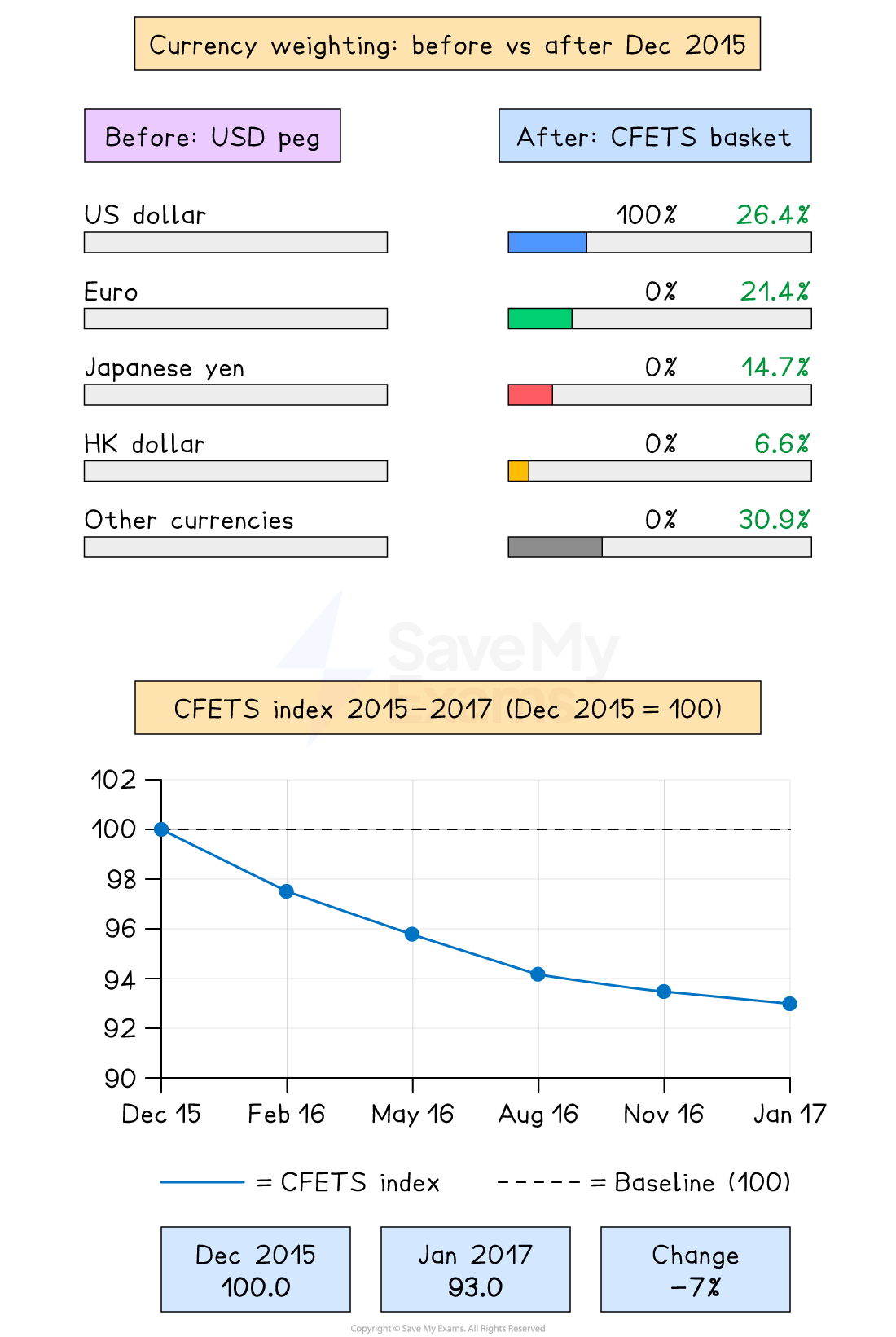
December 2015: PBoC formally switched to managing the RMB against a new trade-weighted basket - the CFETS index - comprising 13 currencies weighted by trade share, including the dollar (26.4%), euro (21.4%) and yen (14.7%)
Outcomes
The CFETS index fell approximately 7% between December 2015 and January 2017, meaning the RMB depreciated on a trade-weighted basis even as the bilateral dollar rate remained relatively stable
Chinese export price competitiveness partially recovered
The case illustrates the core distinction between bilateral and trade-weighted rates:
the two can move in opposite directions simultaneously,
and it is the trade-weighted rate that more accurately captures overall competitive position
Examiner Tips and Tricks
Always make clear that the real rate adjusts for relative price levels and is therefore the correct measure of trade competitiveness.
In a data-response question, if you are given a nominal exchange rate alongside inflation data for two countries, you should recognise that the real competitive position may differ from what the nominal rate implies.
For trade-weighted calculations, apply the weights to each bilateral exchange rate change and sum the results — the trap is to average the bilateral changes without weighting.

Unlock more, it's free!
Join the 100,000+ Students that ❤️ Save My Exams
the (exam) results speak for themselves:

Was this revision note helpful?
