Government Budgets (Cambridge (CIE) A Level Economics): Revision Note
Exam code: 9708

An introduction to fiscal policy
Fiscal Policy involves the use of government spending and taxation (revenue) to influence aggregate demand in the economy
Fiscal policy can be expansionary in order to generate further economic growth
Expansionary policies include reducing taxes or increasing government spending
Fiscal policy can be contractionary in order to slow down economic growth or reduce inflation
Contractionary policies include increasing taxes or decreasing government spending
The government budget
The government budget is a document that presents the governments revenue and expenditure plans for the fiscal year ahead
Fiscal Policy is usually presented annually by the Government through the Government Budget
A balanced budget means that government revenue = government expenditure
A budget deficit means that government revenue < government expenditure
A budget surplus means that government revenue > government expenditure
The national debt
The national debt is the total accumulated stock of government borrowing that remains outstanding
It is the sum of all past budget deficits minus any past surpluses
The national debt is a stock concept - it is the total amount owed at a given point in time
The budget deficit is a flow concept - it is the amount borrowed during a single year
The relationship between them is cumulative:
Each year the government runs a deficit, the national debt increases
Each year the government runs a surplus, the national debt decreases
For example, if the national debt is £2,500bn and the government runs a deficit of £100bn this year, the national debt rises to £2,600bn
Significance of the national debt
Factor | Explanation |
|---|---|
Interest payments |
|
Intergenerational burden |
|
Crowding out |
|
Fiscal sustainability |
|
Reduced fiscal space |
|
Case Study
Rising national debt in Japan
The context
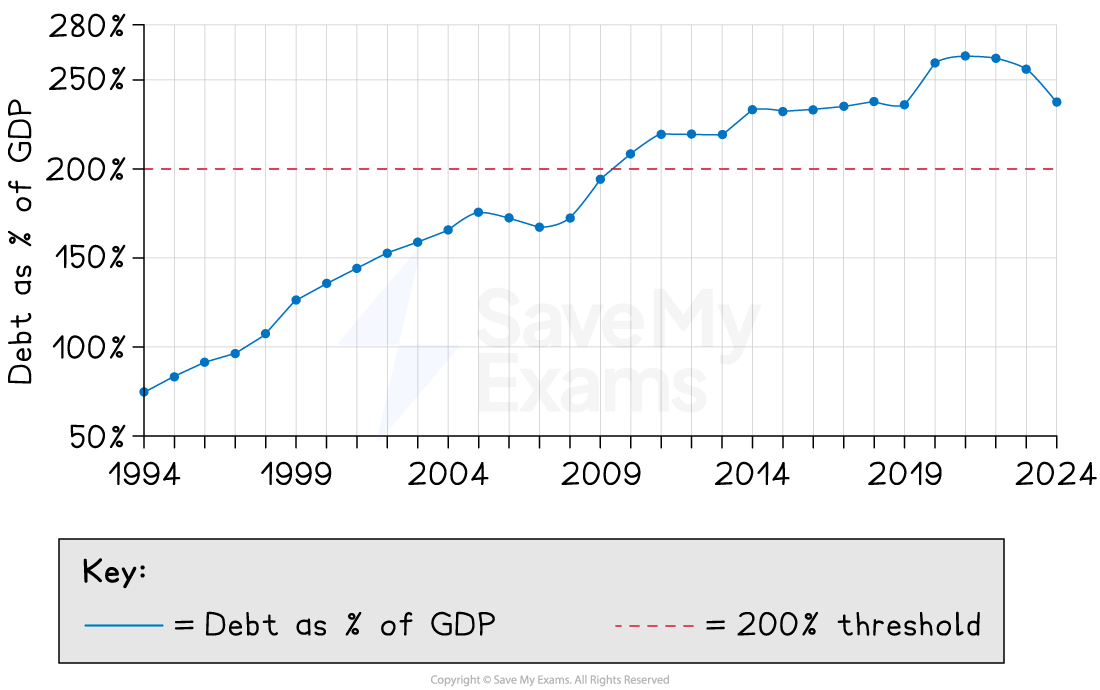
Japan has the highest national debt of any advanced economy - approximately 260% of GDP by 2023. Following the collapse of its asset price bubble in the early 1990s, Japan pursued successive rounds of expansionary fiscal policy to stimulate growth, accumulating debt over three decades
Actions taken
The government ran persistent budget deficits throughout the 1990s and 2000s, financing large infrastructure spending programmes
Following the 2008 global financial crisis and the 2011 Tōhoku earthquake, further emergency spending increased the deficit significantly
The Bank of Japan purchased large quantities of government bonds to keep interest rates near zero, preventing debt servicing costs from becoming unmanageable
Outcomes
Despite its scale, Japan's debt has not triggered a sovereign debt crisis - approximately 90% is held domestically, reducing vulnerability to foreign investor sentiment
However debt interest payments consume a significant share of government revenue, limiting fiscal space for education and infrastructure
Japan's experience illustrates that the consequences of high debt depend heavily on who holds it and at what interest rate - not just on its size relative to GDP - challenging the assumption that high debt automatically causes a crisis
Examiner Tips and Tricks
Always distinguish precisely between the budget deficit and the national debt - the deficit is a flow (the amount borrowed this year) and the national debt is a stock (the total accumulated borrowing).
A government can reduce its deficit while the national debt still rises - as long as any deficit remains, the debt continues to grow.
For evaluation questions on the significance of national debt, the strongest point is reduced fiscal space - a highly indebted government cannot easily use expansionary fiscal policy during a recession, which is precisely when it is most needed. The Japan case study illustrates that the consequences depend heavily on who holds the debt and at what interest rate, not just on its size relative to GDP.

Unlock more, it's free!
Join the 100,000+ Students that ❤️ Save My Exams
the (exam) results speak for themselves:

Was this revision note helpful?
