Sustainable Economic Growth (Cambridge (CIE) A Level Economics): Revision Note
Exam code: 9708

What is sustainable economic growth?
Sustainable economic growth is growth that meets the needs of the present generation without compromising the ability of future generations to meet their own needs (Brundtland definition)
It requires balancing current output with environmental protection and intergenerational equity
Using and conserving resources
Resource type | Characteristic | Condition for sustainable use |
|---|---|---|
Non-renewable (oil, coal, minerals) |
|
|
Renewable (forests, fish, solar) |
|
|
Common access (atmosphere, oceans) |
|
|
Impact of economic growth on environment and climate
Growth typically uses more inputs and emits more waste
These are negative externalities where producers and consumers do not bear the full social cost
Impact | Mechanism |
|---|---|
Climate change |
|
Air and water pollution |
|
Deforestation and biodiversity loss |
|
Resource depletion |
|
Policies to mitigate the environmental impact
The polluter pays principle sits at the core of most policies
Those who generate pollution should bear the cost of damage caused; underpins most environmental policy
The externality problem
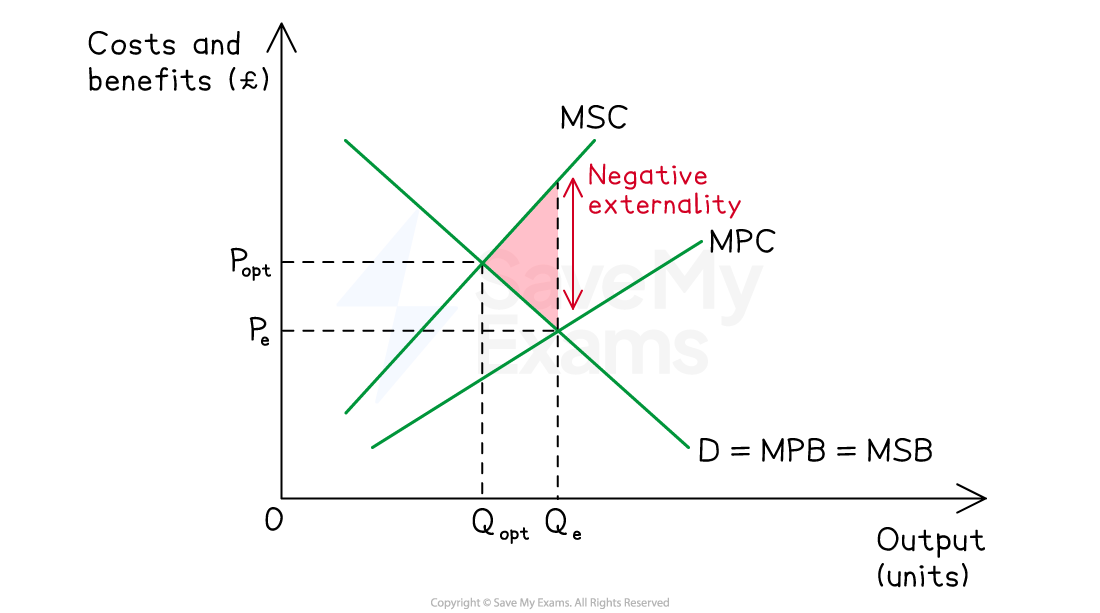
Without intervention, the market produces at Qe where private cost = private benefit
Socially optimal output is Qopt where marginal social cost = marginal social benefit
The gap between Qe and Qopt is the welfare loss — policy aims to close it
Market-based policies
Policy | Mechanism | Real-world example | Limitation |
|---|---|---|---|
Carbon/pollution tax |
|
|
|
Tradable pollution permits (cap-and-trade) |
|
|
|
Subsidies for clean technology |
|
|
|
Command-and-control policies
Policy | Mechanism | Real-world example | Limitation |
|---|---|---|---|
Regulation and emissions standards |
|
|
|
Direct provision |
|
|
|
International agreements
Paris Accord (2015) — 196 parties committed to limit global warming to well below 2°C; each country set its own Nationally Determined Contributions
Kyoto Protocol (1997) — earlier binding commitments for developed countries
Key challenge — free-rider problem: countries benefit from others' emissions cuts without bearing their own costs; weak enforcement mechanisms
Comparing market-based vs command-and-control
Market-based (taxes, permits) | Command-and-control (regulation) | |
|---|---|---|
Strength |
|
|
Weakness |
|
|
Best used when |
|
|
Case Study
Costa Rica's green growth model
Costa Rica has maintained economic growth while reversing severe environmental damage
The policies
Payment for Ecosystem Services (Forestry Law 1996) — landowners paid to conserve forests, funded by a fossil fuel tax
Renewable electricity — over 90% from hydro, geothermal and wind
Protected areas cover ~26% of national territory
Outcomes
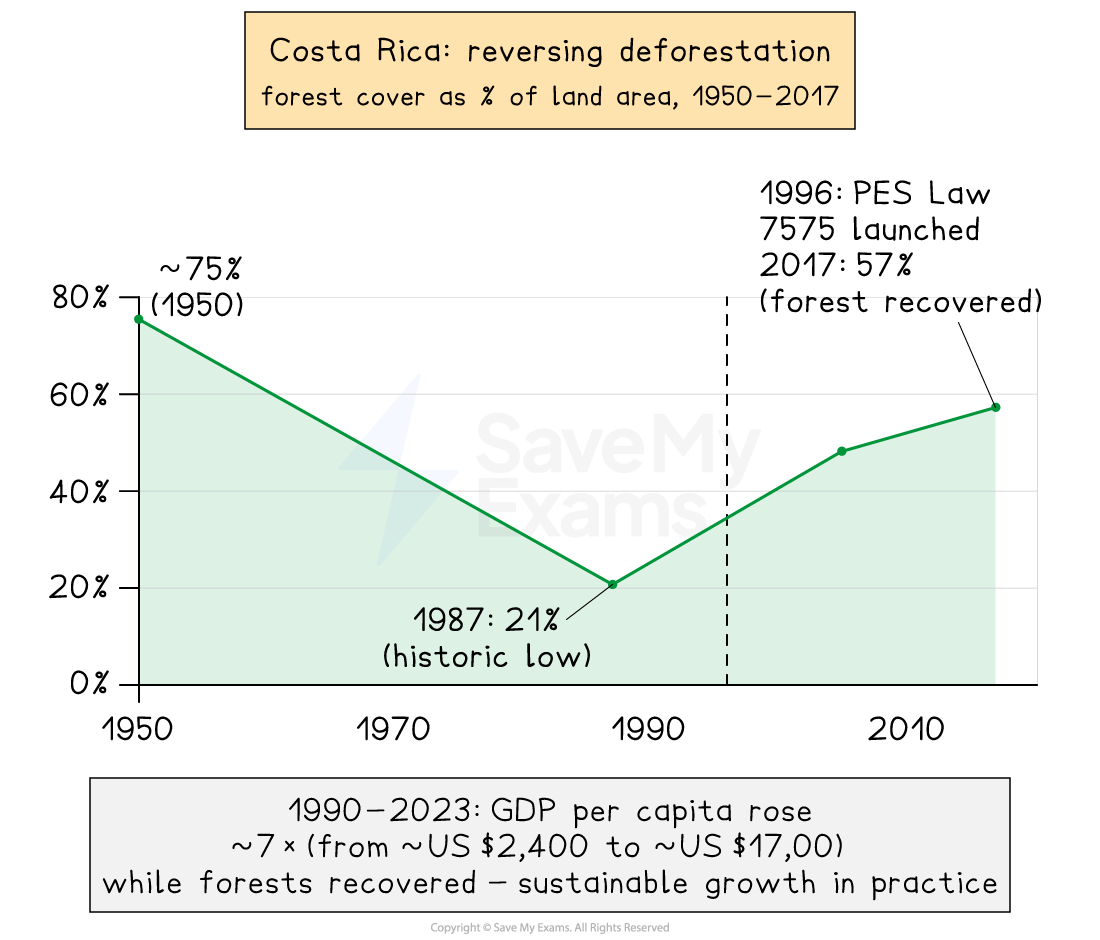
Forest cover rose from 21% (1987) to 57% (2017) — reversing decades of deforestation
GDP per capita rose from ~US$2,400 (1990) to ~US$17,000 (2023)
GDP growth averaged ~4% annually 1990-2020
Limitations
Transport emissions are rising as car ownership grows
Agriculture remains a deforestation pressure
The model relies on favourable geography (hydro potential) and small population
Key lesson
Sustainable growth is achievable with a policy mix combining pricing (carbon tax), incentives (PES) and protection (reserves) — but requires decades of political commitment.
Examiner Tips and Tricks
Always frame sustainable growth around intergenerational equity - meeting present needs without compromising future generations.
For 12-mark evaluation questions, the core trade-off is between short-run growth (often relying on cheap fossil fuels) and long-run sustainability (requiring costly clean alternatives).
For policy questions, distinguish market-based tools (taxes, permits) from command-and-control (regulation, bans) and evaluate which works best given the specific context.

Unlock more, it's free!
Join the 100,000+ Students that ❤️ Save My Exams
the (exam) results speak for themselves:

Was this revision note helpful?
