Policies to Reduce Unemployment (Cambridge (CIE) A Level Economics): Revision Note
Exam code: 9708

How to reduce unemployment
The appropriate policy depends on the type of unemployment
Cyclical unemployment (demand-deficient) → primarily addressed with demand-side policies
Structural, frictional and voluntary unemployment → primarily addressed with supply-side policies
Most real-world economies require a policy mix, with the balance depending on the state of the labour market
Demand-side policies
1. Expansionary fiscal policy
Increases in government spending (G) or cuts in taxation raise disposable income and AD
Multiplier effect amplifies the initial impulse — firms hire more workers as output rises
Most effective when economy has a negative output gap (spare capacity)
2. Expansionary monetary policy
Cut in interest rates reduces the cost of borrowing, raising consumption (C) and investment (I)
Currency may depreciate, raising net exports (X−M)
Quantitative easing increases money supply when interest rates approach zero

Diagram analysis
The economy is initially in macroeconomic equilibrium at AP₁Y₁
This is a position below full employment (YFE) with spare capacity on the highly elastic section of the Keynesian LRAS
The central bank wants to boost economic growth and lowers interest rates
Lower interest rates cause investment and consumption to increase, which are components of AD
Aggregate demand increases from AD₁ → AD₂
The economy reaches a new equilibrium at AP₂Y₂
This is a higher average price level and a greater level of national output, as the economy moves up the upward-sloping section of the LRAS
Employment rises as firms hire more workers to meet the higher level of output
Unemployment falls as the economy moves closer to YFE
Evaluating each policy
Policy | Targets | Strengths | Weaknesses |
|---|---|---|---|
Expansionary fiscal |
|
|
|
Expansionary monetary |
|
|
|
Supply-side policies
1. Market-based supply-side policies
Cuts in income tax and benefits — raise incentive to work; reduce voluntary unemployment
Trade union reform — increases labour market flexibility; reduces disequilibrium unemployment
Deregulation of labour markets — easier hiring and firing encourages job creation
Cuts in corporation tax — encourages firms to invest and expand employment
2. Interventionist supply-side policies
Education and training — reduces structural unemployment by improving skills match
Retraining programmes — help displaced workers move into new occupations (links to 9.3.6)
Improved labour market information — job centres and digital platforms reduce frictional unemployment
Subsidies to employers for hiring — e.g. wage subsidies for young or long-term unemployed workers
Regional policy — infrastructure investment in high-unemployment areas to reduce geographical immobility
Evaluating each policy
Policy | Targets | Strengths | Weaknesses |
|---|---|---|---|
Market-based supply-side |
|
|
|
Interventionist supply-side |
|
|
|
Case Study
Spain's labour market reforms post-2008
The context
The 2008 global financial crisis and the burst of Spain's housing bubble triggered a severe recession. Unemployment soared from around 8% in 2007 to a peak of 26.3% in 2013 over 6 million Spaniards out of work, with construction and youth unemployment hardest hit.
The policy response
2012 labour market reforms - market-based supply-side policy package:
Made firing cheaper and more flexible (reduced severance payments)
Decentralised collective bargaining, allowing firm-level wage agreements
Gave employers greater power to adjust working hours and wages
Active labour market policies - expanded retraining and job-matching services
Outcomes
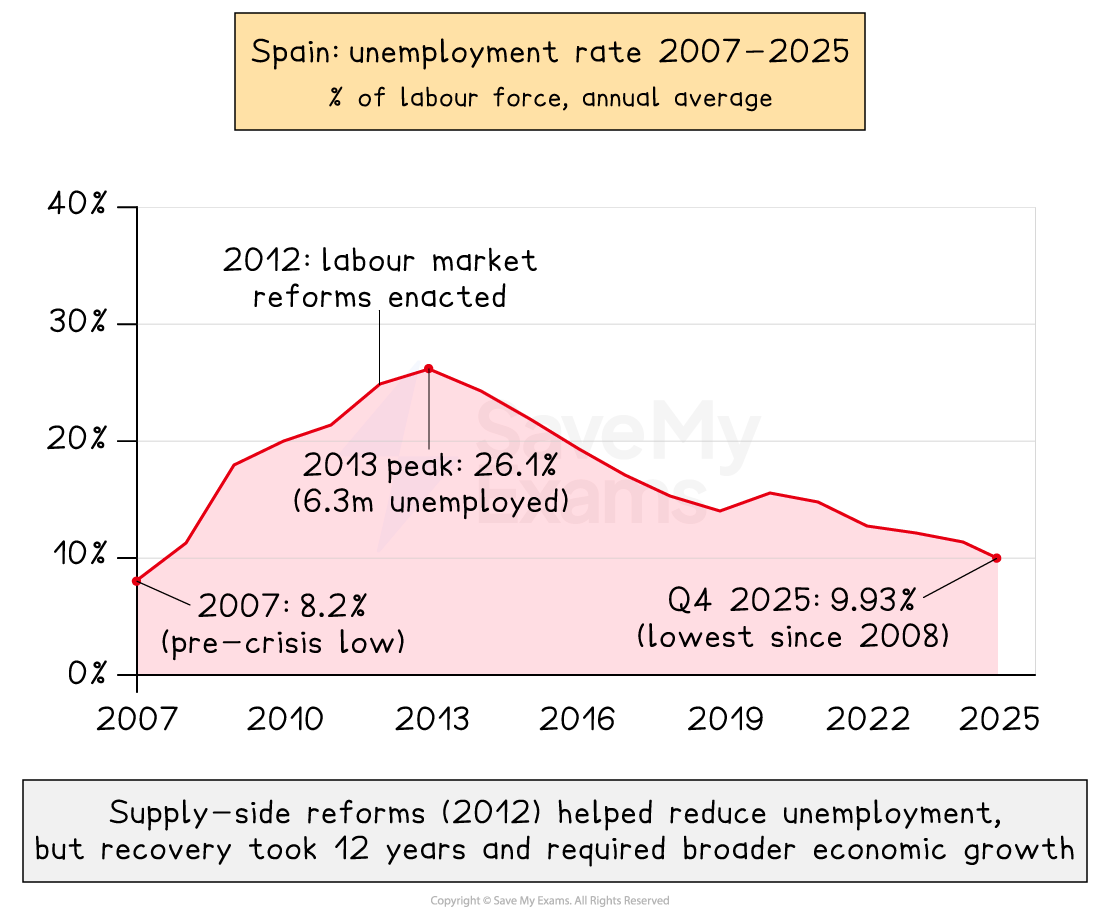
Unemployment fell from 26.3% (2013) to under 10% by late 2025 - the lowest level since 2008
Over 3 million jobs recovered; firms began hiring at lower rates of GDP growth than in previous cycles
Exports surged as unit labour costs fell
Limitations
Rise in precarious temporary contracts
Long-term unemployment and structural issues remain
In-work poverty rose as wages stagnated
Key lesson
Supply-side labour market reforms can substantially reduce unemployment, but the distributional effects on job quality require parallel attention.
Examiner Tips and Tricks
When writing essays on policies to reduce unemployment, consider the following key evaluation points:
Type of unemployment - demand-side policies are ineffective against structural unemployment; supply-side policies cannot quickly address cyclical unemployment
State of the economy - demand-side policies cause inflation if economy is already at YFE (natural rate); only supply-side policies can sustainably reduce unemployment below the previous NRU
Time horizon - demand-side acts in months, supply-side in years or decades
Country context - high-income economies face different unemployment problems (often structural/technological) from low-income economies (often underemployment/informality)
Policy conflicts - reducing unemployment may worsen inflation (Phillips curve), current account balance, or government debt
Policy mix - most effective approach typically combines short-run demand-side stimulus with long-run supply-side reform

Unlock more, it's free!
Join the 100,000+ Students that ❤️ Save My Exams
the (exam) results speak for themselves:

Was this revision note helpful?
