Typical Macroeconomic Objectives (Cambridge (CIE) A Level Economics): Revision Note
Exam code: 9708

An introduction to macroeconomic objectives
The macroeconomic objectives of government are the main long-term targets they strive to achieve to promote a healthy and sustainable economy
They include:
Economic growth
Increasing the total output of goods and services over time
Low unemployment
Ensuring that as many people as possible who are willing and able to work have jobs
Price stability
Keeping the general level of prices steady to protect purchasing power
Economic growth
Economic growth is an increase in national output as measured by real GDP
It is a central macroeconomic aim of most governments
Many developed nations have an annual target growth rate of 2-3%
This is considered to be sustainable growth
Growth at this rate is less likely to cause excessive demand pull inflation
Politicians often use it as a metric of the effectiveness of their policies and leadership
Economic growth has positive impacts on the economy:
Rising employment and household incomes as firms expand output
Higher government tax revenues, allowing increased spending on public services
Improved business and consumer confidence, encouraging further investment
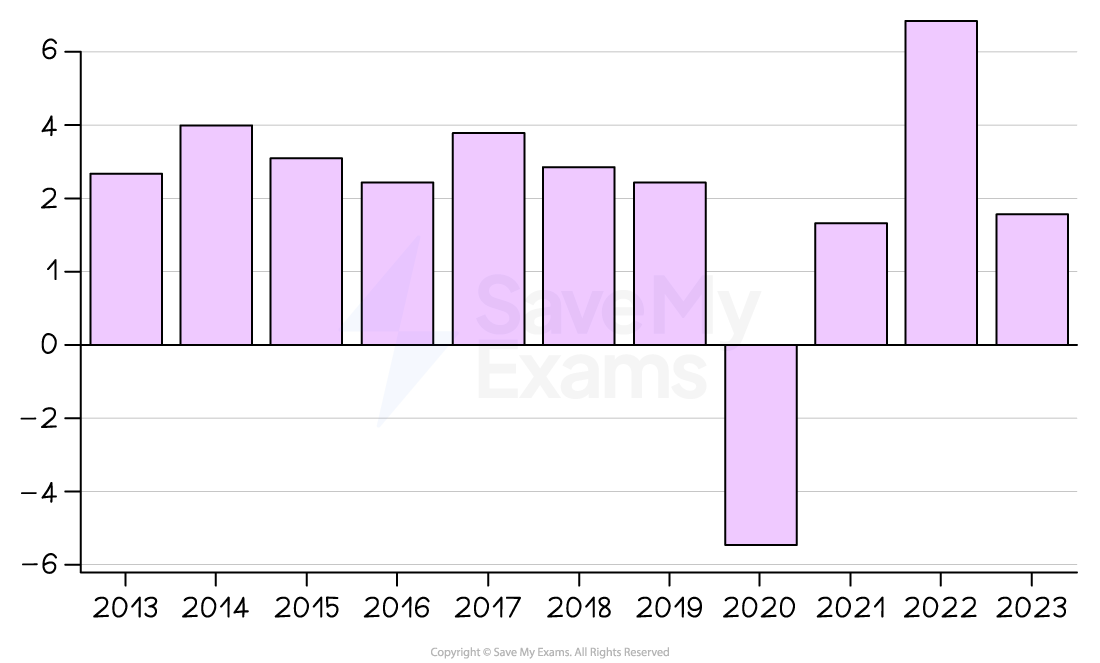
Source: Macrotrends (opens in a new tab) (opens in a new tab)
Explaining Malaysia's chart 2013 - 2023
2014 - 2016 | 2017 - 2019 | 2020 | 2022 |
|---|---|---|---|
|
|
|
|
Low unemployment
Someone is considered to be unemployed if they do not have a job and are actively seeking one
The target unemployment rate depends on the structure of the economy - its degree of labour market flexibility, industrial composition and level of development
E.g. India finds a rate of 6.5% good, whereas Singapore aims for it to be under 2%
The closer an economy is to the full employment level of labour, the better (more efficiently) it is using its human resources
Within the broader unemployment rate, there is an increased emphasis on the unemployment rate within different sections of the population
For example, youth unemployment, ethnic/racial unemployment by group
In 2021, black unemployment in the USA was 8.7% and white unemployment was 4.7%
Unemployment tends to be inversely proportional to real GDP growth
When real GDP increases, unemployment falls
When real GDP decreases, unemployment rises
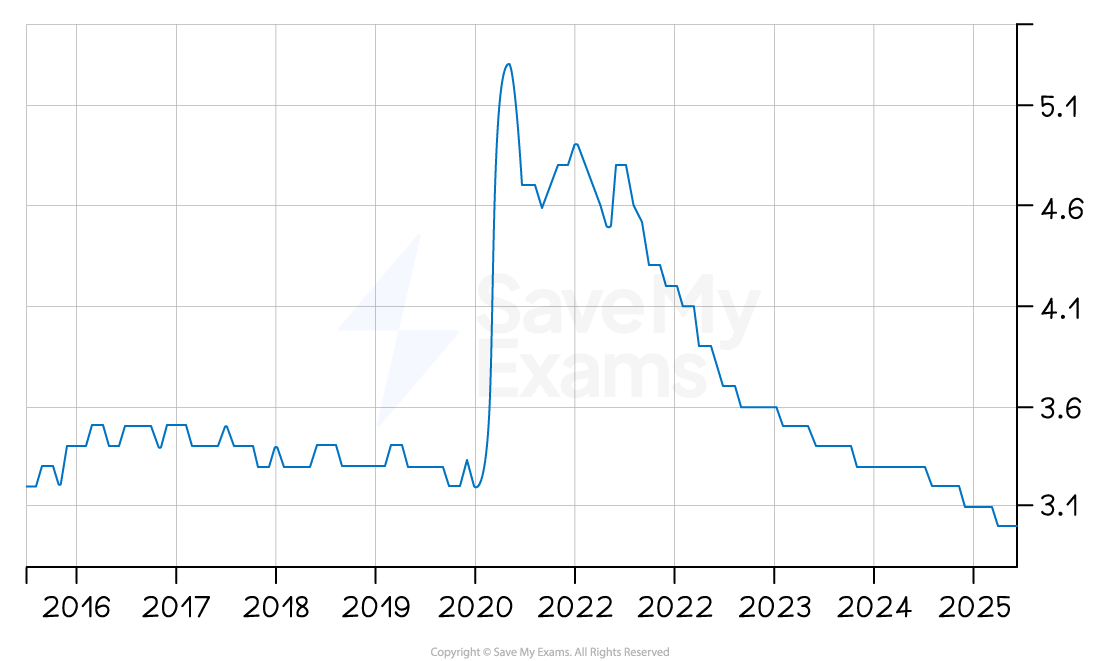
Source: Trading Economics (opens in a new tab) (opens in a new tab)
Chart analysis
2016–2019:
The unemployment rate remained stable at around 3.3–3.5%, indicating a steady labour market
Early 2020:
Slight dip before a sharp spike to over 5% — most likely due to the economic disruption caused by the Covid-19 pandemic and lockdown measures
2021–2022:
Gradual but uneven decline in unemployment, with small fluctuations suggesting partial recovery and intermittent economic disruptions
2022–2025:
Continuous and steady decline, reaching around 3.1% in 2025, indicating strong post-pandemic recovery and possible job creation from economic reopening
Overall trend:
Long-term stability before pandemic → sharp short-term shock → gradual recovery → return to pre-pandemic unemployment levels
Price stability ( low inflation)
Most economies have a target inflation rate of 2% using the Consumer Price Index (CPI)
A low and stable rate of inflation is desirable as it supports economic growth by providing certainty for firms and households to plan, invest and spend with confidence
The different causes of inflation (cost-push or demand-pull) require different policy responses from the government
Demand-side policies ease demand-pull inflation
Supply-side policies ease cost-push inflation
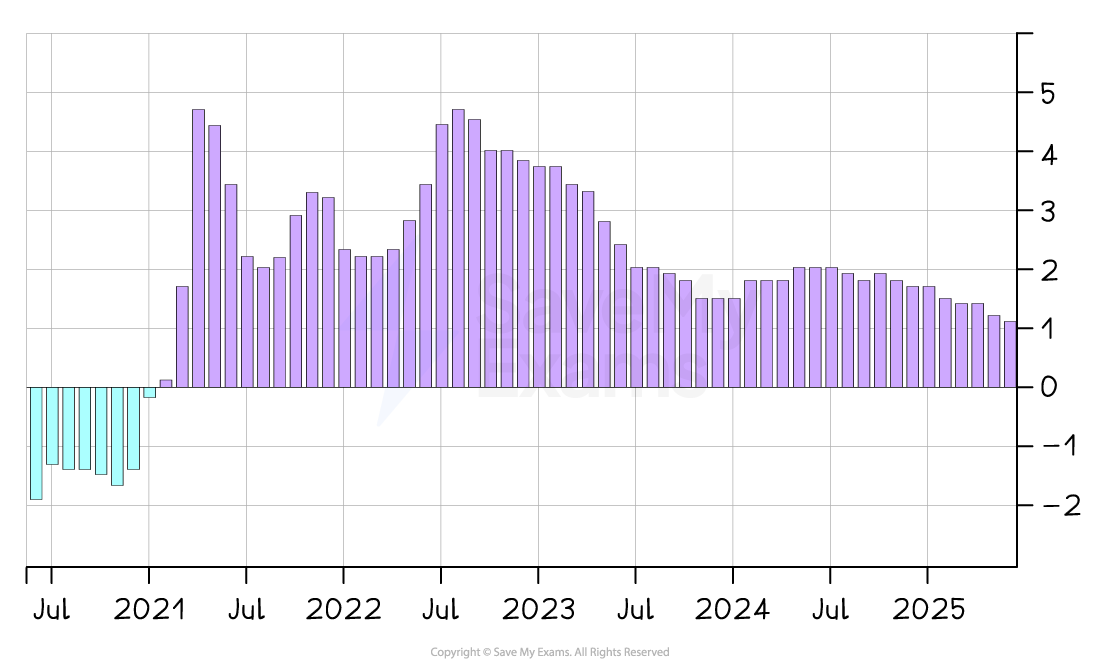
Source: Trading Economics (opens in a new tab)(opens in a new tab)
Malaysia experienced a continual deviation from the target of 2% between July 2021 and July 2023
An inflation rate in July 2022 of 4-5% was considered to be unstable, eroding household purchasing power
A low and stable rate of inflation is important, as it
Allows firms to confidently plan for future investment
Offers price stability to consumers
Worked Example
The table shows the nominal GDP growth and inflation rate in four countries.
Country | Nominal GDP growth rate (%) | Annual inflation rate (%) |
|---|---|---|
W | 2.1 | 1.9 |
X | -1.6 | 8.9 |
Y | 4.1 | 5.8 |
Z | -2.0 | 16.4 |
What can be concluded from the table?
A. W experienced the highest rate of real economic growth
B. X and Z experienced deflation
C. Y experienced the greatest rise in the standard of living
D. Z experienced the greatest growth in public debt
Answer: A - W experienced the highest rate of real economic growth
Worked solution
Calculate real GDP growth for each country using:
Real GDP growth = Nominal GDP growth - Inflation rate
Country | Nominal GDP growth | Inflation | Real GDP growth |
|---|---|---|---|
W | 2.1% | 1.9% | +0.2% |
X | -1.6% | 8.9% | -10.5% |
Y | 4.1% | 5.8% | -1.7% |
Z | -2.0% | 16.4% | -18.4% |
W has the highest real GDP growth rate at +0.2% - the only country where real output is actually rising.
Option B is incorrect - deflation means a negative inflation rate. X and Z both have positive inflation rates (8.9% and 16.4%) - they are experiencing high inflation, not deflation
Option C is incorrect - Y's real GDP is falling (-1.7%), so living standards are declining despite nominal growth appearing positive
Option D cannot be concluded from the data given - public debt figures are not provided
Examiner Tips and Tricks
Always be precise about the three objectives - price stability does not mean zero inflation, it means a low and stable rate, typically around 2%. Low unemployment does not mean zero unemployment - frictional unemployment always exists in a healthy economy.
Economic growth must be measured in real terms - nominal GDP growth is meaningless as a measure of the objective if inflation is not stripped out first.
When data questions present nominal GDP and inflation figures together, always calculate real GDP growth before drawing conclusions about any of the three objectives. A country with rising nominal GDP and high inflation may be failing on all three objectives simultaneously - as countries X, Y and Z illustrate above.

Unlock more, it's free!
Join the 100,000+ Students that ❤️ Save My Exams
the (exam) results speak for themselves:

Was this revision note helpful?
