International Aid (Cambridge (CIE) A Level Economics): Revision Note
Exam code: 9708

What is aid?
International aid is the voluntary transfer of resources from one country (or international organisation) to another, typically from higher-income to lower-income economies, to support development or humanitarian relief
Aid is one of several international financial flows alongside Foreign Direct Investment and remittances
Its relative importance has declined for middle-income economies as private capital flows have grown, but it remains critical for the poorest countries
Forms of aid
Aid is classified along two main dimensions, and a single aid flow can fall into multiple categories
By source of aid
Type | Definition | International example |
|---|---|---|
Bilateral aid |
|
|
Multilateral aid |
|
|
By terms attached
Type | Definition | Implication for the recipient |
|---|---|---|
Grants |
|
|
Concessional (soft) loans |
|
|
Tied aid |
|
|
Untied aid |
|
|
Humanitarian aid |
|
|
Reasons for giving aid
Donor countries provide aid for a mixture of altruistic and self-interested motives, and these motives often overlap.
Humanitarian and moral reasons
Reducing global poverty, hunger and preventable death; responding to disasters. The US PEPFAR programme (President's Emergency Plan for AIDS Relief), launched in 2003, is estimated to have saved over 25 million lives across Africa
Economic reasons
Building future trading partners, securing access to natural resources or growing markets, and creating commercial opportunities for donor-country firms (especially through tied aid)
Political and strategic reasons
Strengthening diplomatic alliances and influence; the US and China are increasingly competing for influence across Africa, Latin America and Southeast Asia through development finance
Historical reasons
Former colonial powers often provide significant aid to former colonies, reflecting post-colonial ties (France remains the largest bilateral donor to much of West Africa)
Effects of aid
The effects of aid depend heavily on the type of aid, donor motives and the recipient country's institutions
Positive effects
Effect | Explanation |
|---|---|
Fills the savings gap |
|
Fills the foreign exchange gap |
|
Develops infrastructure |
|
Develops human capital |
|
Provides emergency relief |
|
Negative effects
Effect | Explanation |
|---|---|
Aid dependency |
|
Corruption and rent-seeking |
|
Dutch disease |
|
Tied aid distortion |
|
Crowds out domestic enterprise |
|
Importance of aid
The importance of aid varies enormously across countries.
For Least Developed Countries (LDCs) — including South Sudan, Somalia and Afghanistan — aid can represent over 10% of GNI and is a critical source of investment funds
For middle-income economies such as Brazil, India and Indonesia, aid is a small share of total capital flows
Globally, remittances sent home by migrant workers now exceed total aid flows by a significant margin
Aid remains particularly important for:
Sub-Saharan African countries with limited access to international capital markets
Post-conflict and fragile states rebuilding after war
Countries facing acute humanitarian crises
Case Study
Rwanda's use of aid for development
The context
Rwanda emerged from the 1994 genocide as one of the world's poorest and most devastated countries. Aid has been central to its reconstruction and development trajectory since 2000
Actions taken
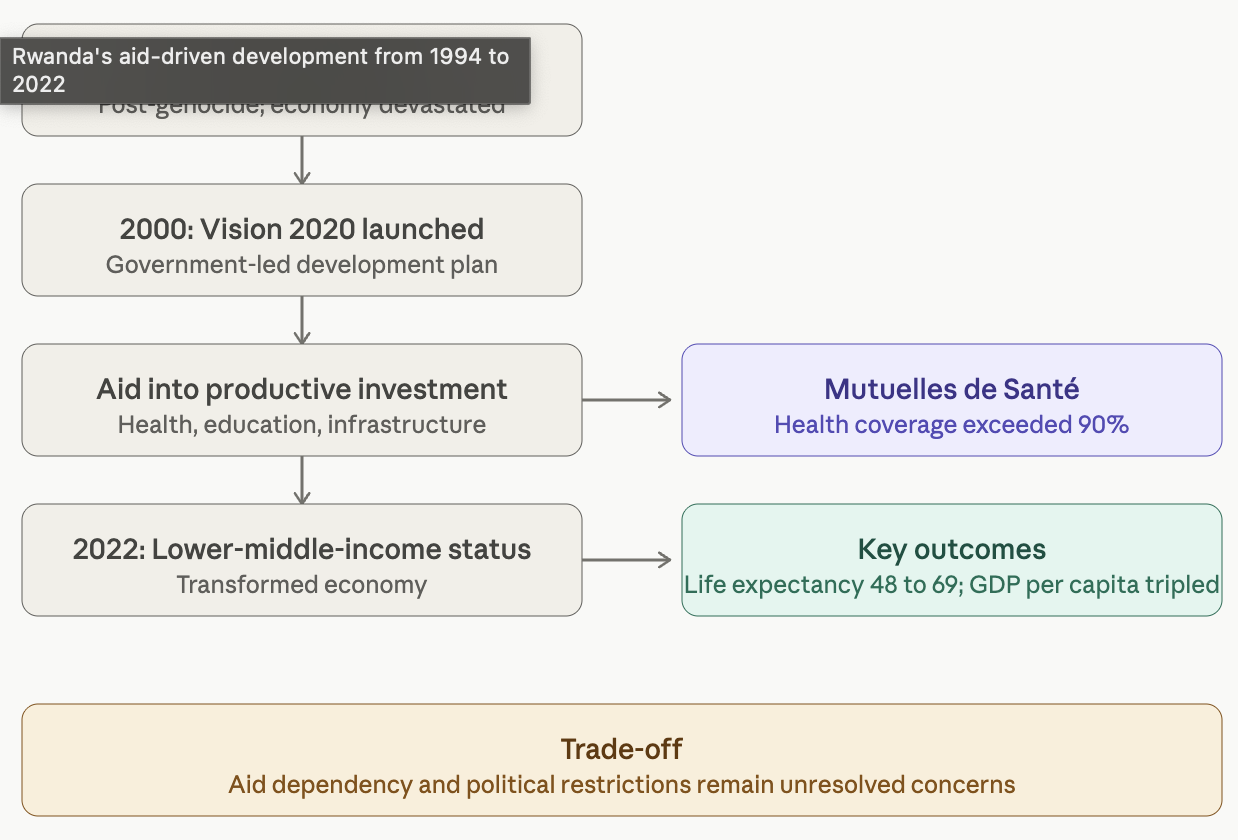
The Rwandan government channelled aid into productive investment in health, education, infrastructure and agriculture rather than recurrent spending
Strong central control and low tolerance for corruption — Rwanda is consistently ranked one of Africa's least corrupt countries by Transparency International
Aid coordinated through the government's own development plans (Vision 2020, Vision 2050) rather than donor priorities
The Mutuelles de Santé community-based health insurance scheme, funded partly through aid, achieved coverage of over 90% of the population
Outcomes
Real GDP per capita more than tripled between 2000 and 2020
Life expectancy rose from approximately 48 years in 2000 to around 69 years by 2022
Rwanda transitioned from a low-income to a lower-middle-income economy
Critics note that long-term aid dependency and political restrictions remain unresolved — illustrating that even successful uses of aid involve trade-offs
Examiner Tips and Tricks
The strongest evaluation point on aid is that effects depend on the type of aid, donor motives and recipient governance — never make blanket statements about aid being "good" or "bad". Specifically link your evaluation to the form of aid being discussed.
Always connect aid to the savings gap and foreign exchange gap — this links directly to wider development theory and demonstrates synoptic understanding.
Use country-specific examples — vague references to "Africa" or "developing countries" lose marks for AO2 application. Strong responses name specific donors (PEPFAR, France, World Bank) and recipients (Rwanda, Bangladesh, Ethiopia).
For evaluation, the two strongest critical points are aid dependency (which undermines the institutions needed for self-sustaining development) and tied aid (which reduces recipient autonomy and value for money)

Unlock more, it's free!
Join the 100,000+ Students that ❤️ Save My Exams
the (exam) results speak for themselves:

Was this revision note helpful?
