Supply-Side Policy & International Trade Policy (Cambridge (CIE) A Level Economics): Revision Note
Exam code: 9708

The link between supply-side policy and international trade
Supply-side policy raises the productive capacity of the economy by improving efficiency, productivity, and the quantity and quality of factors of production
International trade policy uses tariffs, quotas, subsidies, and trade agreements to shape an economy's external environment in pursuit of macroeconomic objectives
Both work primarily through the supply side
Supply-side policy expands LRAS directly
Trade policy alters the supply environment by changing the cost and availability of imports, exports and inputs
Recap from AS
The AS syllabus covers the basic tools and effects of both policies
Supply-side tools (training, infrastructure, R&D, deregulation, privatisation, tax cuts) and their basic effects on LRAS
Trade policy tools (tariffs, quotas, subsidies, embargoes) plus the arguments for free trade and protectionism
This page builds on that foundation and adds the classification of supply-side tools into market-based and interventionist approaches, and the integrated effectiveness analysis of both policies across multiple macroeconomic objectives
Supply-side policy
Supply-side policy is government action that raises the productive capacity of the economy, shifting LRAS rightwards and allowing higher output without inflationary pressure
Policies can be separated into market-based and interventionist
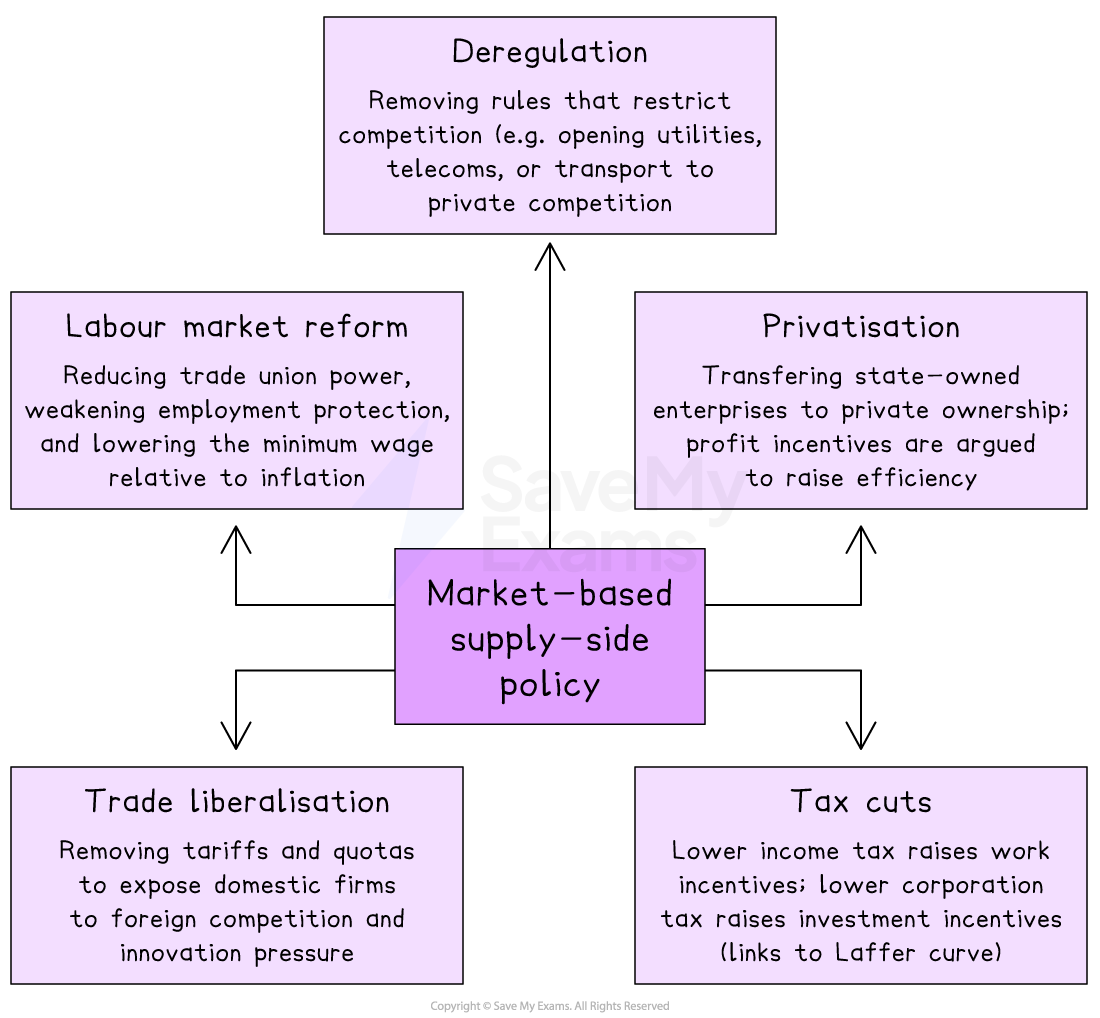
Market-based supply-side policy
Market-based supply-side policy reduces government intervention in markets, allowing market forces to determine prices, employment and resource allocation more freely
The main tools are
Interventionist supply-side policy
Interventionist supply-side policy involves direct government investment in the productive capacity of the economy, addressing market failures that prevent the private sector from achieving efficient outcomes alone
The main tools are
Education and training — government-funded schools, universities, vocational training, apprenticeships
Infrastructure investment — transport networks, broadband, energy grids, ports
R&D subsidies — direct funding or tax credits for private research and innovation
Industrial policy — strategic support for sectors deemed critical for long-run growth (e.g. green technology, semiconductors)
Healthcare investment — improving the productivity of the labour force through better health outcomes
Effectiveness across objectives
Objective | Mechanism | Effectiveness |
|---|---|---|
Economic growth |
|
|
Low inflation |
|
|
Low unemployment |
|
|
Balance of payments |
|
|
Equitable income distribution |
|
|
Examiner Tips and Tricks
When evaluating in essays, choose the approach based on the objective:
Interventionist policies (education, training, infrastructure) for inequality and structural unemployment
Market-based policies (tax cuts, deregulation) for raising business investment and short-term efficiency.
International trade policy
International trade policy is the use of tariffs, quotas, subsidies and trade agreements to shape an economy's external trade environment in pursuit of macroeconomic objectives
The arguments for free trade (comparative advantage, lower consumer prices, productivity through competition) and for protectionism (infant industries, anti-dumping, strategic protection) are covered earlier at AS Level starting here
The focus now is on how trade policy serves macroeconomic objectives
Three policy stances that can be taken
Protectionist
Tariffs and quotas to protect domestic industries
Subsidies to support exporters
Capital controls to manage currency flows
Free trade
Minimal restrictions on imports and exports
Participation in trade agreements (FTAs, customs unions)
Commitment to WTO rules
Strategic
Selective protection of strategic industries (semiconductors, food security, defence) combined with free trade in other sectors
Effectiveness across objectives
Objective | Mechanism | Effectiveness |
|---|---|---|
Economic growth |
|
|
Low inflation |
|
|
Low unemployment |
|
|
Balance of payments |
|
|
Equitable income distribution |
|
|
Strengths and limitations
Strengths | Limitations | |
|---|---|---|
Supply-side policy |
|
|
Trade policy |
|
|
Worked Example
With the help of a diagram, assess the effectiveness of government policies which might be used to reduce cost-push inflation.
[20 marks]
Indicative answer structure
AO1 Knowledge: Define cost-push inflation; identify possible policy responses (supply-side policy, exchange rate appreciation, trade liberalisation)
AO2 Analysis: Use AD/AS diagram to show how supply-side policy shifts LRAS rightwards, reducing the price level. Explain that
Market-based supply-side policy (deregulation, tax cuts, trade liberalisation) reduces costs by raising efficiency
Interventionist supply-side policy (training, infrastructure, R&D) reduces costs over time by raising productivity
Free trade reduces import prices directly, easing cost-push pressure
Demand-side policy (contractionary monetary or fiscal) is largely ineffective because it raises unemployment without addressing the supply-side cause
AO3 Evaluation: Supply-side policy is the theoretically appropriate response to cost-push inflation, but it has limitations
Time lags — effects take years; cost-push shocks may persist in the short run
Uncertain outcomes — productivity gains are not guaranteed
Cost — interventionist policies raise government debt
Distributional effects — market-based policies may widen inequality
Conclude that supply-side and trade policy are the most effective long-run responses to cost-push inflation, while demand-side policy may need to manage short-run pressures despite its limitations
Examiner Tips and Tricks
In essays, distinguish market-based from interventionist policies explicitly and evaluate them separately.
The strongest answers identify which approach is more appropriate for the specific objective in the question:
Interventionist for reducing inequality and structural unemployment
Market-based for raising business investment and short-term efficiency
Treating supply-side policy as a single category limits evaluation marks.
For trade policy questions, the key insight is that free trade vs protectionism is rarely a binary choice - most countries use a strategic mix. The strongest answers evaluate both stances against the country's stage of development, industrial structure, and external position.
Use the post-2021 inflation episode as an evaluative anchor for supply-side questions. The episode was driven by supply-side shocks (energy, supply chains) - supply-side policy is the theoretically appropriate response, yet most central banks responded with contractionary monetary policy because it acts faster. This contrast illustrates the time-lag limitation of supply-side policy in real-world settings.

Unlock more, it's free!
Join the 100,000+ Students that ❤️ Save My Exams
the (exam) results speak for themselves:

Was this revision note helpful?
