The Effect of the Multiplier on National Income (Cambridge (CIE) A Level Economics): Revision Note
Exam code: 9708

National income determination with the multiplier process
You are required to understand two complementary approaches for showing the multiplier's effect on national income:
The income-expenditure approach (Keynesian 45-degree diagram) - shows why the change in income is a multiple of the initial injection
The AD/AS approach - shows what that multiplied change means for real output, the price level and employment
Income-expenditure (45-degree) approach
This diagram plots:
National income (Y) on the horizontal axis
Aggregate expenditure (AE = C + I + G + (X − M)) on the vertical axis
A 45-degree reference line where Y = AE, representing every possible point at which total planned spending equals total output
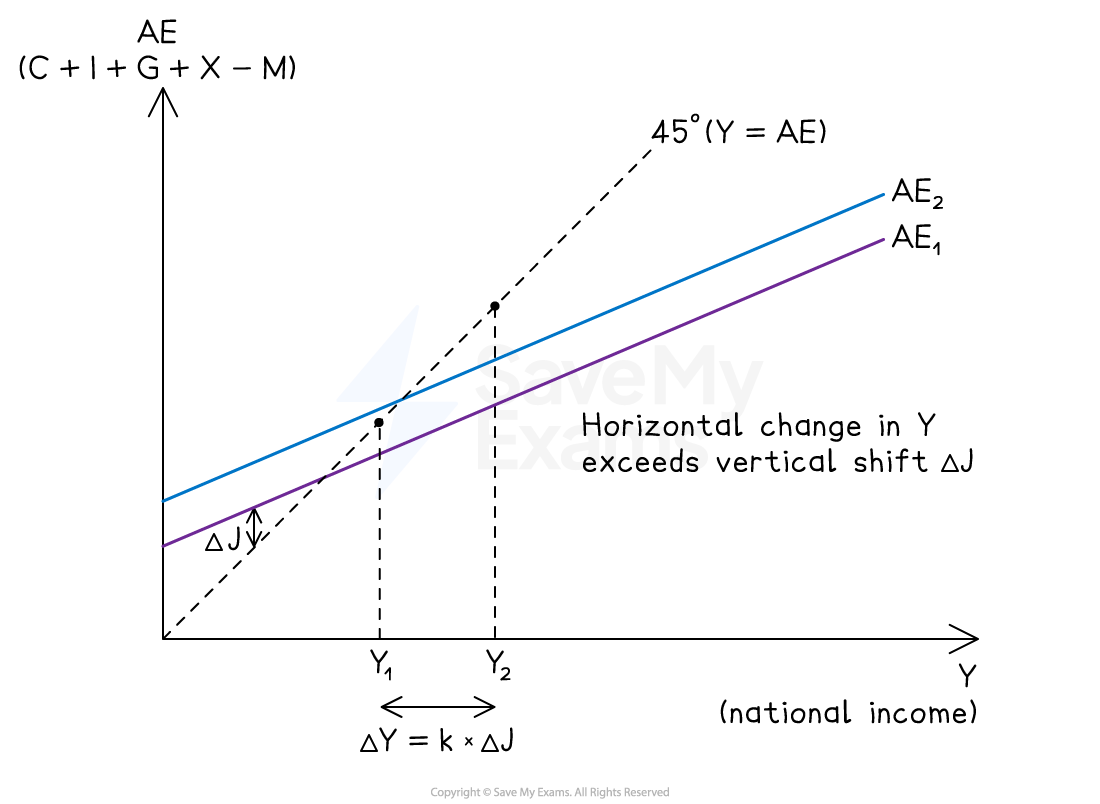
Diagram analysis
Equilibrium national income occurs at Y₁, where the AE curve crosses the 45-degree line
At this point, planned expenditure equals output and there is no pressure for income to change
A rise in any injection (investment, government spending or exports) shifts the AE curve vertically upward by the size of the injection, ΔJ
The new equilibrium forms at Y₂, further along the 45-degree line
The horizontal change in income (ΔY) is larger than the vertical shift (ΔJ) because each round of additional spending creates further rounds of income
The ratio ΔY ÷ ΔJ is the multiplier k
Provided spare capacity exists, firms raise output from Y₁ to Y₂ and employment rises
This is the graphical form of ΔY = k × ΔJ, and shows the multiplier mechanism most directly - the vertical shift is the cause, the horizontal change is the multiplied effect
AD/AS approach
The same multiplier process can be shown on an AD/AS diagram, using two successive rightward shifts of AD
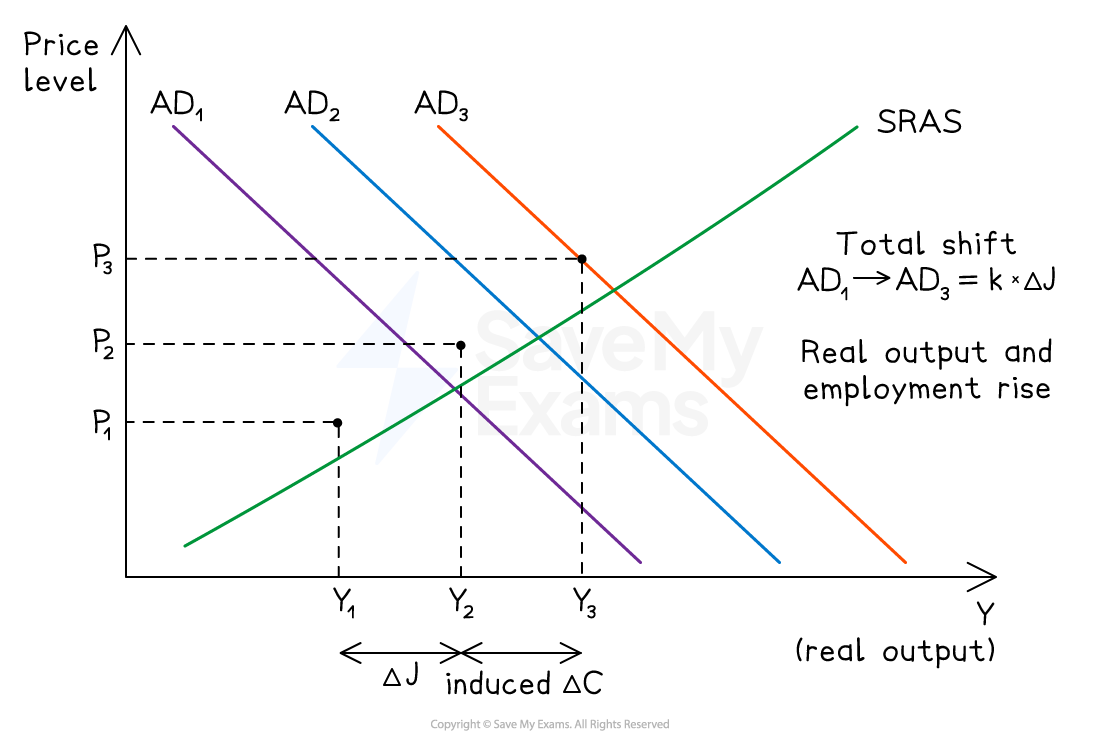
Diagram analysis
Initial equilibrium is at P₁Y₁, where AD₁ intersects SRAS
The initial injection shifts AD from AD₁ to AD₂, a rightward shift equal to ΔJ
The multiplier process then plays out through successive rounds of induced consumer spending, shifting AD further right from AD₂ to AD₃
The total horizontal shift from AD₁ to AD₃ equals k × ΔJ - the multiplied change in national income
At the new equilibrium P₃Y₃, real output is higher, employment has risen as firms expand to meet demand, and the price level has risen
The balance of output versus price effects depends on the slope of SRAS: with significant spare capacity, the gain is mostly in real output and employment
near full capacity most of the effect becomes inflationary with limited employment gains
Calculating the effect of changing AD on national income
Any change in a component of aggregate demand (C, I, G or X − M) feeds through the multiplier to produce a larger change in national income. The core calculation is:
ΔY = k × ΔJ
Worked Example
change in national income and employment
An open economy with a government has MPS = 0.1, MRT = 0.2, MPM = 0.1. The government announces a $50bn increase in infrastructure spending.
Step 1: Calculate the multiplier
Step 2: Calculate the change in national income
ΔY = 2.5 × $50bn = $125bn
Step 3: Interpret in AD/AS terms
AD shifts right by the full multiplied amount of $125bn, raising the equilibrium level of real output, raising the price level (if the economy has spare capacity, the price effect is smaller), and raising employment as firms hire to meet the higher demand
Evaluation and limitations
The multiplier is a powerful tool but rests on the following strong assumptions:
Assumes a stable MPC - in reality, MPC varies with income level, confidence and the phase of the economic cycle
Assumes spare capacity - if the economy is at or near full employment, the multiplied increase in AD translates into inflation rather than output growth
Ignores time lags - the full multiplier effect takes several quarters to work through; it is not instantaneous
Ignores crowding out - if the initial injection is government spending financed by borrowing, higher interest rates may reduce private investment, partially offsetting the multiplier
Small open economies have small multipliers - countries like Singapore or Ireland have very high MPMs, so domestic multipliers are close to 1; fiscal stimulus leaks abroad
The reverse multiplier amplifies downturns - a fall in exports or investment reduces national income by a multiple of the initial fall, which is why recessions deepen rapidly
Why do multiplier estimates vary internationally
IMF estimates of fiscal multipliers typically range from 0.5 to 2.5 depending on country and conditions. Multipliers tend to be larger in:
Large economies with low import dependence (e.g. the USA)
Economies in recession with significant spare capacity
Economies where monetary policy does not offset fiscal expansion
Multipliers tend to be smaller in:
Small, highly open economies (Singapore, the Netherlands)
Economies at or near full employment
Economies with high public debt where consumers save extra income in anticipation of future tax rises (Ricardian equivalence)
This variation is why blanket claims about fiscal policy effectiveness are rarely correct - the multiplier is context-dependent

Unlock more, it's free!
Join the 100,000+ Students that ❤️ Save My Exams
the (exam) results speak for themselves:

Was this revision note helpful?