Components of the Balance of Payments Accounts: (Cambridge (CIE) A Level Economics): Revision Note
Exam code: 9708

Components of the balance of payments accounts
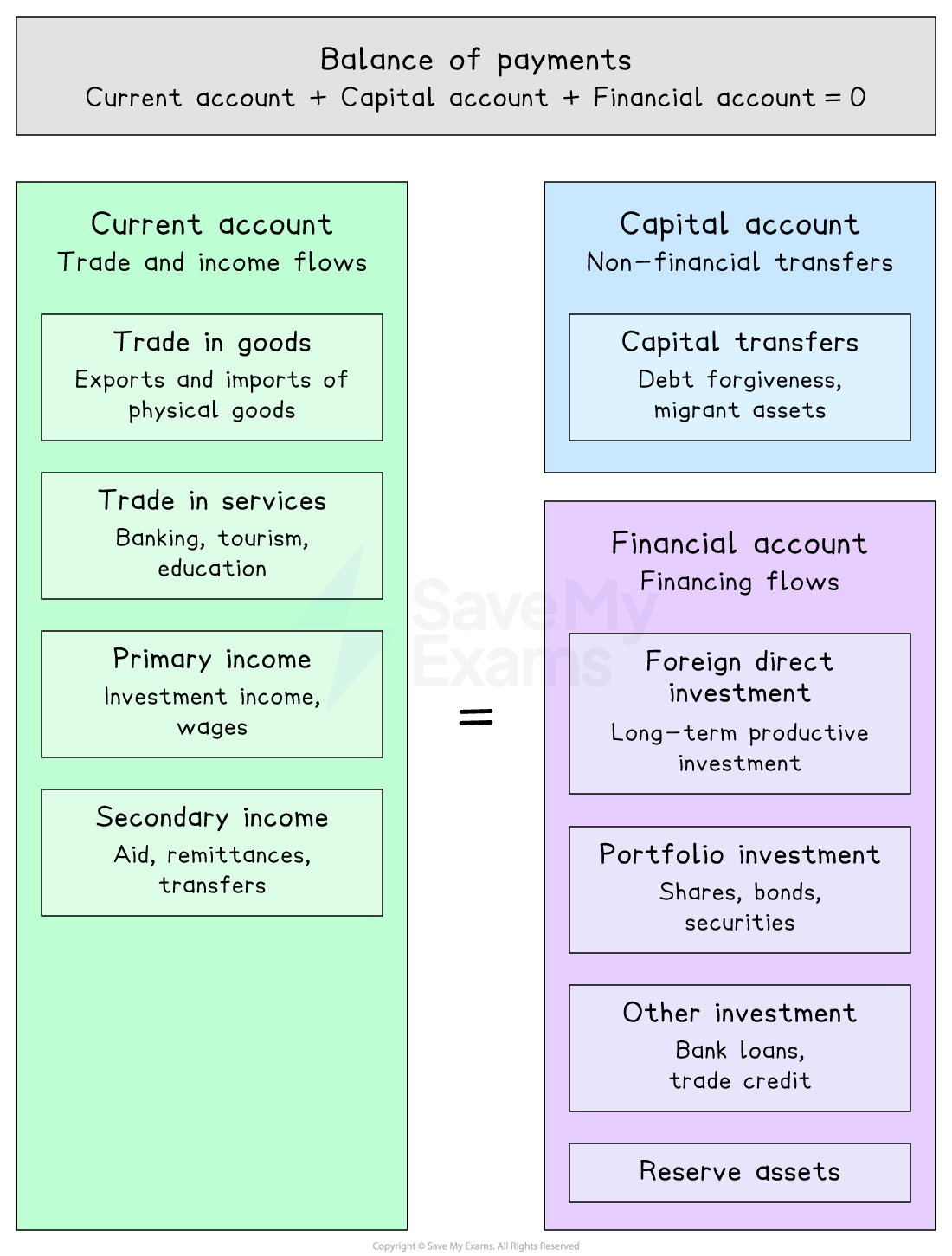
The balance of payments is a record of all financial transactions between a country and the rest of the world over a given time period - it must always balance as an accounting identity
The balance of payments has three main accounts:
the current account,
the financial account and,
the capital account
The current account
The current account was covered in detail in the AS Section, Components of the Current Account
It records trade in goods, trade in services, primary income and secondary income
A current account deficit means debits exceed credits - the country is a net payer of funds to the rest of the world
A current account surplus means credits exceed debits - the country is a net receiver of funds
The financial account
The financial account records flows of financial assets and liabilities between a country and the rest of the world - it finances imbalances on the current account
It has four main components:
Component | What it records | Example |
|---|---|---|
Foreign direct investment (FDI) |
|
|
Portfolio investment |
|
|
Other investment |
|
|
Reserve assets |
|
|
A current account deficit must be financed by a surplus on the financial account - either through attracting foreign investment, borrowing abroad or running down reserve assets
A current account surplus must be offset by a deficit on the financial account - the country is exporting capital, building up foreign asset holdings
The capital account
The capital account is the smallest of the three accounts - it records non-financial, non-produced asset transfers and capital transfers between countries
Examples include: debt forgiveness between governments, transfer of assets by migrants moving country, purchases and sales of intellectual property rights (patents, trademarks)
The capital account is typically very small relative to the current and financial accounts
How does the balance of payments balance?
The accounting identity
Current account + financial account + capital account = 0
In practice, measurement errors mean a balancing item (errors and omissions) is included to ensure the accounts balance
A current account deficit does not mean the overall balance of payments is in deficit - it means the financial and capital accounts must show a corresponding surplus to finance it
Worked Example
Which components are included in the current account and financial account of the balance of payments?
Current account | Financial account | |
|---|---|---|
A | Trade in goods | Official reserve assets |
B | Primary income and secondary income | Trade in goods |
C | Trade in goods and trade in services | Secondary income |
D | Trade in services and secondary income | Portfolio investment and official reserve assets |
Answer: D
Option D is correct - trade in services and secondary income are both current account items; portfolio investment and official reserve assets are both financial account items
Worked solution
Option A is incorrect - official reserve assets belong to the financial account, not the current account; trade in goods alone does not represent the full current account
Option B is the trap - primary income and secondary income are correctly identified as current account components, but trade in goods is a current account component, not a financial account component; students who confuse the two accounts may select this
Option C is incorrect - secondary income is a current account component, not a financial account component
Examiner Tips and Tricks
The balance of payments always balances as an accounting identity - a current account deficit must be matched by a surplus on the financial and capital accounts combined.
A common error is confusing which components belong to which account:
trade in goods and services, primary income and secondary income belong to the current account;
FDI, portfolio investment and reserve assets belong to the financial account;
capital transfers belong to the capital account.
In calculations, always identify the account before assigning credits or debits - money flowing in is a credit, money flowing out is a debit.

Unlock more, it's free!
Join the 100,000+ Students that ❤️ Save My Exams
the (exam) results speak for themselves:

Was this revision note helpful?
