Economic Integration (Cambridge (CIE) A Level Economics): Revision Note
Exam code: 9708

What is economic integration?
Economic integration occurs when countries reduce trade and other economic barriers between themselves and become more economically interdependent
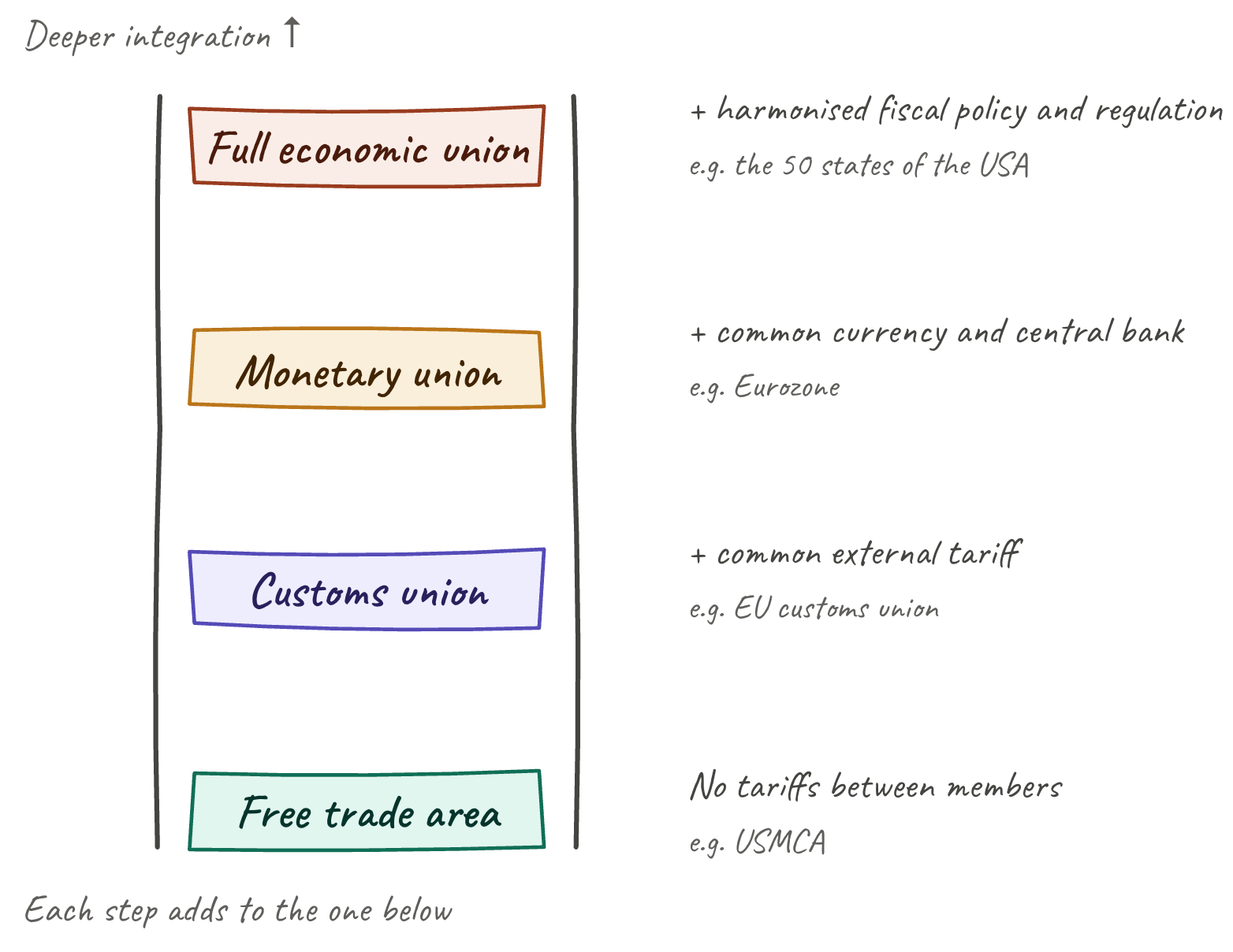
The syllabus requires students to distinguish between four forms of economic integration — each representing a deeper level of integration than the last
Form | Depth of integration |
|---|---|
Free trade area | Lowest |
Customs union | Increasing |
Monetary union | Increasing |
Full economic union | Highest |
Free trade area
A free trade area is an agreement between member countries to abolish tariffs and other trade barriers on goods and services traded between themselves
Each member retains its own independent trade policy with non-member countries
Members can set different external tariffs on the same good
This is the least integrated form — countries cooperate on mutual trade but remain free to trade externally on their own terms

Example: The United States-Mexico-Canada Agreement (USMCA)
Mexico, Canada and the USA have reduced/eliminated many trade restrictions between themselves
The USA refuses to trade with Cuba and has placed a complete ban on all exports/imports to Cuba
Canada trades with Cuba but imposes tariffs on all imports
Mexico trades freely with Cuba
Customs union
A customs union extends a free trade area by adding a common external tariff — all members agree to apply the same tariffs on imports from non-member countries
Goods and services are traded freely between members
Members lose the ability to set independent trade policies with non-members
The common external tariff is a key distinction from a free trade area

Countries in the European Union have eliminated all tariff barriers between themselves but impose common tariff barriers on third party countries such as the UK or China
Monetary union
A monetary union takes integration a step further by establishing a common currency and a single central bank that controls monetary policy for all members
Members share all the benefits of a customs union
A common currency eliminates exchange rate risk within the union and reduces transaction costs
Members lose independent monetary policy - they cannot set their own interest rates or adjust their exchange rate against other members
Example: The Eurozone
20 of the 27 EU members (as of 2023) use the euro as their common currency
The European Central Bank (ECB) sets monetary policy for the whole Eurozone
Worked Example
In which exchange rate regime would the central bank of a country be best able to pursue an independent monetary policy to control the rate of inflation?
A. a freely floating exchange rate system
B. a system where the country's currency has a targeted value in relation to the US$
C. a system where the central bank buys and sells foreign currency at a fixed rate
D. where the country participates in a monetary union with other countries
Answer: A
Independent monetary policy means a central bank can set its own interest rates to control inflation in its economy, without being constrained by the need to maintain a particular exchange rate or by monetary policy decisions made elsewhere.
A freely floating exchange rate leaves the central bank completely free to adjust interest rates — the exchange rate simply moves in response to market forces.
Worked solution
Option B is incorrect — targeting the currency against the US$ forces the central bank to use interest rates to defend the target; monetary policy becomes dedicated to the exchange rate, not inflation
Option C is incorrect — a fixed exchange rate removes monetary policy independence even more strictly, since interest rates must be set at whatever level maintains the fix
Option D is the trap — students may pick this because monetary unions are a Section 11 topic and seem most relevant; but in a monetary union, members have no independent monetary policy at all — a single central bank sets rates for the whole union
Full economic union
A full economic union is the deepest form of integration
Members share a common currency and harmonise fiscal policy, economic regulation and institutions across the union
Members share monetary policy (as in a monetary union)
Members also coordinate fiscal policy, with some transfers of tax and spending powers to union-level institutions
Regulations on labour, product standards, competition and the environment are harmonised
In effect, member economies operate as a single integrated economy
Example: No current trading bloc fully meets this definition — the EU comes closest but fiscal policy remains largely national. The clearest real-world example is the 50 states of the USA:
A common currency (the US dollar) used across all states
A common central bank (the Federal Reserve) setting monetary policy nationally
Coordinated fiscal policy through federal taxes and federal spending
Harmonised regulation on interstate commerce, labour law and product standards
Free movement of goods, services, capital and people between states
The USA illustrates what full economic union means in practice: member states operating as if they were regions of a single economy.
Benefits and costs of economic integration
Deeper integration brings greater potential benefits but also greater loss of national autonomy
Benefits
Benefit | Explanation |
|---|---|
Increased trade between members |
|
Lower prices and wider consumer choice |
|
Economies of scale |
|
Increased FDI |
|
Stronger bargaining power |
|
Costs
Cost | Explanation |
|---|---|
Loss of policy autonomy |
|
Trade diversion |
|
Asymmetric shocks |
|
Uneven distribution of gains |
|
Examiner Tips and Tricks
The strongest exam move is to present the four forms as a progression of deepening integration — each adds something to the previous. This structure is what mark schemes reward.
The key distinction between a free trade area and customs union is the common external tariff — customs unions have one, free trade areas do not. This distinction is frequently tested.
The key cost of monetary union is the loss of independent monetary policy — members facing different economic conditions cannot respond with their own interest rate or exchange rate adjustments. The Eurozone crisis (2010–12) is the classic example of this constraint in practice.
Use specific bloc examples: USMCA (free trade area), EU (customs union), Eurozone (monetary union). Avoid vague references to "trade blocs".
For synoptic depth, link to trade creation and trade diversion (11.6.3) — these are the main analytical tools for evaluating whether economic integration improves or reduces overall welfare.

Unlock more, it's free!
Join the 100,000+ Students that ❤️ Save My Exams
the (exam) results speak for themselves:

Was this revision note helpful?
