Role of IMF & World Bank (Cambridge (CIE) A Level Economics): Revision Note
Exam code: 9708

Introducing the IMF and World Bank
The International Monetary Fund (IMF) and the World Bank are two major international financial institutions that support member countries, but they have distinct roles.
Both institutions were established in 1944 as part of the post-war Bretton Woods system
Both are funded by member countries (almost all countries are members)
They work in complementary ways - the IMF focuses on short-term financial stability, while the World Bank focuses on long-term development
Role of the IMF
The IMF's core role is to promote global financial stability. It does this through three main activities:
Activity | Explanation |
|---|---|
Surveillance |
|
Lending |
|
Technical assistance |
|
IMF conditionality
IMF lending typically comes with conditions
These are policy reforms the borrowing country must implement in exchange for financial support. Common conditions include:
Austerity measures: cuts to public spending and tax rises to reduce fiscal deficits
Privatisation of state-owned enterprises
Currency devaluation or floating to correct overvalued exchange rates
Trade liberalisation and removal of subsidies
The rationale is that these reforms restore macroeconomic stability and the country's ability to repay
Conditionality is also one of the most controversial aspects of IMF lending
Critics argue that austerity can worsen poverty and that reforms may not suit the country's circumstances.
Examples of IMF lending
Sri Lanka (2023) — approximately US$3 billion bailout following the 2022 default
Argentina — multiple IMF programmes reflecting recurring debt crises
Ghana (2022) — US$3 billion programme following debt distress
Worked Example
The following are four conditions sometimes attached to IMF loans to developing countries. Which condition would conflict with the 'infant industry' argument?
A. the need to allow free trade
B. the need to control inflation
C. the need to have a contractionary fiscal policy
D. the need to privatise government enterprises
Answer: A
The infant industry argument states that new industries in developing countries need temporary protection from foreign competition until they achieve economies of scale and become internationally competitive.
This protection is typically provided through tariffs or import restrictions — the opposite of free trade. Any condition that removes trade protection directly conflicts with the argument.
Worked solution
Option A is correct — free trade removes the protection infant industries need; it exposes them immediately to established foreign competitors against whom they cannot yet compete
Option B is incorrect — controlling inflation benefits all firms, including infant industries, by maintaining price stability
Option C is incorrect — contractionary fiscal policy reduces aggregate demand but does not directly remove trade protection for infant industries
Option D is the trap — students may select this assuming any IMF condition conflicts with government support; but privatisation changes ownership, not the trade protection that the infant industry argument requires
Role of the World Bank
The World Bank's core role is to promote long-term economic development and poverty reduction in lower- and middle-income countries
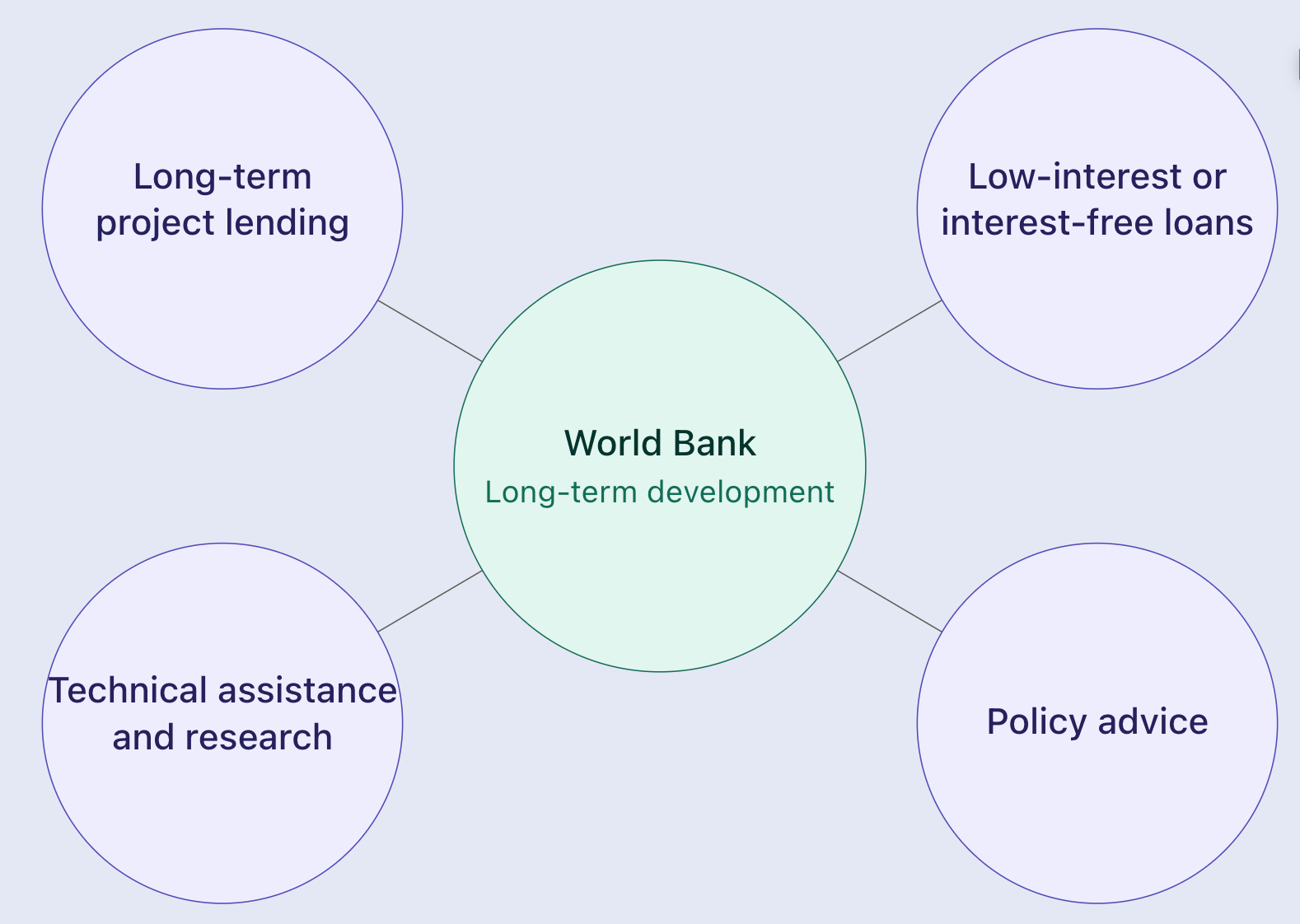
Activity | Explanation |
|---|---|
Long-term project lending |
|
Low-interest or interest-free loans |
|
Technical assistance and research |
|
Policy advice |
|
Examples of World Bank activity
Funding for transport infrastructure across Sub-Saharan Africa
Support for education and health programmes in South Asia and Latin America
Investment in renewable energy projects aligned with climate goals
Comparing the IMF and World Bank
Feature | IMF | World Bank |
|---|---|---|
Primary focus |
|
|
Typical lending |
|
|
Time horizon |
|
|
Typical borrower |
|
|
Conditions attached |
|
|
Evaluating the role of the IMF and World Bank
Positive contributions
Provide financial support that countries cannot access through private markets, particularly during crises
Support long-term investment in infrastructure and human capital that would otherwise be unaffordable
Offer technical expertise and policy advice based on global experience
Criticisms
Conditionality may worsen outcomes — austerity measures can deepen recessions and increase poverty in the short run
One-size-fits-all approach — critics argue policies are imposed without sufficient regard for local conditions
Governance concerns — voting power is weighted towards wealthier economies, raising questions about whose interests are prioritised
Long-term dependency — repeated programmes may reflect failure to address underlying problems rather than successful support
Examiner Tips and Tricks
The most common exam use of these syllabus points is as context in questions on other topics — especially debt, privatisation and government policy. You don't need to know institutional detail beyond the core distinction: IMF = short-term stability; World Bank = long-term development.
When discussing IMF conditionality, always acknowledge both sides - reforms may restore stability but may also impose short-term hardship. This balanced framing is what AO3 evaluation rewards.
A strong analytical move is to link these institutions to other syllabus points: IMF programmes often require privatisation and austerity; World Bank loans are a form of concessional external finance that complements aid and FDI.
Use country-specific examples: Sri Lanka, Argentina and Ghana for IMF programmes; Ethiopia, India and Vietnam have received substantial World Bank support for development projects. Vague references lose AO2 marks.

Unlock more, it's free!
Join the 100,000+ Students that ❤️ Save My Exams
the (exam) results speak for themselves:

Was this revision note helpful?
