Trade & Investment (Cambridge (CIE) A Level Economics): Revision Note
Exam code: 9708

Trade and investment in a development context
Trade refers to the import and export of goods and services between countries
Investment refers to spending on capital, infrastructure or productive assets, which may come from domestic or foreign sources
The way developing economies participate in trade and attract investment significantly shapes their development trajectory
Trade and investment are two of the main channels through which countries at different levels of development interact economically
They are alternatives to - and often complements of international aid
Foreign Direct Investment specifically is covered in a separate page
This note focuses on the broader role of trade and investment in development
The role of trade in development
Benefits of trade for developing economies
Benefit | Explanation |
|---|---|
Export-led growth |
|
Foreign exchange earnings |
|
Technology and knowledge transfer |
|
Economies of scale |
|
Job creation |
|
Challenges of trade for developing economies
Challenge | Explanation |
|---|---|
Commodity dependence |
|
Declining terms of trade |
|
Vulnerability to external shocks |
|
Trade barriers in developed markets |
|
Unequal bargaining power |
|
The role of investment in development
Investment is critical for development because it builds the productive capacity needed for long-run growth
Many low-income economies face a savings gap — domestic savings are too low to fund the level of investment needed for sustained growth, making external sources of finance important
Types of investment flows
Domestic investment
Funded from domestic savings and government spending
Foreign Direct Investment (FDI)
Long-term investment in physical assets by foreign firms (covered in a separate page)
Portfolio investment
Purchase of financial assets such as shares and bonds; more volatile than FDI and can reverse quickly
Public investment
Government spending on infrastructure, education and healthcare
For most developing economies, attracting external investment is essential to supplement limited domestic savings
But the type matters. Long-term productive investment supports development more reliably than short-term portfolio flows that can reverse rapidly during periods of financial stress
How trade and investment work together
Trade and investment are typically complementary rather than alternatives:
Trade liberalisation attracts investment — opening to trade signals to foreign investors that a country is integrating into the global economy
Investment supports trade competitiveness — investment in infrastructure (ports, roads, power) and human capital raises export capacity
Global value chains link the two — multinational firms invest in developing economies specifically to produce goods for export back to developed markets
The combination has been particularly important in East and Southeast Asia, where rapid development was driven by simultaneous opening to trade and attraction of foreign investment
Case Study
Vietnam's Trade and Investment-Led Development
The context
Vietnam emerged from decades of war and isolation as one of Asia's poorest economies in the late 1980s. The Doi Moi (Renovation) reforms launched in 1986 began the country's transition from a centrally planned to a market-oriented economy
Actions taken
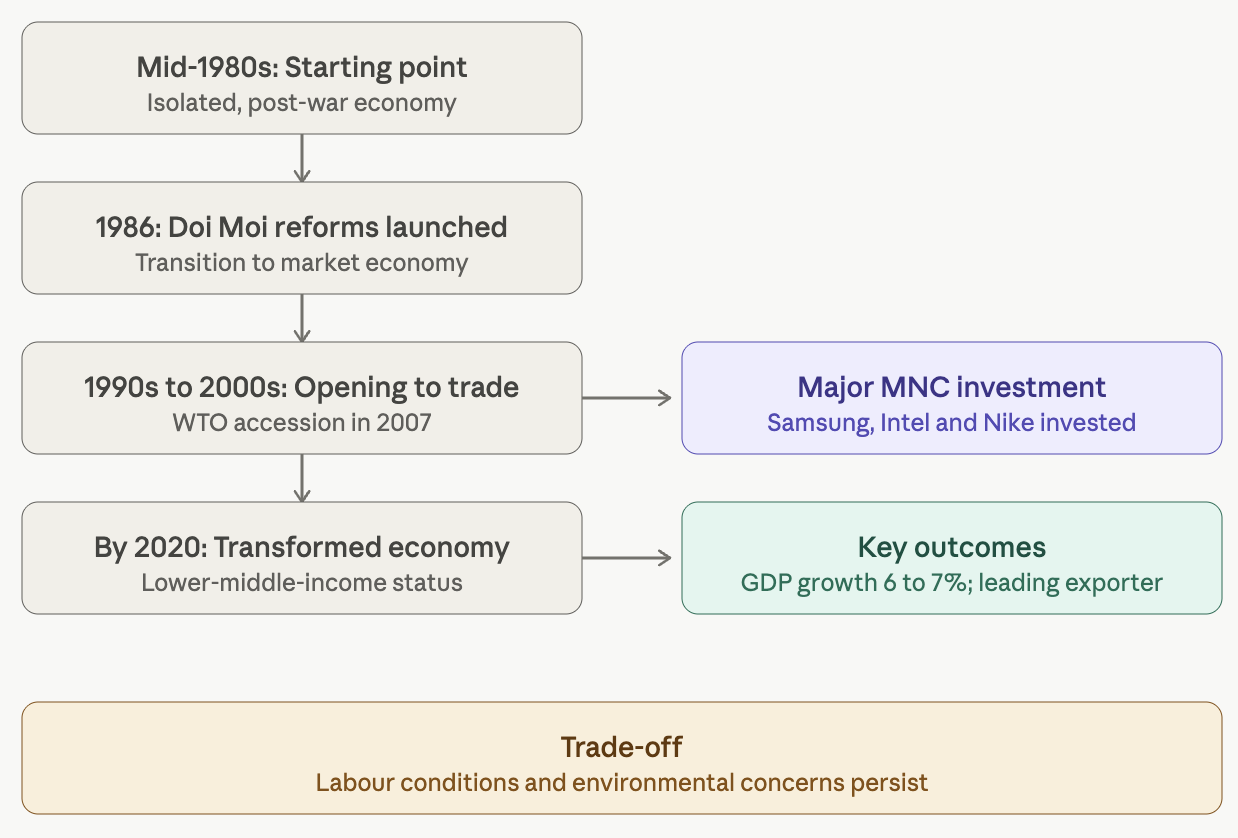
Progressive trade liberalisation through the 1990s, including normalising trade relations with the US (2001) and joining the World Trade Organization in 2007
Active courting of foreign investment through tax incentives, special economic zones and a stable policy environment
Major public investment in education, infrastructure and ports to support export competitiveness
Bilateral free trade agreements with the EU (2020), UK and participation in regional agreements (RCEP, CPTPP)
Outcomes
Real GDP growth averaged around 6–7% annually for over two decades
Vietnam became a leading global exporter of textiles, footwear, electronics and agricultural products
Major multinational manufacturers including Samsung, Intel and Nike established large operations
Vietnam moved from low-income to lower-middle-income status by 2010
Concerns persist regarding labour conditions, environmental impact and over-reliance on a few major export markets
Examiner Tips and Tricks
The strongest analytical point on trade and development is that commodity dependence leaves economies vulnerable — diversification of exports is widely viewed as critical for sustained development.
Always distinguish trade from aid, and from FDI — these are separate syllabus points and examiners reward clear differentiation rather than treating them as interchangeable.
For evaluation, the key tension is export-led growth versus vulnerability — trade and investment can drive rapid development (the East Asian model) but also create dependence on global conditions outside the country's control.
Use country-specific examples showing both successes (Vietnam, South Korea, Botswana) and challenges (commodity-dependent African economies, Latin American debt crises). Vague references to "developing countries" lose AO2 marks.

Unlock more, it's free!
Join the 100,000+ Students that ❤️ Save My Exams
the (exam) results speak for themselves:

Was this revision note helpful?
