Policies To Correct Imbalances on the Current Account (Cambridge (CIE) A Level Economics): Revision Note
Exam code: 9708

Government policy objective of stability of the current account
Current account stability refers to a government's objective of avoiding persistent and large imbalances - either deficits or surpluses - on the current account of the balance of payments
A persistent current account deficit is unsustainable in the long run as it requires continuous financing through the financial account - building up foreign liabilities and increasing future primary income outflows
A persistent current account surplus may attract international political pressure and reflect suppressed domestic consumption, reducing living standards below productive capacity
Governments therefore aim for a broadly balanced current account over time rather than targeting an exact figure in any single period
Achieving current account stability may cause conflicts
The objective of current account stability may conflict with other macroeconomic objectives
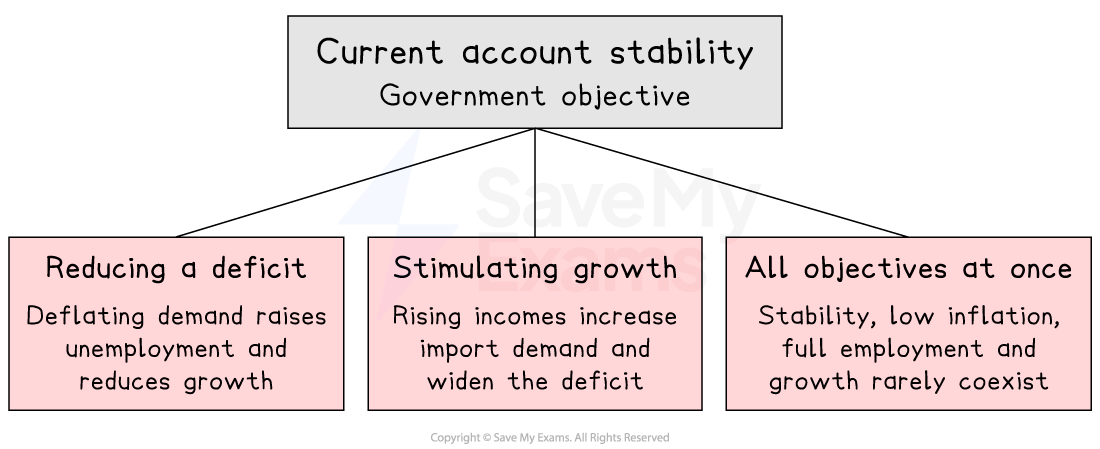
Policies to reduce a deficit (e.g. deflating domestic demand) may increase unemployment and reduce growth
Policies to stimulate growth may worsen the current account by increasing import demand
Achieving current account stability while maintaining low inflation, full employment and growth simultaneously is rarely possible - policy trade-offs are inevitable
Effect of fiscal policies on the current account
Contractionary fiscal policy (higher taxes, lower government spending) reduces domestic aggregate demand, lowering household incomes and reducing expenditure on imports
The current account deficit narrows as import spending falls
However, lower growth and higher unemployment are likely side effects - a significant policy trade-off
Expansionary fiscal policy worsens the current account as rising incomes pull in more imports
Fiscal policy works through the demand channel - it affects the current account indirectly by changing the level of domestic income rather than directly targeting trade competitiveness
Effect of monetary policies on the current account
Higher interest rates attract hot money inflows from foreign investors seeking better returns, increasing demand for the domestic currency and causing an appreciation
Appreciation makes exports more expensive and imports cheaper, tending to worsen the trade balance
However, higher interest rates also reduce domestic consumption and investment, lowering import demand - a partially offsetting effect
Lower interest rates cause depreciation of the exchange rate, making exports cheaper and imports dearer, tending to improve the trade balance
The effectiveness of monetary policy on the current account depends critically on price elasticities of demand for exports and imports
Effect of supply-side policies on the current account
Supply-side policies improve the current account by raising the productive efficiency and international competitiveness of domestic firms
Improved competitiveness lowers unit costs, making exports more price competitive in world markets and reducing dependence on imports
Examples include:
Investment in education and training - raises labour productivity, lowering unit labour costs
Research and development subsidies - encourages innovation, improving export quality and non-price competitiveness
Deregulation - reduces costs of production, improving efficiency
Supply-side policies address the structural causes of a current account deficit rather than merely suppressing demand - they are therefore regarded as the most sustainable long-run solution
The main limitation is that supply-side policies operate slowly - improvements in productivity and competitiveness take years to feed through into export performance
Effect of protectionist policies on the current account
Tariffs raise the price of imports, reducing import volumes and narrowing the trade deficit directly
Import quotas limit the volume of imports entering the country, directly reducing import expenditure
Export subsidies lower the price of exports in foreign markets, boosting export demand and improving the trade balance
Protectionist policies can improve the current account in the short run but carry significant risks:
Trading partners may retaliate with their own protectionist measures, reducing export demand and potentially worsening the current account
They reduce competitive pressure on domestic firms, allowing inefficiency to persist rather than addressing the underlying causes of the deficit
They may violate WTO rules, exposing the country to trade disputes and sanctions
Consumer welfare falls as import prices rise
Summary table of policy effects
Policy | Mechanism | Effect on current account | Key limitation |
|---|---|---|---|
Contractionary fiscal |
|
|
|
Lower interest rates / depreciation |
|
|
|
Supply-side |
|
|
|
Tariffs / quotas |
|
|
|
Export subsidies |
|
|
|
Worked Example
A government aims to reduce unemployment through expansionary fiscal policy and borrows more from commercial banks, increasing its borrowing requirement. What will be the result?
A. - a decrease in the budget deficit
B. - a decrease in the national debt
C. - an increase in the balance of payments deficit on the current account
D. - an increase in interest rates
Answer: D
When the government borrows more from commercial banks, it increases the demand for loanable funds in the financial system - competition for available funds pushes up the price of borrowing, which is the rate of interest
This is the crowding out mechanism - government borrowing competes with private sector borrowing, driving up interest rates and potentially reducing private investment
Worked solution
Option A is incorrect - borrowing more to fund expenditure increases the budget deficit, not decreases it
Option B is incorrect - additional borrowing adds to the national debt, not reduces it
Option C is the trap - students who know that expansionary fiscal policy increases incomes and therefore imports may select this; while this is a valid long-run consequence of expansionary fiscal policy, the direct and immediate result of increased government borrowing from commercial banks is upward pressure on interest rates, not a current account change
Examiner Tips and Tricks
When evaluating policies to correct a current account deficit, always consider both the mechanism and the limitations - a policy that improves the current account may simultaneously worsen other macroeconomic objectives.
Supply-side policy is generally the strongest evaluation point as it addresses the root causes of uncompetitiveness rather than suppressing demand or distorting trade.

Unlock more, it's free!
Join the 100,000+ Students that ❤️ Save My Exams
the (exam) results speak for themselves:

Was this revision note helpful?
