Expansionary & Contractionary Fiscal Policy (Cambridge (CIE) A Level Economics): Revision Note
Exam code: 9708

Expansionary fiscal policy
Expansionary fiscal policies include reducing taxes or increasing government spending with the aim of increasing AD
AD = household consumption (C) + firms investment (I) + government spending (G) + exports (X) - imports (M)
AD = C + I + G + (X - M)
Expansionary fiscal policy aims to shift aggregate demand (AD) to the right
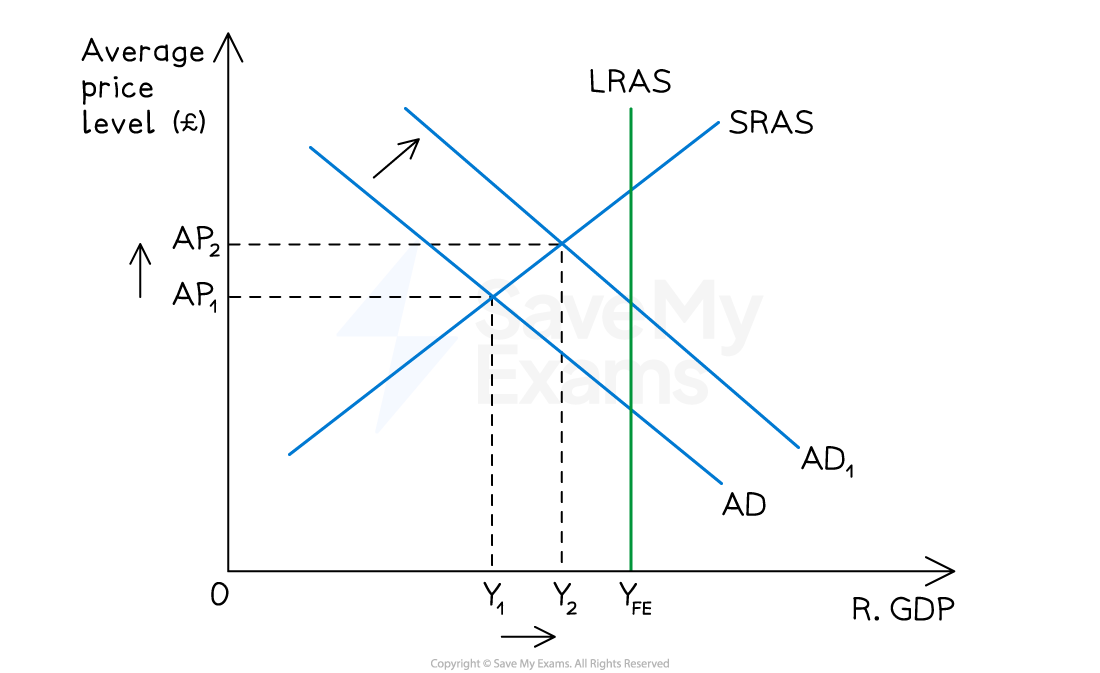
Diagram analysis
The economy is initially in macroeconomic equilibrium AP1Y1: there is a recessionary gap
The Government wants to boost economic growth and lowers the rate of income and corporation taxes
Lower taxes cause investment and consumption to increase, which are components of AD
Aggregate demand increases from AD→ AD1
The economy reaches a new equilibrium at AP2Y2 - a higher average price level and a greater level of national output
As real output rises from Y1 to Y2, firms require more workers to produce the higher level of output - employment rises and unemployment falls
Examples of the impact of expansionary fiscal policy
Example 1: The Government decreases corporation tax | |
|---|---|
Effect on the economy |
|
Impact on macroeconomic aims |
|
Example 2: The Government increases unemployment benefits | |
|---|---|
Effect on the economy |
|
Impact on macroeconomic aims |
|
Contractionary fiscal policy
Contractionary fiscal policies include increasing taxes or decreasing government spending with the aim of decreasing AD
AD= household consumption (C) + firms investment (I) + government spending (G) + exports (X) - imports (M)
AD = C + I + G + (X - M)
Changes to fiscal policy can influence government spending or consumption or investment
Changing taxation can influence household consumption and the investment by firms
Contractionary fiscal policies aims to shift aggregate demand (AD) to the left
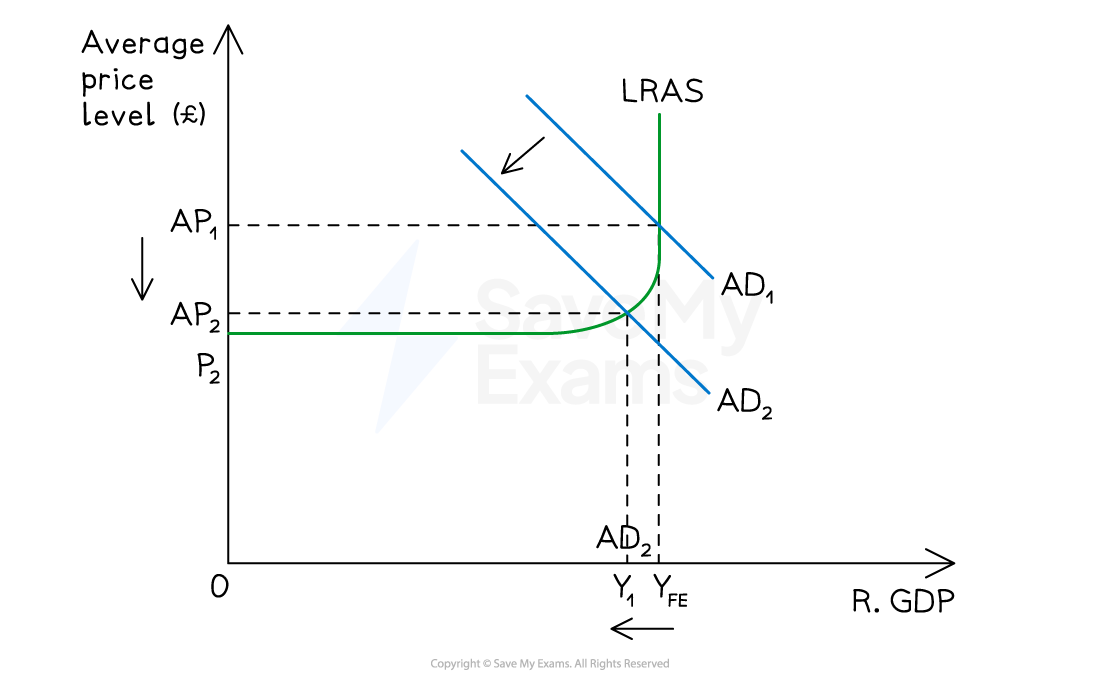
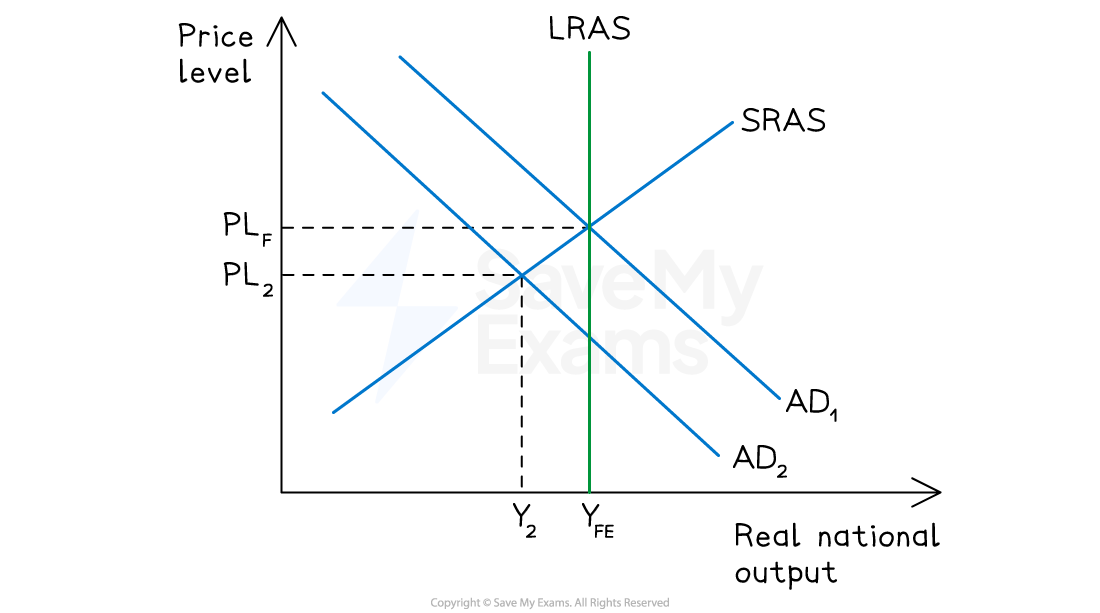
Diagram analysis
The economy is initially in macroeconomic equilibrium AP1YFE - an inflationary output gap is developing
The economy is booming and the Government wants to lower inflation towards its target of 2%
The Government increases the rate of income tax
Higher tax rates cause households to have less discretionary income, causing consumption to decrease
Aggregate demand decreases from AD1→ AD2
The economy reaches a new equilibrium at AP2Y1 - a lower average price level and a smaller level of national output
As real output falls from YFE to Y1, firms require fewer workers - employment falls and unemployment rises
Examples of the impact of contractionary fiscal policy
Example 1: The Government increases the rate of income tax | |
|---|---|
Effect on the economy |
|
Impact on macroeconomic aims |
|
Example 2: The Government freezes/reduces public sector workers pay | |
|---|---|
Effect on the economy |
|
Impact on macroeconomic aims |
|
Example 3: The Government cuts Government Spending in their Budget | |
|---|---|
Effect on the economy |
|
Impact on macroeconomic aims |
|
Worked Example
The government of a country plans to raise income tax rates. The initial equilibrium for the country is represented by point X on the diagram.
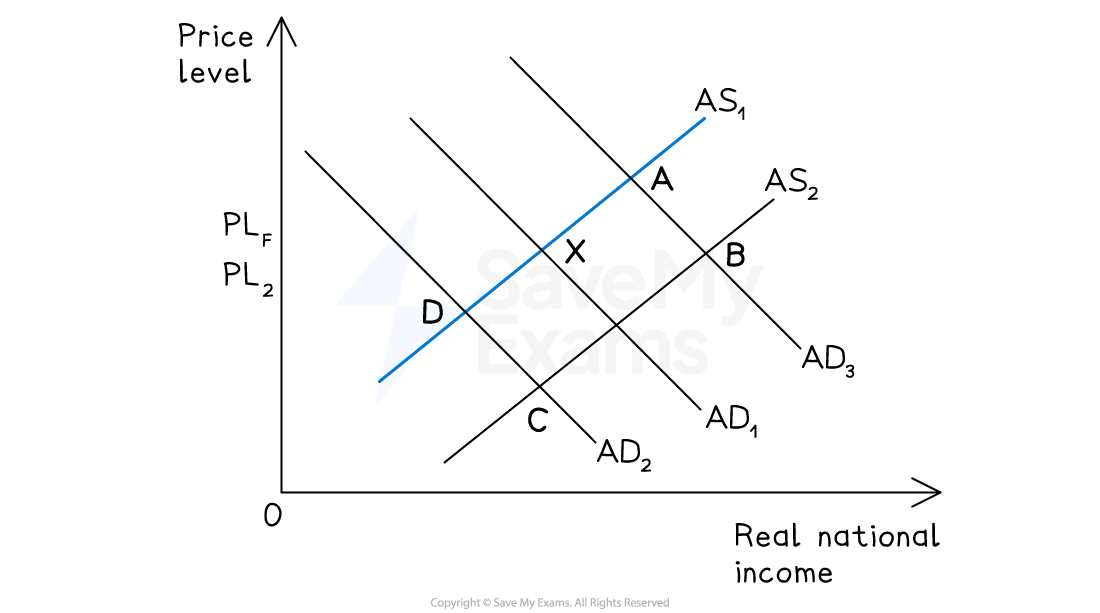
Which new equilibrium point would an economist predict as the result?
A B C D
Answer: D
Step 1: Work out which curve shifts, and which way
Raising income tax is contractionary fiscal policy. It reduces households' disposable income, so consumption (C), a component of AD, falls.
AD shifts left, from AD₁ to AD₂.
The AS curve does not shift, because income tax does not directly affect firms' costs of production.
Step 2: Find the new equilibrium
The new equilibrium is where the new AD curve (AD₂) crosses the original AS curve (AS₁).
It must be to the left of X, because real national income is lower.
The price level must also be lower, because AD has fallen along the same AS curve.
Point D is the only point where AD₂ meets AS₁, so D is the correct answer.
Ruling out the wrong answers
A: This is where AS₁ meets AD₃. It would need AD to rise, which comes from expansionary policy such as an income tax cut, not an income tax rise.
B: This is where AD₁ meets AS₂. AD hasn't moved here and AS has shifted right, which is the opposite of what an income tax rise does.
C: This is where AD₂ meets AS₂. AD falls correctly, but C also needs AS to shift right, and income tax does not shift AS.
The effect on all three variables
Real output falls: national income is lower.
The price level falls: inflationary pressure eases.
Employment falls: firms produce less and need less labour, so unemployment rises.
The trap is option C. Students who correctly shift AD left may also shift AS without a reason. C sits on the right AD curve (AD₂) but the wrong AS curve (AS₂). At AS Level, the main effect of income tax is on households' disposable income, and therefore on AD, not on productive capacity. Only one curve should move here.
Examiner Tips and Tricks
Always identify which curve shifts and why before locating the new equilibrium. Fiscal policy operates primarily through AD: tax cuts and spending increases shift AD right; tax rises and spending cuts shift AD left. The AS curve only shifts if the policy directly affects costs of production or productive capacity. Higher income tax can reduce the incentive to work, but unless the question points you towards this, treat a change in income tax as an AD shift only.
For the impact on all three variables, use the following framework when the AS curve slopes upwards: a rightward AD shift raises real output, raises the price level and raises employment; a leftward AD shift does the opposite.
The slope of the AS curve affects the size of each change. The flatter the AS curve, the larger the effect of an AD shift on output and the smaller the effect on the price level. The steeper the AS curve (as the economy nears full capacity), the smaller the output effect and the larger the price effect. If a question uses the Keynesian LRAS, remember the extremes: on the horizontal section, the price level barely changes; on the vertical section, only the price level changes.
Fiscal policy and aggregate supply
Many fiscal policies have the ability to improve the productive potential (supply-side) of an economy
E.g. Education subsidies to help the poorest households constitute an annual expenditure for the government
However, in the long term, they help to improve human capital, which boosts productivity and output
The fiscal policy is short-term (annually); however, the supply-side impact occurs in the long term

Unlock more, it's free!
Join the 100,000+ Students that ❤️ Save My Exams
the (exam) results speak for themselves:

Was this revision note helpful?
