Trade Creation & Trade Diversion (Cambridge (CIE) A Level Economics): Revision Note
Exam code: 9708

What are trade creation and trade diversion?
When countries form a customs union, they remove tariffs between members while imposing a common external tariff on non-members
This reallocates where imports come from, producing two opposite welfare effects: trade creation and trade diversion
The net welfare effect of a customs union depends on which dominates
Trade creation
Trade creation occurs when a customs union causes high-cost domestic production to be replaced by lower-cost imports from a partner country
Before the union, a tariff protected domestic producers, allowing inefficient domestic production to continue
After the union, the tariff on partner imports is removed, so consumers switch to cheaper imports from the partner
Resources are reallocated away from inefficient domestic production towards sectors where the country has a comparative advantage
This represents a net welfare gain — consumers pay lower prices and global output is produced more efficiently
Trade diversion
Trade diversion occurs when a customs union causes imports to shift from a lower-cost non-member producer to a higher-cost partner producer
Before the union, the country imported from the world's most efficient producer (paying the world price plus tariff)
After the union, the tariff is removed on partner imports but remains on non-member imports
Even if the partner is less efficient than the non-member, it can now undercut the non-member's tariff-inclusive price
Imports are diverted from the most efficient global producer to a less efficient partner
This represents a net welfare loss — global resources are used less efficiently, even though consumers may still pay a lower price than before
Welfare analysis
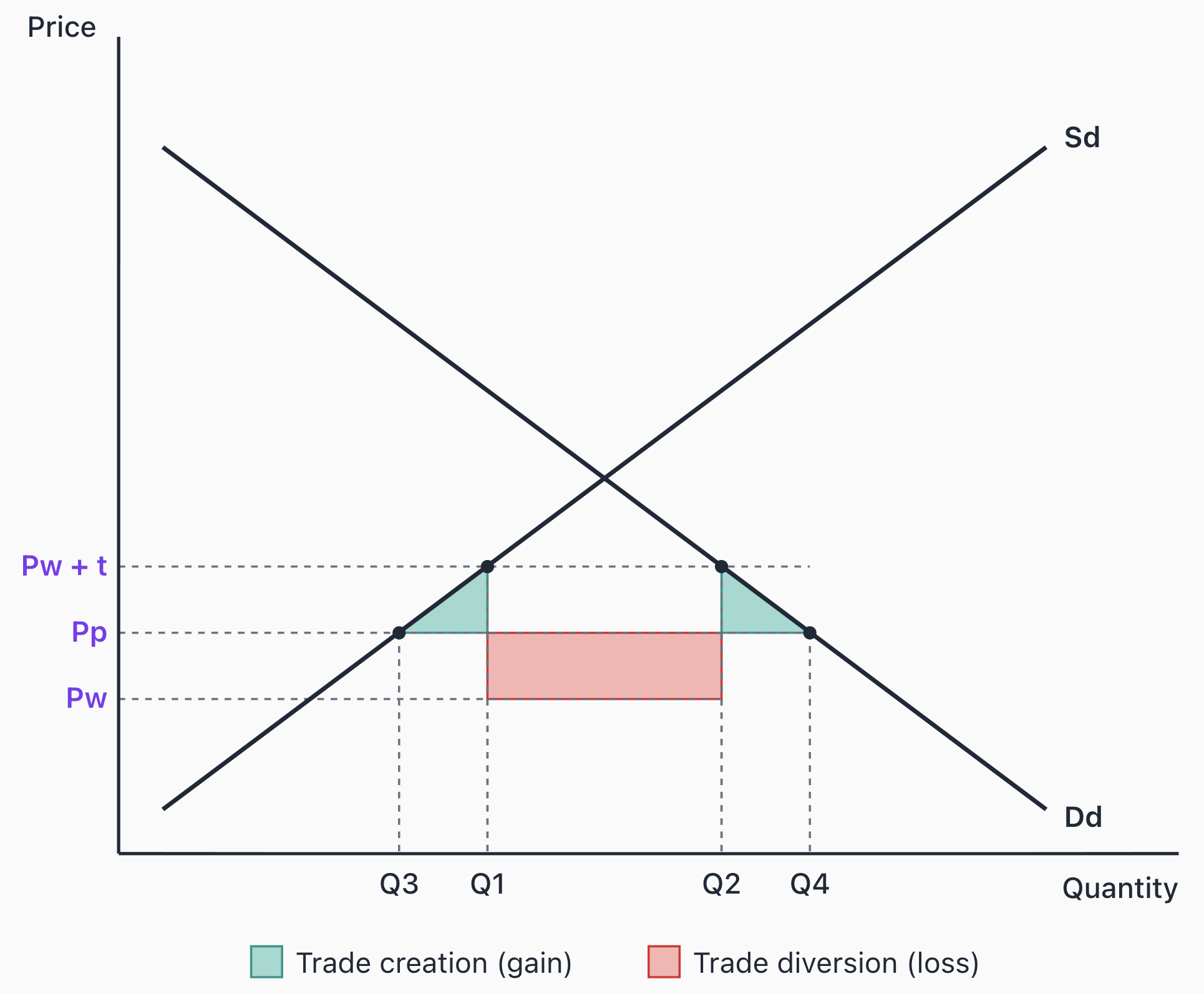
Diagram analysis
Before the customs union
Price is Pw + t (world price plus tariff)
Domestic producers supply Q1, consumers demand Q2
Imports (Q2 − Q1) come from the world's lowest-cost producer
Government receives tariff revenue = t × (Q2 − Q1)
After the customs union
Price falls to Pp (partner's price, below Pw + t but above Pw)
Domestic production contracts to Q3; consumption expands to Q4
All imports (Q4 − Q3) now come from the partner, not the world producer
Tariff revenue falls to zero
Trade creation (welfare gain) — shown by the two triangles
Production-side triangle: inefficient domestic production between Q3 and Q1 is replaced by lower-cost partner imports
Consumption-side triangle: additional consumption between Q2 and Q4 generates new consumer surplus
Trade diversion (welfare loss) — shown by the rectangle of width (Q2 − Q1) and height (Pp − Pw)
The original imports (Q2 − Q1) used to come from the world at price Pw
They now come from the partner at a higher price Pp
Society effectively loses the former tariff revenue without a compensating efficiency gain
Net welfare effect
If triangles > rectangle → trade creation dominates → net welfare gain
If rectangle > triangles → trade diversion dominates → net welfare loss
This result is ambiguous — it depends on the specific shapes of supply and demand, tariff levels, and the price gap between partner and world producers
International examples
Customs union / trade bloc | Empirical evidence on trade creation vs diversion |
|---|---|
European Union |
|
EU–Turkey Customs Union (1995) |
|
Mercosur (Argentina, Brazil, Paraguay, Uruguay) |
|
Worked Example
Country X imposes a 20% tariff on all imported wheat. It then forms a customs union with Country Y. Before the union, some domestic demand was met by Country X's producers and the rest was imported from Country Z, the world's lowest-cost producer. After the union, all imported wheat comes from Country Y at a price below Country Z's tariff-inclusive price but above Country Z's pre-tariff price.
Which of the following is most likely to have occurred?
A. Only trade creation; world welfare increases
B. Only trade diversion; world welfare decreases
C. Both trade creation and trade diversion; the net effect on world welfare is ambiguous
D. Neither trade creation nor trade diversion, since the tariff still applies to Country Z
Answer: C
Two effects occur simultaneously. Some of Country X's inefficient domestic wheat production is displaced by cheaper imports from Y — trade creation (welfare gain). At the same time, imports previously sourced from Z (the world's most efficient producer) now come from Y — trade diversion (welfare loss). The net effect on world welfare is ambiguous without information on the relative magnitudes
Worked solution
Option A is incorrect — it ignores the shift in imports from Country Z to Country Y, which is trade diversion
Option B is incorrect — it ignores the displacement of inefficient domestic production by partner imports, which is trade creation
Option D is the trap — students may pick this because the tariff on Country Z has not been removed. But trade diversion does not require the tariff to change; it occurs because Country Y's tariff-free price is now lower than Country Z's tariff-inclusive price, making Y more attractive even though Z is the more efficient producer globally
Examiner Tips and Tricks
The strongest analytical point is that the net welfare effect is ambiguous — it depends on the balance between trade creation and trade diversion. Avoid claiming integration is unambiguously good or bad.
In FTA and customs union essays, mark schemes typically reward a simpler tariff-removal diagram showing price falling from Pw + t to Pp with the consumer surplus gain shaded. Draw this in the exam and discuss trade creation and trade diversion verbally as AO3 evaluation

Unlock more, it's free!
Join the 100,000+ Students that ❤️ Save My Exams
the (exam) results speak for themselves:

Was this revision note helpful?
