Policies to Promote Economic Growth (Cambridge (CIE) A Level Economics): Revision Note
Exam code: 9708

Introduction: two types of growth
Actual growth - is an increase in real GDP from using existing resources more fully (AD-driven, short-run)
Potential growth - is an increase in productive capacity of the economy (LRAS-driven, long-run)
Policies to promote growth fall into two categories:
Demand-side policies (fiscal and monetary)
These primarily boost actual growth by shifting AD right
Supply-side policies (market-based and interventionist)
These primarily boost potential growth by shifting LRAS right
Effective long-run growth strategy usually requires a combination of both
1. Demand-side policies
Expansionary fiscal policy
Increase in government spending (G) or cuts in taxation (T) raise AD
Higher disposable income raises consumption (C); lower corporation tax raises investment (I)
Multiplier effect amplifies the initial injection
Expansionary monetary policy
Cut in interest rates reduces cost of borrowing and return on saving
Raises consumption (C) — households borrow more, save less
Raises investment (I) — firms face lower cost of capital
Quantitative easing increases money supply and lowers long-term yields
Currency may depreciate, raising net exports (X-M)

Diagram analysis: demand-side policies
Economy is initially in equilibrium at AP₁Y₁ with a negative output gap (Y₁YFE)
Expansionary demand-side policy shifts AD right from AD₁ to AD₂
Real GDP rises from Y₁ to Y₂ and the average price level rises from AP₁ to AP₂
Employment rises as firms hire more workers to meet the higher output
The negative output gap narrows and the economy moves closer to full employment
2. Supply-side policies
Market-based supply-side policies
Rely on market forces and incentives to improve efficiency
Key tools:
Cuts in income tax and corporation tax to incentivise work and investment
Deregulation to reduce costs and encourage competition
Privatisation to improve efficiency through profit incentive
Trade union reform to improve labour market flexibility
Reducing unemployment benefits to incentivise job search
Interventionist supply-side policies
Rely on direct government action to expand productive capacity
Key tools:
Government spending on education and training to raise human capital
Infrastructure investment (transport, energy, digital) to raise productivity
Subsidies for R&D to promote innovation and technological progress
Industrial policy to support strategic sectors

Diagram analysis: supply-side policies
The economy is initially at full employment equilibrium AP₁YFE1
Successful supply-side policy shifts LRAS right from LRAS₁ to LRAS₂ (and SRAS right)
Real GDP rises from YFE1 to YFE2 — an increase in potential output
Average price level falls from AP₁ to AP₂ — non-inflationary growth
Employment rises as productive capacity expands and new jobs are created
The effectiveness of each policy
Policy | Strengths | Weaknesses |
|---|---|---|
Fiscal (expansionary) |
|
|
Monetary (expansionary) |
|
|
Market-based supply-side |
|
|
Interventionist supply-side |
|
|
Key evaluation points
Short-run vs long-run: demand-side policies deliver faster results but may be inflationary; supply-side policies are slower but produce sustainable, non-inflationary growth
State of the economy matters:
In recession (spare capacity) — demand-side policies most effective as AD is the constraint
At full employment — supply-side policies essential as LRAS is the constraint
Policy trade-offs: expansionary policies may worsen inflation, current account deficit, or government debt
Keynesian vs Classical view:
Keynesians favour demand-side intervention when economy is below full employment
Classicals argue only supply-side policies can raise long-run growth; demand-side policies are purely inflationary in the long run
Combined approach: most economies use a mix - monetary policy for short-run stabilisation, supply-side for long-run capacity
Worked Example
South Korea's growth strategy (1960s - 2000s)
The context
In the 1960s, South Korea was one of the poorest countries in the world, with GDP per capita below many sub-Saharan African economies. By 2020, it had become a high-income economy and member of the OECD, with GDP per capita exceeding US$30,000.
The policy mix
South Korea's government pursued a long-term interventionist supply-side strategy:
Heavy public investment in education — literacy rose from around 22% in 1945 to near-universal by the 1980s
State-directed investment in heavy industry (steel, shipbuilding, electronics) through subsidised credit to chaebol (conglomerates such as Samsung and Hyundai)
Infrastructure investment in transport, ports and telecommunications
R&D spending rose from under 0.5% of GDP in the 1970s to over 4% by 2020 — among the highest in the world
The outcome
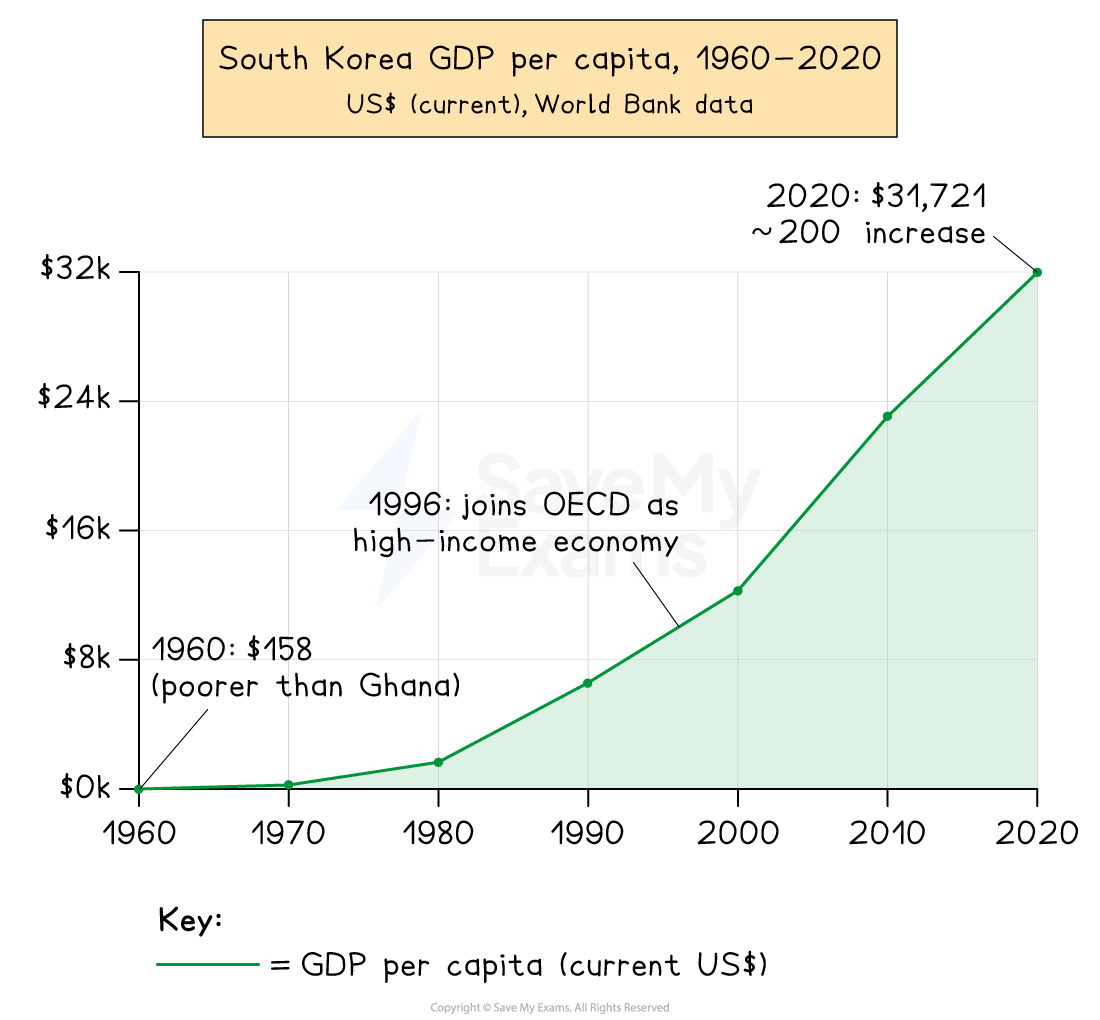
Real GDP grew at an average rate of around 7% per year between 1960 and 1997 — one of the fastest sustained growth rates in history
LRAS shifted dramatically rightward over decades as human and physical capital accumulated
Employment rose as the economy industrialised and moved workers from agriculture into manufacturing and services
What this illustrates
South Korea demonstrates that interventionist supply-side policies, sustained over decades, can transform an economy's productive capacity. Crucially, growth was driven by LRAS expansion rather than AD stimulus — producing non-inflationary, sustainable growth
Examiner Tips and Tricks
When a question asks about policies to promote growth, always distinguish between actual and potential growth from the outset. Demand-side policies primarily raise actual growth by closing a negative output gap - supply-side policies raise potential growth by expanding productive capacity. Confusing these loses analysis marks.
For 12-mark "assess" questions, always evaluate each policy's effectiveness using at least two criteria: time lags, the state of the economy (spare capacity vs full employment), and policy conflicts (inflation, debt, current account). A one-sided answer - e.g. "supply-side policies are best because they are non-inflationary" - caps your AO3 at Level 1.
Top-band answers compare policies directly and reach a supported judgment. For example: "In a recession with spare capacity, fiscal policy is likely more effective because the multiplier raises output without triggering inflation — but in an economy near full employment, supply-side policies are essential because further AD stimulus would simply cause inflation." Always link your judgment to the specific economic context given in the question.

Unlock more, it's free!
Join the 100,000+ Students that ❤️ Save My Exams
the (exam) results speak for themselves:

Was this revision note helpful?
