Expenditure-Switching & Expenditure-Reducing Policies (Cambridge (CIE) A Level Economics): Revision Note
Exam code: 9708

Expenditure-switching policies
Policies to correct a current account deficit can be classified into two broad categories - expenditure-switching and expenditure-reducing - a distinction that is central to A Level evaluation
Expenditure-switching policies aim to redirect domestic and foreign expenditure away from imports and towards domestically produced goods and services, without necessarily reducing the total level of spending in the economy
They work by changing relative prices - making imports more expensive or domestic goods more competitive
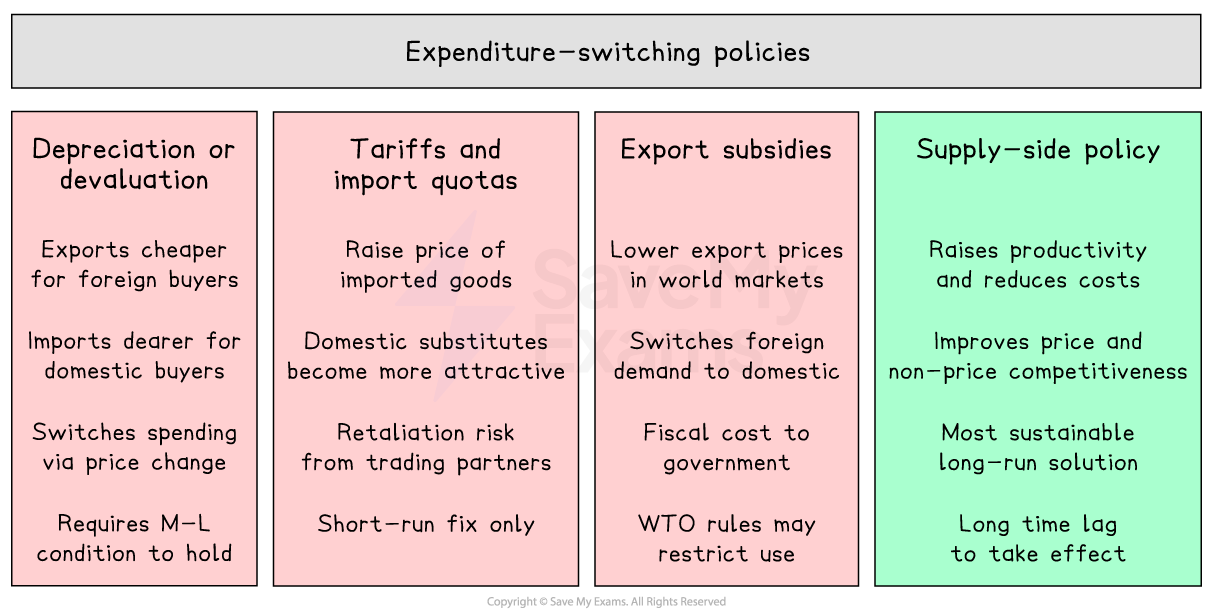
Depreciation or devaluation of the exchange rate
Makes exports cheaper for foreign buyers and imports dearer for domestic consumers
Tariffs and import quotas
Raises the price of imported goods relative to domestic substitutes
Export subsidies
Lowers the price of exports in world markets, switching foreign expenditure towards domestic goods
Supply-side policies
Improves productivity and reduce unit costs, switching both domestic and foreign expenditure towards domestically produced goods through improved price and non-price competitiveness
Expenditure-switching policies can improve the current account without reducing domestic output and employment
They redirect spending rather than reduce it
Their effectiveness depends on price elasticities of demand
If demand for imports and exports is inelastic, switching will be limited
Worked Example
A government decides to devalue its currency to reduce a deficit on the current account of the balance of payments. How should this policy be classified?
A. - an expenditure-reducing policy
B. - an expenditure-switching policy
C. - the law of comparative advantage
D. - the Marshall-Lerner condition
Answer: B
Devaluation works by changing relative prices - exports become cheaper in foreign currency terms and imports become dearer in domestic currency terms, redirecting domestic and foreign spending towards domestically produced goods without necessarily reducing the total level of expenditure in the economy
This is the defining characteristic of an expenditure-switching policy: it switches the composition of spending rather than reducing it
Worked solution
Option A is the trap - students who know that contractionary fiscal policy and contractionary monetary policy also reduce the current account deficit may over-generalise and classify all CA policies as expenditure-reducing; but these work through cutting total AD, not through price switching
Option C is incorrect - comparative advantage explains the basis for trade, not a policy mechanism
Option D is incorrect - the Marshall-Lerner condition is a prerequisite for devaluation to work (the combined PED for exports and imports must exceed 1), not a classification of the policy itself; confusing a condition with a policy type is a common exam error
Expenditure-reducing policies
Expenditure-reducing policies aim to reduce the total level of domestic aggregate demand, which automatically lowers import spending as incomes fall
They work through the income effect - as domestic incomes fall, households spend less on all goods, including imports
Examples include:
Contractionary fiscal policy - higher taxes and lower government spending reduce disposable income and aggregate demand
Contractionary monetary policy - higher interest rates reduce consumption and investment, lowering aggregate demand and import spending
Expenditure-reducing policies are reliable in reducing imports - but carry significant costs:
Lower growth and rising unemployment as domestic demand falls
Potential deflation if demand falls sharply
The current account improves but at the cost of other macroeconomic objectives - a major policy trade-off
Comparing the two policies
Expenditure-switching | Expenditure-reducing | |
|---|---|---|
Mechanism |
|
|
Effect on output |
|
|
Effect on employment |
|
|
Effectiveness |
|
|
Time lag |
|
|
Examples |
|
|
In practice, governments often use a combination of both approaches - expenditure-switching to improve competitiveness while using expenditure-reducing measures to prevent the economy from overheating if the switch in spending creates excess demand
Examiner Tips and Tricks
When asked to assess policies to correct a current account deficit, always classify each as switching or reducing and explain the trade-offs.
Switching is preferable with spare capacity - it improves the current account without sacrificing growth.
Reducing suits excess demand but carries output and employment costs. The strongest evaluative point is that supply-side policy is uniquely both switching and supply-expanding - making it the most sustainable long-run solution.

Unlock more, it's free!
Join the 100,000+ Students that ❤️ Save My Exams
the (exam) results speak for themselves:

Was this revision note helpful?
