Price Controls, Production Quotas & Prohibitions (Cambridge (CIE) A Level Economics): Revision Note
Exam code: 9708

Price controls, production quotas and licences
These policies all work by directly restricting price or quantity in a market, rather than using fiscal measures such as taxes or subsidies
They are used when governments judge that the price mechanism alone is producing a socially undesirable outcome - either too high a price, too low a price, or too great a quantity of a harmful good
At A Level, the focus is on allocative efficiency: do these interventions move output closer to or further from the socially optimal level where MSB = MSC?
Maximum prices (price ceilings)
A maximum price is set below the free-market equilibrium price
Sellers cannot legally charge above this price
Governments use maximum prices to:
Make essential goods and services more affordable, particularly for low-income consumers
Increase consumption of merit goods towards the socially optimal level
Prevent monopoly exploitation in markets where a single supplier would otherwise charge very high prices
International examples of maximum prices
Argentina: the government has imposed maximum prices on basic foodstuffs such as flour, cooking oil and rice to protect low-income households from inflation - though both cases led to severe shortages
Nigeria: the government has at various points imposed maximum prices on petrol to keep fuel affordable, given the country's heavy dependence on petroleum products

Diagram analysis
The free-market equilibrium is at PeQe
A maximum price is imposed at Pmax, below Pe
The lower price reduces the incentive to supply - quantity supplied contracts from Qe → Qs
The lower price increases the incentive to consume - quantity demanded extends from Qe → Qd
This creates excess demand (shortage) equal to Qs Qd
The shortage may lead to:
Non-price rationing: queuing, waiting lists or favouritism
Black markets: illegal trade at prices above Pmax
Consumer surplus increases for those who successfully purchase at the lower price
Producer surplus falls as the price received is below the free-market level
Minimum prices (price floors)
A minimum price is set above the free-market equilibrium price
Sellers cannot legally charge below this price
Governments use minimum prices to:
Protect producers from excessively low prices, particularly in agricultural markets
Reduce consumption of demerit goods by raising their price above the free-market level
Protect workers from exploitation - minimum wages are a form of price floor in the labour market
International examples of minimum prices
Agricultural price floors: the EU's Common Agricultural Policy (CAP) has historically set minimum prices for agricultural products to guarantee farmer incomes - though this led to well-known surplus problems ("butter mountains", "wine lakes")
Demerit goods: Thailand and South Africa have introduced minimum unit pricing on alcohol to reduce consumption and the associated negative externalities of harmful drinking
Minimum wages: Mexico, Brazil and South Africa all operate national minimum wages as a price floor in the labour market, aiming to reduce poverty and income inequality
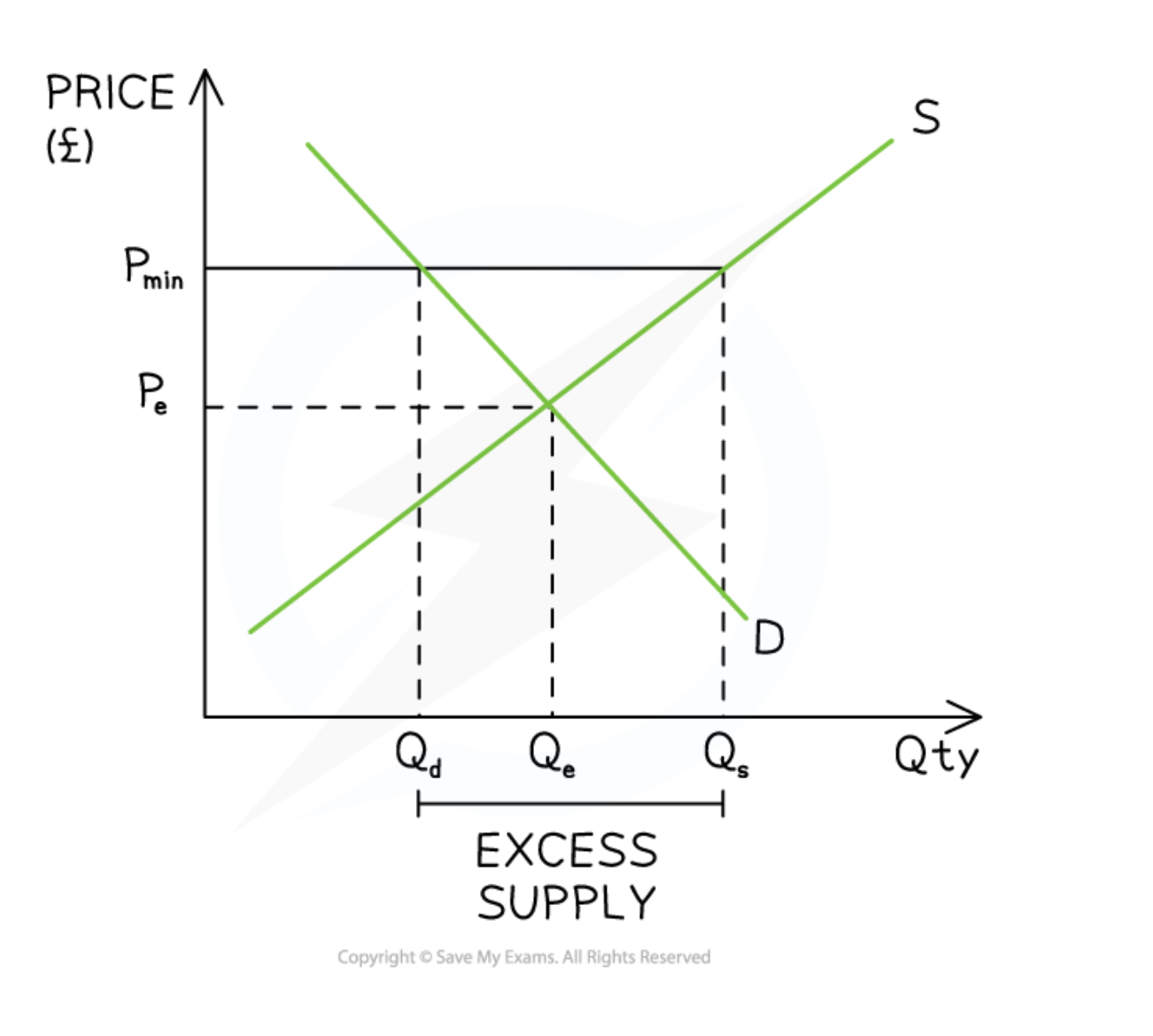
Diagram analysis
The free-market equilibrium is at PeQe
A minimum price is imposed at Pmin, above Pe
The higher price increases the incentive to supply — quantity supplied extends from Qe → Qs
The higher price reduces the incentive to consume — quantity demanded contracts from Qe → Qd
This creates excess supply (surplus) equal to Qd Qs
In demerit good markets, the reduced consumption moves output closer to the socially optimal level - provided Pmin is set appropriately
In agricultural markets, governments may purchase the excess supply at the guaranteed price, storing or exporting it - this represents a significant fiscal cost
Producer surplus increases; consumer surplus falls
Production quotas
A production quota is a legal limit on the quantity a producer is permitted to supply
Quotas work by directly restricting output rather than adjusting price, shifting the effective supply curve to become perfectly inelastic at the quota level
They are used to:
Reduce output of goods generating negative externalities of production
Manage common pool resources to prevent over-exploitation
Support producer prices in agricultural markets
International examples of production quotas
OPEC oil quotas: member countries including Saudi Arabia, UAE and Iraq agree production quotas to restrict global oil supply and support prices — a form of cartel behaviour with significant global macroeconomic implications
Fishing quotas: the EU, Norway and Iceland impose catch quotas on fishing fleets to prevent over-exploitation of fish stocks — a classic common pool resource problem
Carbon quotas: under cap-and-trade systems such as the EU Emissions Trading System, firms are allocated production quotas for carbon emissions, restricting total output of a negative externality
Prohibitions
A complete prohibition is the most extreme form of quantity restriction - output is reduced to zero in the legal market
Used for goods whose consumption generates severe negative externalities or where consumption is judged to be entirely socially undesirable
International examples:
Illegal drugs: most countries prohibit the production and sale of substances such as heroin and cocaine, though the effectiveness of prohibition is widely debated
Ivory trade: the CITES international agreement prohibits trade in elephant ivory to protect endangered species — an example of a global externality being addressed through prohibition
Asbestos: banned in over 60 countries including throughout the EU, Japan and Australia due to the severe health externalities of production and consumption
Licences
Licences allow governments to control the number and quality of suppliers without eliminating the market entirely
They restrict supply, raising price and reducing quantity — similar in effect to a quota but with quality control built in
International examples:
Alcohol licences: most countries require sellers of alcohol to hold a government licence, limiting the number of outlets and reducing accessibility of a demerit good
Broadcasting licences: governments licence broadcasters to control content and prevent market failure from the public good characteristics of the broadcast spectrum
Taxi and transport licences: cities including Singapore, Tokyo and Mexico City licence taxi operators to control supply and maintain service quality
Evaluating price controls, quotas, prohibitions and licences
Allocative efficiency
All of these policies create a wedge between the market price and the equilibrium price, or restrict output below or above the free-market level
They improve allocative efficiency only if they move output closer to the socially optimal level where MSB = MSC
If set incorrectly, they can worsen the misallocation of resources - a form of government failure
The problem of setting the correct level
Governments face the same fundamental information problem as with taxes and subsidies: they need to know the socially optimal price or quantity, which is extremely difficult to measure
For example, fishing quotas in many countries have been set too high relative to the sustainable yield, failing to prevent overfishing - the EU's quota system has faced persistent criticism on these grounds
Unintended consequences
Maximum prices and prohibitions frequently generate black markets, where goods are traded illegally at prices above the legal maximum or without government oversight
Venezuela's price controls on food created extensive black market activity
Drug prohibition in many countries has given rise to large illegal markets with associated crime and violence
Minimum prices and quotas can lead to excess supply that must either be purchased by the government at significant fiscal cost or destroyed
Time and the key concept
The effectiveness of these policies often changes over time
In the short run, supply and demand tend to be more inelastic, so price controls have a smaller effect on quantities
In the long run, producers and consumers adjust - shortages worsen under maximum prices as supply contracts further, and black markets grow
Equity
Maximum prices on essential goods improve equity in the short run by making goods affordable for low-income consumers
However, if shortages result, it is often higher-income or better-connected consumers who access the scarce supply - undermining the equity objective
Minimum wages as a price floor are generally pro-equity, raising incomes of the lowest-paid workers, though critics argue they may reduce employment if set too high
Examiner Tips and Tricks
For evaluation, the strongest analytical point for any of these policies is the information problem: governments cannot observe the true socially optimal price or quantity, so all interventions risk being set incorrectly and creating government failure
Link time explicitly to your evaluation: in the short run supply and demand are more inelastic, so the effects of price controls are more muted — but in the long run, shortages and surpluses tend to worsen as producers and consumers fully adjust
For prohibitions, always acknowledge the black market problem: a prohibition reduces legal supply to zero but does not eliminate demand, so illegal markets emerge. This is a particularly strong evaluative point because it shows the policy may worsen outcomes

Unlock more, it's free!
Join the 100,000+ Students that ❤️ Save My Exams
the (exam) results speak for themselves:

Was this revision note helpful?
