Components of Aggregate Demand: Consumption & Saving (Cambridge (CIE) A Level Economics): Revision Note
Exam code: 9708

Bridge from AS Level
At AS Level the components of AD were introduced as the identity AD = C + I + G + (X − M), with determinants listed but not explored in technical depth
At A Level, each component is modelled more formally
Consumption and saving are split into autonomous and induced parts and written as functions of income
Autonomous versus induced expenditure
A key distinction is between autonomous and induced spending:
Autonomous spending is independent of the current level of national income
It occurs even when Y = 0 and is driven by factors outside the income-expenditure model (interest rates, expectations, government policy)
Induced spending varies directly with national income
As Y rises, induced spending rises in proportion
Every component of AD can be broken down into these two elements
The distinction matters because only induced spending feeds back into the multiplier process, while autonomous spending is the initial injection that the multiplier acts upon
The consumption function
The consumption function expresses total consumer expenditure as the sum of an autonomous component and an induced component:
C = a + bY
Where:
a = autonomous consumption - the amount consumers spend when Y = 0, financed by dissaving, borrowing or running down wealth
b = the marginal propensity to consume (MPC) - the fraction of each additional £1 of income spent on consumption
bY = induced consumption - rises as income rises
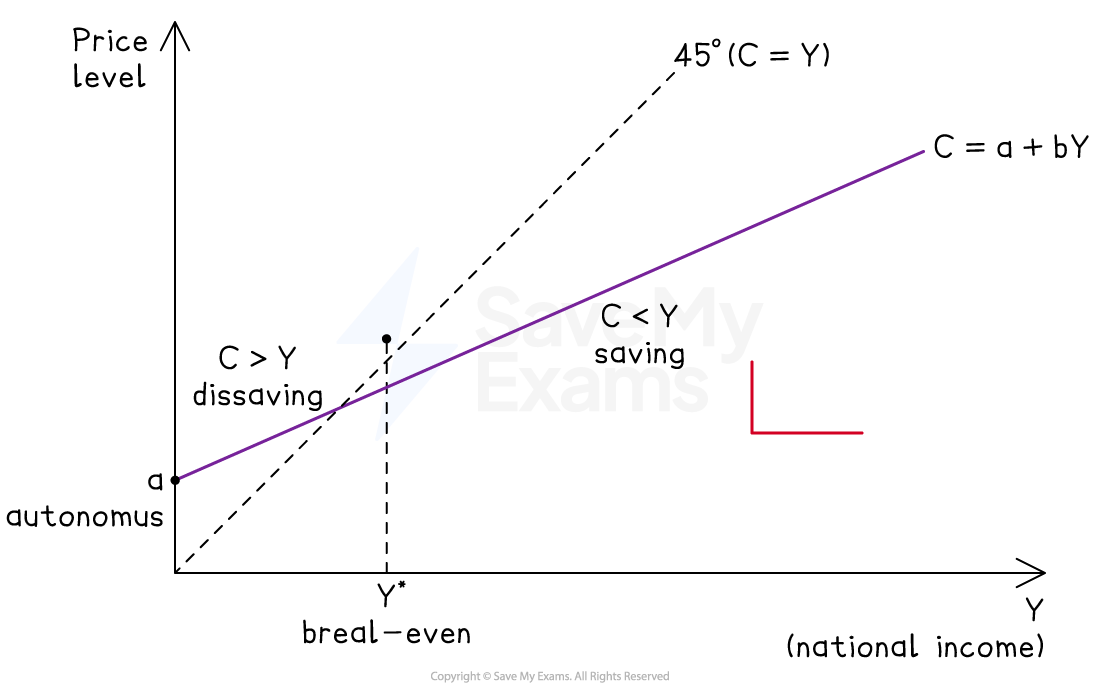
Diagram analysis
The consumption function starts at a positive vertical intercept a, showing that consumption is positive even when income is zero (autonomous consumption financed by dissaving or borrowing)
The function slopes upward with gradient b (the MPC), which is positive and less than 1 - each additional £1 of income raises consumption by less than £1
The 45° line shows every point at which C = Y
The consumption function crosses the 45° line at the break-even level of income Y*, where consumption exactly equals income and saving is zero
To the left of Y*, the function sits above the 45° line - households consume more than their income and must dissave
To the right of Y*, the function sits below the 45° line - households consume less than their income and save the remainder
Determinants of autonomous consumption (shifts in the function)
Autonomous consumption changes when:
Wealth rises or falls (the wealth effect - a rise in house or asset prices raises a)
Consumer confidence shifts (optimism about future incomes raises a)
Interest rates change (lower rates make saving less attractive and borrowing cheaper, raising a)
Availability of credit expands or contracts
Determinants of the MPC (slope of the function)
The slope b depends on:
Income distribution - lower-income households have a higher MPC than higher-income households, so redistribution towards the poor raises the aggregate MPC
Expectations about future income - if income rises are seen as permanent, MPC is higher than if they are seen as temporary
The consumption function is central to the multiplier
The larger b, the smaller the leakage into saving and the larger the multiplier k = 1 ÷ (1 − b) in a closed economy with no government
The savings function
Saving is simply the residual of disposable income not spent on consumption. Because Y = C + S by definition in a closed economy with no government:
S = −a + (1 − b)Y or S = −a + sY
where s = 1 − b is the marginal propensity to save (MPS).
Autonomous saving is negative (−a) - at Y = 0 households are dissaving to finance autonomous consumption
Induced saving (sY) rises with income - higher income means a larger absolute amount saved even at a constant MPS
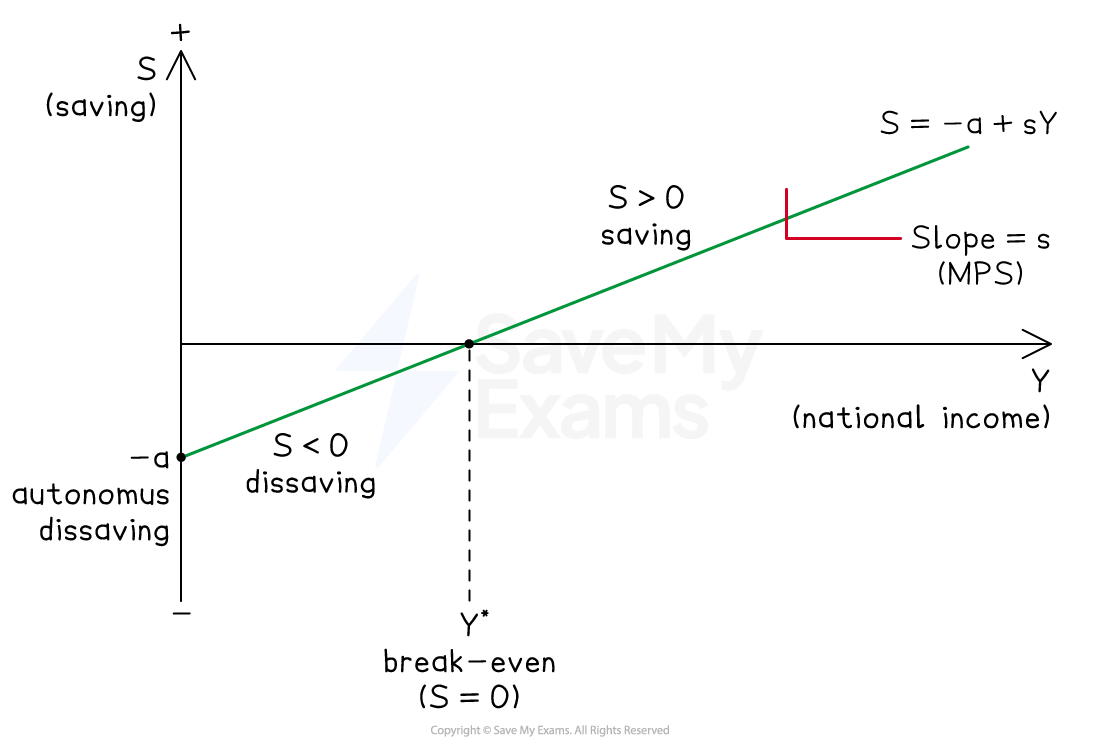
Diagram analysis
The savings function starts at a negative vertical intercept −a, showing that saving is negative when income is zero (households dissave to finance autonomous consumption)
The function slopes upward with gradient s (the MPS), positive and less than 1 - each additional £1 of income adds less than £1 to saving
The function crosses the horizontal axis at the break-even level of income Y*, where saving is zero
To the left of Y*, saving is negative (dissaving)
To the right of Y*, saving is positive and rises with income
The savings function is the mirror image of the consumption function: the two must sum to Y at every level of income. Any shift in the consumption function produces an equal and opposite shift in the savings function
Determinants of saving
The savings function shifts when:
Interest rates rise (raising the reward for saving, shifting S up)
Confidence falls (precautionary saving rises, shifting S up)
Demographic structure changes (ageing populations save differently from younger ones)
Tax treatment of savings changes (tax-advantaged savings accounts raise S)
Examiner Tips and Tricks
The most common error at A Level is treating the autonomous/induced distinction as a formality rather than using it. Every question on the multiplier or the determinants of consumer behaviour can be strengthened by identifying which element is autonomous (the initial cause of a change) and which is induced (the mechanism through which the change transmits).
Link the consumption function's slope (MPC) directly to the size of the multiplier in your evaluation. The stronger the MPC, the larger the multiplier, the greater the impact of any autonomous change in G, I or X on equilibrium Y. This connects the consumption function back to 9.1.1 and demonstrates understanding of the income-expenditure model as a whole.
Be precise with the savings function. Strong answers identify that S = −a at Y = 0 (dissaving), that S crosses zero at the break-even point of income, and that shifts in S are the mirror image of shifts in C. Examiners reward candidates who can explain this symmetry rather than treating C and S as independent.
The mirror-image relationship
Because Y = C + S at every level of income, the consumption function and the savings function are mirror images of one another
Any shift in one produces an equal and opposite shift in the other, and both functions share the same break-even level of income Y*
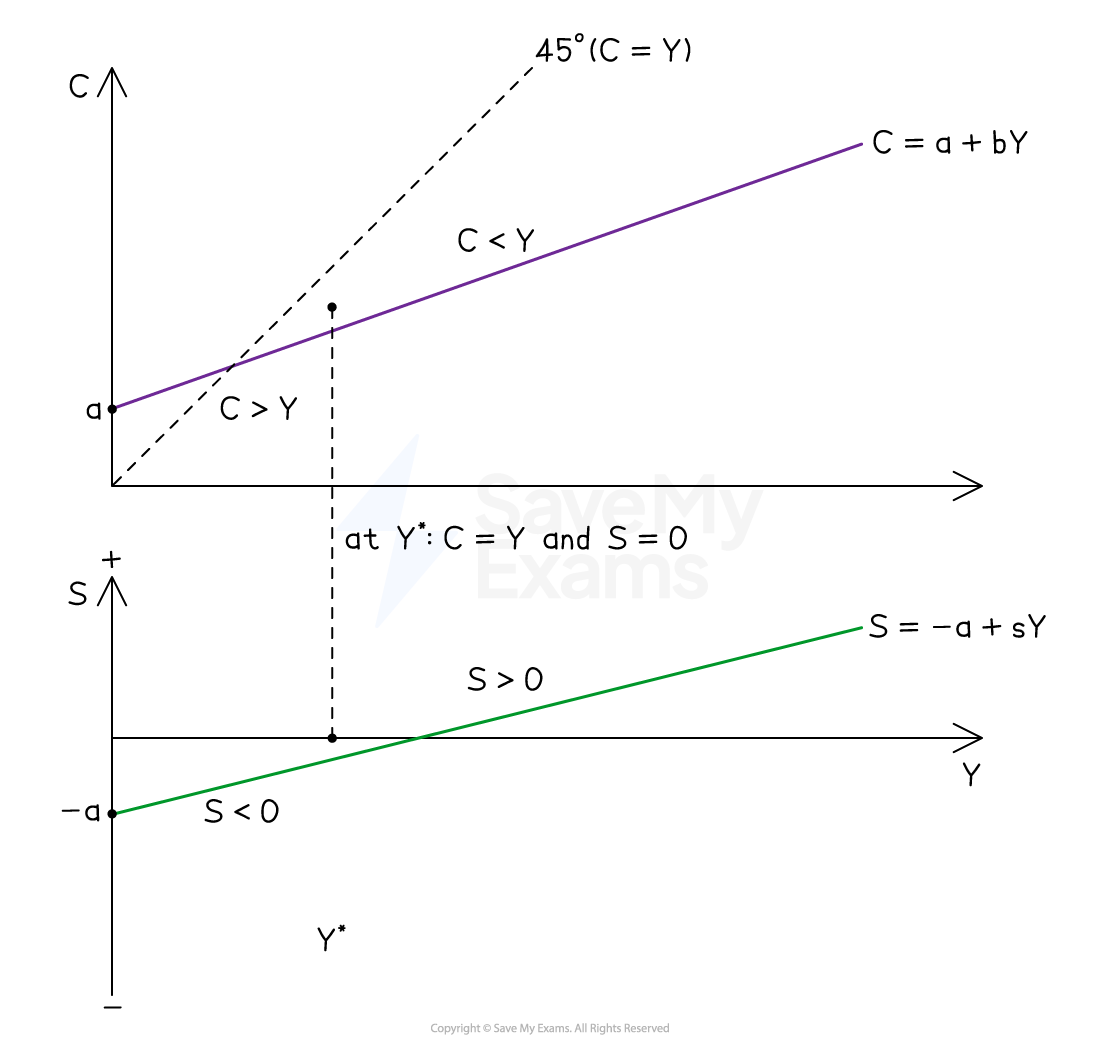
Diagram analysis
The upper panel shows the consumption function; the lower panel shows the savings function; both share the same horizontal income axis
At Y = 0, C = a (positive autonomous consumption) and S = −a (equal and opposite autonomous dissaving) - the two intercepts mirror one another
At Y*, the consumption function crosses the 45° line and the savings function crosses the horizontal axis simultaneously - this is the single break-even level of income at which C = Y and S = 0
To the left of Y*: C > Y in the upper panel corresponds to S < 0 in the lower panel (dissaving finances the excess consumption)
To the right of Y*: C < Y in the upper panel corresponds to S > 0 in the lower panel (income exceeds consumption, producing positive saving)
A rise in autonomous consumption (shift of C upward) must be matched by a fall in autonomous saving (shift of S downward) by the same amount

Unlock more, it's free!
Join the 100,000+ Students that ❤️ Save My Exams
the (exam) results speak for themselves:

Was this revision note helpful?