Common Policy Objectives (Cambridge (CIE) A Level Economics): Revision Note
Exam code: 9708

Introduction to macroeconomic objectives
Macroeconomic objectives are goals set by the government aimed at improving the overall economic performance of a country as well as the quality of life of its citizens
The government aims to achieve these objectives through the use of macroeconomic policies
It can be difficult to achieve some outcomes simultaneously
E.g. high economic growth and stable price levels can be in conflict with one another
Economic growth
Economic growth is an increase in national output as measured by real GDP
Economic growth is a central macroeconomic aim of most governments
Many developed nations (UK included) have an annual target rate of 2–3%
This is considered to be sustainable growth
Growth at this rate is less likely to cause excessive demand pull inflation
Politicians often use it as a metric of the effectiveness of their policies and leadership
Economic growth has positive impacts on confidence, consumption, investment, employment, incomes, living standards and government budgets
Strong economic growth means higher incomes, lower unemployment rates and better government budgets
Sustainable economic growth will have less demand-pull inflationary pressures or excessive environmental pressure
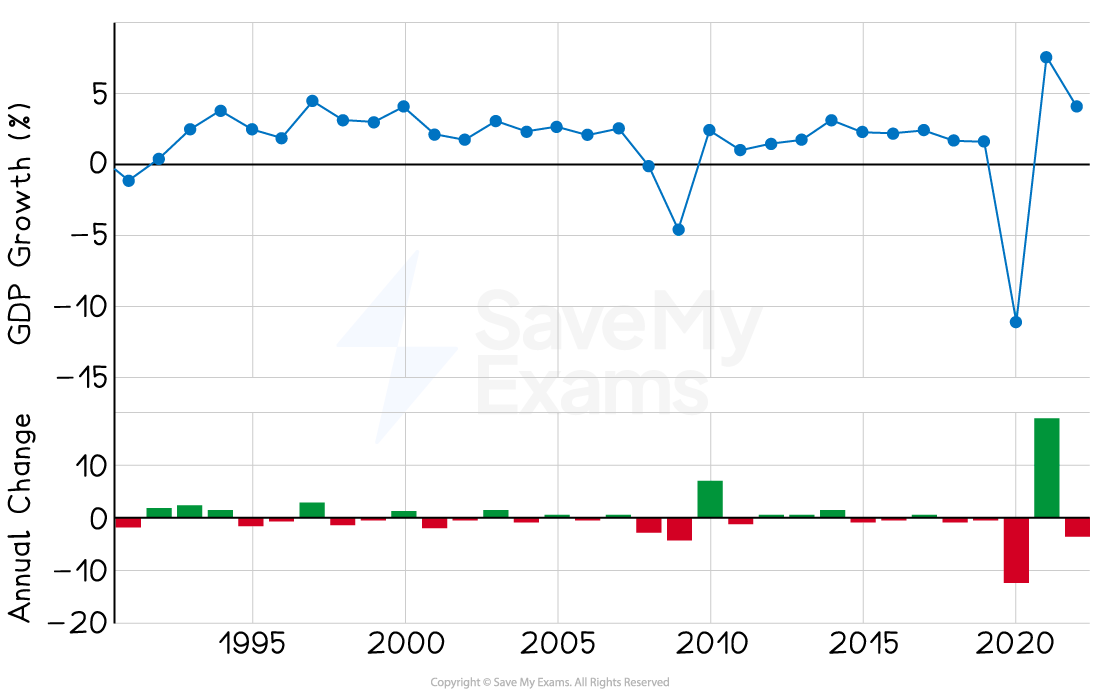
Growth trends
An increase in real GDP is a sign that the economy is expanding and employment is increasing
A fall in real GDP (-11% in 2020) caused by Covid restrictions is a sign economy is contracting
In 2021 and 2022, real GDP growth rate shows signs of recovery post-Covid restrictions
High inflation rates also occurred during this period
UK Economic Growth Trends 2019–2022
Year | GDP Growth (%) | Economic Trends |
|---|---|---|
2019 | 1.6% | Stable economic growth rate |
2020 | -11% | Fall in GDP growth rate Recession |
2021 | 7.6% | Rapid economic growth post-covid recovery |
2022 | 4.1% | Continued economic growth, but at a decreasing rate |
Price stability
Inflation is a sustained increase in the average price level of goods/services in an economy
The UK has a target inflation rate of 2% using the Consumer Price Index (CPI)
A low rate of inflation is desirable, as it is a symptom of economic growth
The different causes of inflation (cost push or demand pull) require different policy responses from the Government
Demand-side policies ease demand pull inflation
Supply-side policies ease cost push inflation
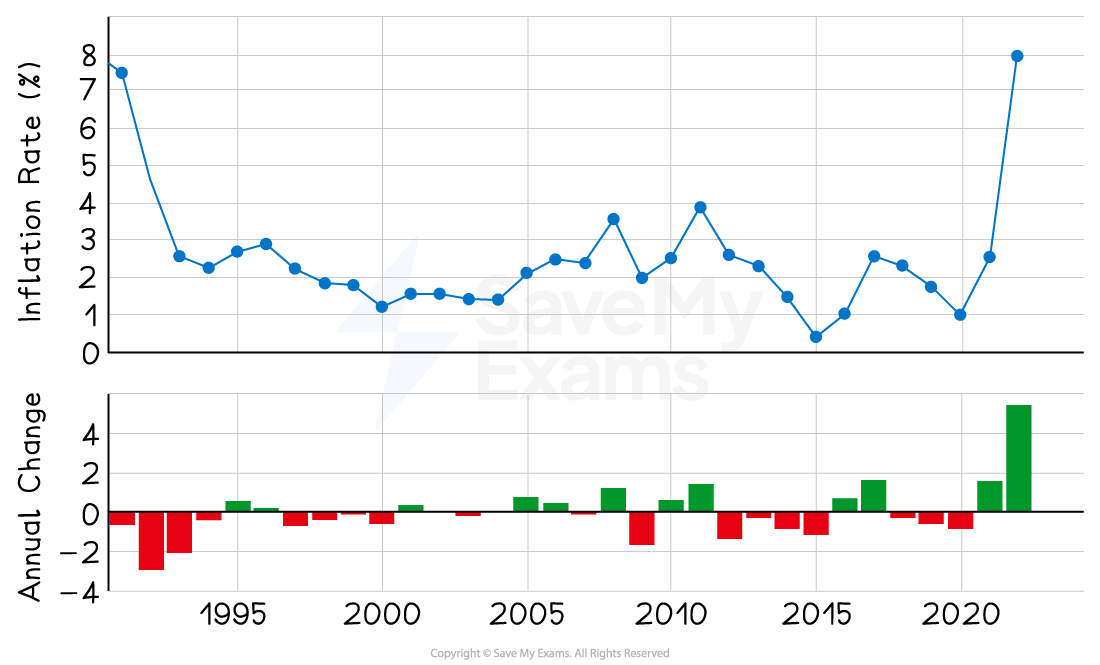
Inflation trends for 2015–2023
In the period following the pandemic, inflation rates have exceeded the target rate of 2%
The CPI peaked at around 8% in 2023
This is due to supply chain disruptions causing cost-push inflation
Increased spending following the pandemic caused demand-pull inflation
The Bank of England (BoE) uses monetary policy to observe and regulate inflation rate
Minimising unemployment levels
The target unemployment rate for the UK is 4–5%
This is close to the full employment level of labour (YFE)
There will always be a level of frictional unemployment
This makes it impossible to achieve 100% employment
Within the broader unemployment rate, there is an increased emphasis on the unemployment rate within different sections of the population
E.g. youth unemployment, ethnic/racial unemployment by group
In 2021, black unemployment in the UK was 11% and white unemployment was 4.1%
Low levels of unemployment are a sign of a strongly performing economy and are inversely linked to real GDP growth
When real GDP increases, unemployment falls
When real GDP decreases, unemployment rises
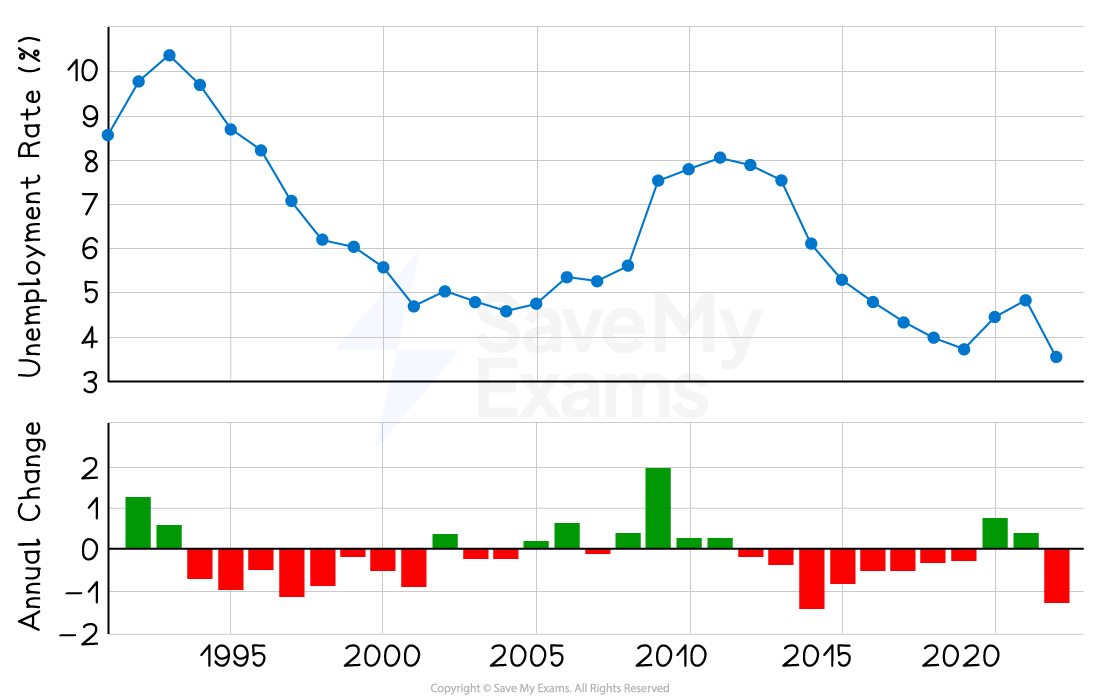
Unemployment trends
In the six years following the 2007 financial crisis, unemployment in the UK remained relatively high
It declined during economic recovery in 2012, reaching lowest levels just before Covid pandemic
However, with restrictions, unemployment rose again
Unemployment increased from 2021 to 2022 but decreased by just over 1% in 2023
Stable balance of payments on current account
The Balance of Payments (BoP) for a country is a record of all the financial transactions that occur between it and the rest of the world
The current account focuses mainly on the financial transactions related to exports and imports of goods and services
Governments aim for Balance of Payments equilibrium on the Current Account
If exports > imports, it will create a current account surplus
If imports > exports, it will create a current account deficit
Each one of these conditions has advantages and disadvantages associated with it
However, a current account deficit is more problematic in the long run
The UK has traditionally run a small deficit
As a percentage of GDP, the UK current account deficit is insignificant and has not been problematic
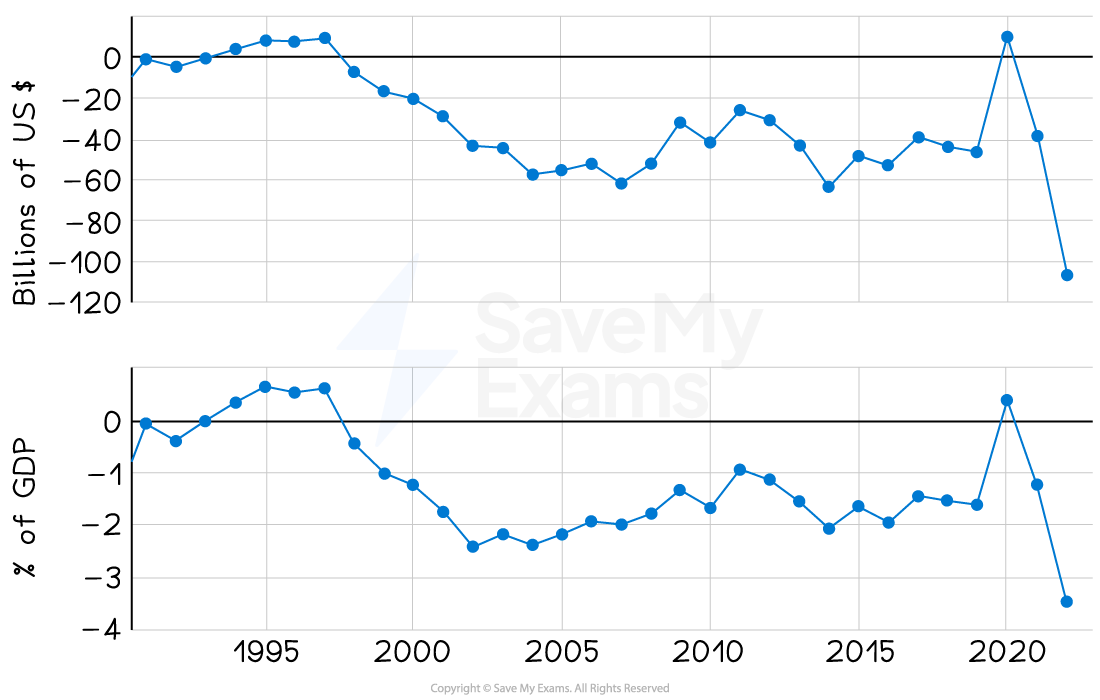
Graph analysis
The U.K. trade balance for 2019 was $-46.14B, a 4.78% increase from 2018
The U.K. trade balance for 2020 was $9.69B, a 121% decline from 2019
The U.K. trade balance for 2021 was $-38.56B, a 498.05% decline from 2020.
The U.K. trade balance for 2022 was $-106.79B, a 176.91% increase from 2021
The UK offsets its negative trade in goods with a very positive trade in services
Sustainability
The UK government aims to ensure sustainable economic development and reduce adverse impacts on the environment
In April 2021, the UK Government stated that their environmental aim was to reduce emissions by 78% by 2035
This reduction is based on the emission levels of 1990
It is one of the most ambitious climate change targets globally
It includes the UK’s share of international aviation and shipping emissions
Broader environmental aims include
A focus on sustainability
The reduction of negative externalities of production
100% energy from renewable sources by 2035
Redistribution of income and wealth
Equitable distribution of income and wealth ensures fairness and allows the same opportunities for everyone
The aim is not equality of distribution, as it removes the incentive to work and study
High levels of income inequality can create social unrest
Income inequality is measured using the Gini Coefficient
Income Inequality for 2020 using Gini Coefficient
Country | Gini Index |
|---|---|
Belgium | 0.248 |
Uk | 0.357 |
Mexico | 0.420 |
The higher the Gini coefficient, the more unequal the distribution of income
0 = complete equality; 1 = complete inequality
Most developed economies have a Gini target of 0.3–0.4
There is a need for the UK government to intervene to maintain acceptable levels of income inequality. Governments can redistribute income
Through a progressive tax system
Providing essential merit goods such as healthcare and education

Unlock more, it's free!
Join the 100,000+ Students that ❤️ Save My Exams
the (exam) results speak for themselves:

Was this revision note helpful?
