The Mobility of Labour (Cambridge (CIE) A Level Economics): Revision Note
Exam code: 9708

The mobility of labour
Labour mobility refers to the ability of workers to move between jobs, occupations or locations in response to changes in the labour market
High mobility helps labour markets clear efficiently
Low mobility contributes to structural unemployment and wage differentials
Forms of labour mobility
Form | Definition | Example |
|---|---|---|
Geographical mobility |
|
|
Occupational mobility |
|
|
Factors affecting geopgraphic and labour mobility
1. Geographical mobility
Factor | Effect on mobility |
|---|---|
Housing costs and availability |
|
Family and social ties |
|
Cultural and language differences |
|
Transport infrastructure |
|
Information about jobs elsewhere |
|
Immigration controls |
|
Differences in cost of living |
|
2. Occupational mobility
Factor | Effect on mobility |
|---|---|
Education and transferable skills |
|
Training and retraining availability |
|
Age of worker |
|
Professional qualifications and licensing |
|
Technological change |
|
Trade union and professional body restrictions |
|
Worked Example
What is a factor affecting the occupational mobility of labour?
A | education and training |
B | immigration controls |
C | price of housing |
D | transport infrastructure |
Answer: A
Option A is correct - education and training directly affects occupational mobility because workers with broader skills and qualifications find it easier to move between different jobs and industries
Worked solution
Option B is the trap - immigration controls affect geographical mobility of labour by restricting cross-border movement; students who confuse the two forms of mobility may select this
Option C is incorrect - the price of housing affects geographical mobility because high house prices in growing regions deter workers from relocating; it has no direct effect on a worker's ability to switch between occupations
Option D is incorrect - transport infrastructure affects geographical mobility by widening the range of accessible jobs through commuting; it is not a factor in occupational change
Why labour mobility matters
Reduces structural unemployment - workers can move from declining to expanding industries and regions
Improves allocative efficiency - labour moves to its most productive uses
Narrows wage differentials - flows of labour equalise wages across regions and occupations over time
Lowers the natural rate of unemployment (NRU) - better matching between workers and jobs
Supports long-run growth - shifts LRAS right by raising productive capacity
Consequences of low labour mobility
Persistent regional unemployment - declining areas cannot absorb job losses through out-migration
Persistent occupational mismatch - vacancies unfilled in one sector while others have surplus labour
Wider wage gaps between regions and occupations
Hysteresis risk - workers stuck in declining areas/occupations lose skills over time
Case Study
Detroit and the immobility trap
The context
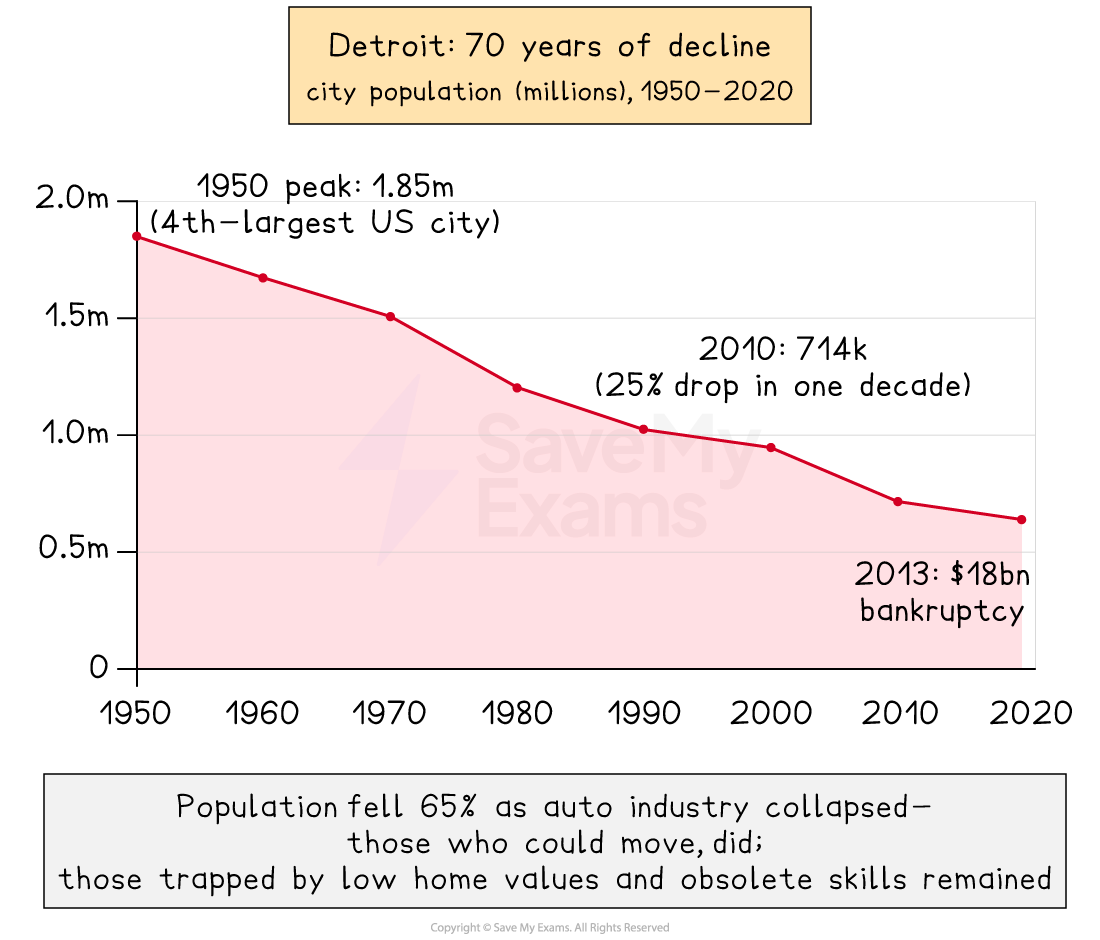
Detroit was America's fourth-largest city in 1950 with 1.85 million residents, built around the "Big Three" automakers (Ford, GM, Chrysler). From the 1970s, auto production shifted to lower-cost US states and to Mexico. By 2010, Detroit's unemployment reached 24.9%
The mobility problem
Geographical immobility - low house values meant homeowners could not sell and relocate; remaining residents were disproportionately poorer and unable to afford moves
Occupational immobility - specialised assembly-line skills had little application in growing service industries; older auto workers found retraining difficult
Hysteresis effect - long-term unemployment eroded skills and employability over decades
Outcomes
Population fell 61% from 1950 to 2010 - those who could move did; those who could not were trapped
By 2014, around 30% of residential buildings stood vacant or derelict
Detroit filed the largest US municipal bankruptcy in history (2013) with $18 billion in debt
Recovery from 2015 has been uneven - downtown revival but many neighbourhoods still struggling
Key lesson
When workers cannot move between locations or occupations, a single-industry shock produces decades of structural unemployment and permanent regional decline.
Examiner Tips and Tricks
Always distinguish the two forms of mobility clearly - geographical mobility concerns location, occupational mobility concerns the type of work.
Past paper MCQs frequently ask for a single factor affecting one form specifically, so don't mix the factor lists in your answer.
For evaluation questions, link low mobility to structural unemployment and to the natural rate of unemployment - this shows the connection between mobility and the wider labour market.
Mobility is also a common evaluation point in policy questions - the effectiveness of supply-side policies often depends on whether workers can actually move to new jobs.

Unlock more, it's free!
Join the 100,000+ Students that ❤️ Save My Exams
the (exam) results speak for themselves:

Was this revision note helpful?
