Expansionary & Contractionary Monetary Policy (Cambridge (CIE) A Level Economics): Revision Note
Exam code: 9708

Expansionary monetary policy
Expansionary monetary policy involves reducing interest rates, increasing the money supply (including through quantitative easing), or loosening credit regulations - with the aim of increasing aggregate demand in the economy
To understand the effects of monetary policy on an economy, it is useful to know how aggregate demand (AD) is calculated
AD= household consumption (C) + firms investment (I) + government spending (G) + exports (X) - imports (M)
AD = C + I + G + (X - M)
From this, it is logical that changes to monetary policy can influence any of these components - and often several of them at once

Diagram analysis
The economy is initially in macroeconomic equilibrium AP1Y1
The Central Bank wants to boost economic growth and lower interest rates
Lower interest rates cause investment and consumption to increase, which are components of AD
Aggregate demand increases from AD1→ AD2
The economy reaches a new equilibrium at AP2Y2 - a higher average price level and a greater level of national output
As real output rises from Y1 to Y2, firms require more workers - employment rises and unemployment falls
An example of how expansionary monetary policy works
The USA Federal Reserve Bank commits to an extra $60bn a month of QE | |
|---|---|
Effect on the economy |
|
Impact on macroeconomic aims |
|
Worked Example
Which combination would represent the most expansionary set of monetary policies?
Credit availability | Interest rates | Money supply | |
|---|---|---|---|
A | increased | up | reduced |
B | increased | down | increased |
C | reduced | up | increased |
D | reduced | down | reduced |
Answer: B
Worked solution:
Assess each tool against its expansionary direction:
Credit availability - increasing availability makes borrowing easier, stimulating consumption and investment - expansionary. Options C and D reduce credit - contractionary. Eliminates C and D
Interest rates - cutting rates reduces the cost of borrowing and the return on saving, raising consumption and investment - expansionary. Option A raises rates - contractionary. Eliminates A
Money supply - increasing money supply puts more money into circulation, reducing interest rates and stimulating spending - expansionary. Option B increases money supply - confirms B
All three tools in option B point in the same expansionary direction. The trap is option A - two tools are expansionary but raising interest rates is contractionary, making it a mixed rather than the most expansionary combination.
Contractionary monetary policy
Contractionary monetary policy involves raising interest rates, stopping/reducing quantitative easing or reducing the amount of credit, with the aim of decreasing aggregate demand in the economy

Diagram analysis
The economy is initially in macroeconomic equilibrium AP1YFE
The central bank is wanting to lower inflation towards its target rate
Higher interest rates cause investment and consumption to decrease
Aggregate demand decreases from AD1→ AD2
As real output falls from YFE to Y1, firms require fewer workers - employment falls and unemployment rises
The economy reaches a new equilibrium at AP2Y1 - a lower average price level and a smaller level of national output
An example of how contractionary monetary policy works
The Central Bank increases interest rates | |
|---|---|
Effect on the economy |
|
Impact on macroeconomic aims |
|
Case Study
Contractionary monetary policy - United States 2022-2023
The context
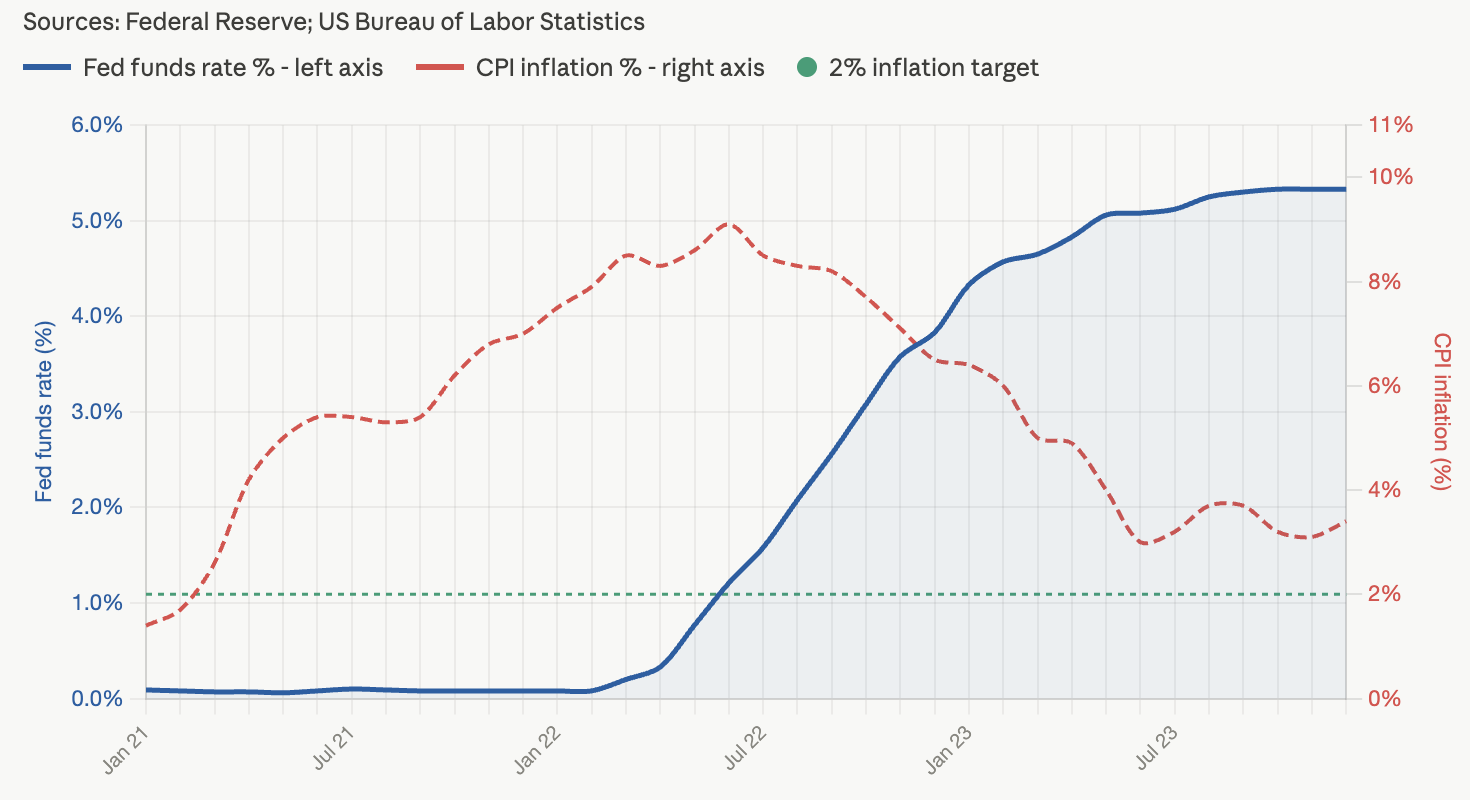
US inflation rose to 9.1% in June 2022 - its highest level since 1981 - driven by post-pandemic demand surges, supply chain disruptions and rising energy prices. The Federal Reserve responded with its fastest tightening cycle in decades.
Actions taken
The Federal Reserve raised the federal funds rate from near zero in March 2022 to 5.25-5.50% by July 2023 - eleven consecutive increases over sixteen months
Higher rates increased mortgage costs, credit card rates and business borrowing costs, reducing consumption and investment
The Fed also began reducing the quantitative easing of the pandemic period by selling bonds and withdrawing money from circulation
Outcomes
Inflation fell from 9.1% in June 2022 to approximately 3.2% by October 2023 - a significant reduction achieved without triggering a recession
GDP growth slowed but remained positive throughout, and unemployment stayed below 4% - leading economists to describe it as a rare "soft landing"
The case illustrates that contractionary monetary policy can reduce inflation without necessarily causing large falls in output and employment - though the Fed itself acknowledged the outcome was better than most models predicted
It also shows all three monetary policy tools working together - higher interest rates, tighter credit conditions and reduced money supply reinforcing each other to shift AD left
Examiner Tips and Tricks
Always state the full transmission mechanism when analysing monetary policy - do not simply say "cutting interest rates increases AD." The chain must include: rates fall - cost of borrowing falls and return on saving falls - consumption and investment rise - AD shifts right - real output, price level and employment rise.
The key distinction between the three tools is that interest rates affect the cost of borrowing, money supply affects the volume of money in circulation, and credit regulations affect the availability of borrowing. All three shift AD but through different channels.
In an exam question asking which tool is most appropriate, consider which channel is most relevant to the economic problem described.

Unlock more, it's free!
Join the 100,000+ Students that ❤️ Save My Exams
the (exam) results speak for themselves:

Was this revision note helpful?
