Causes & Consequences of Economic Growth (Cambridge (CIE) A Level Economics): Revision Note
Exam code: 9708

Causes of economic growth
Economic growth can be caused by factors that increase actual output (drawing on spare capacity) or factors that increase potential output (expanding productive capacity)
In AD/AS terms, actual growth is driven by a rightward shift in AD; potential growth is driven by a rightward shift in LRAS
For the distinction between actual and potential growth and the associated diagrams, see the revision note on 'Understanding Economic Growth'
1. Demand-side causes: shifts in AD

Increase in consumption
Rising household incomes, falling interest rates, or rising consumer confidence increase consumption (C), shifting AD right and raising real output
Increase in investment
Falling interest rates reduce the cost of borrowing for firms, encouraging capital investment (I); rising business confidence has the same effect - both shift AD right
Increase in government spending
Expansionary fiscal policy - a rise in G or a cut in taxation - increases AD directly, raising real output in the short run
Increase in net exports
A depreciation of the exchange rate makes exports cheaper abroad and imports more expensive domestically, raising net exports (X-M) and shifting AD right
2. Supply-side causes: shifts in LRAS

Technological progress
New technology increases the productivity of factors of production, allowing more output to be produced from the same inputs - LRAS shifts right and potential output increases
Improvements in human capital
Investment in education and training raises the quality of labour, increasing productivity and shifting LRAS right
Increase in the quantity of factors of production
Growth in the labour force (through population growth or net immigration) or increases in the capital stock (through investment) expand productive capacity and shift LRAS right
Institutional improvements
Stronger property rights, reduced corruption, deregulation and improved infrastructure reduce the costs of doing business, raising productive capacity over time
Case Study
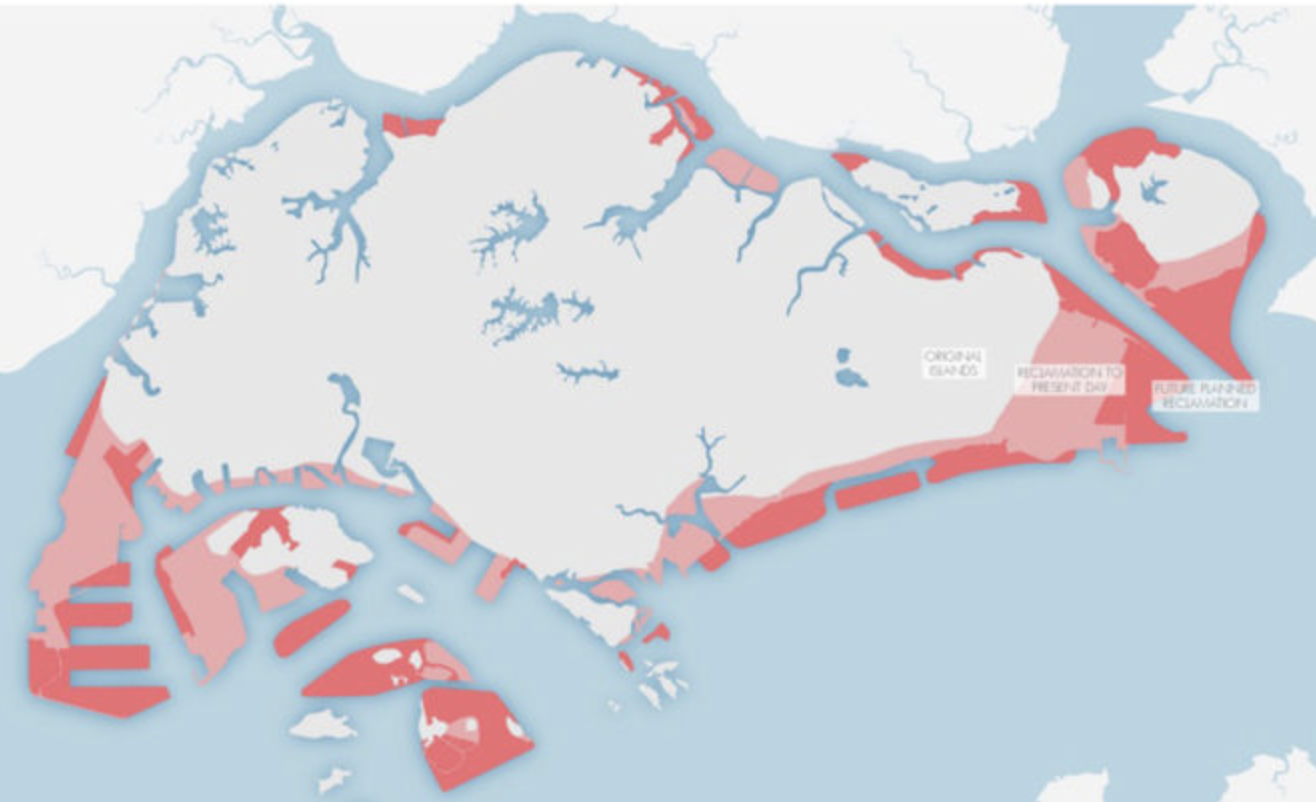
Potential growth - land reclamation in Singapore
The context
Singapore's land area has grown by approximately 25% since independence in 1965 - from 580 km² to over 730 km² - entirely through reclamation, pumping sand from the seabed to create new land.
Actions taken
Major reclamation projects created Jurong Island - an industrial complex contributing around 5% of GDP and hosting over $60 billion of capital investment
Changi Airport was extended into the sea, expanding Singapore's capacity to handle international trade, tourism and financial services
Outcomes
In AD/AS terms, reclamation directly shifted Singapore's LRAS rightward by increasing the quantity of land available as a factor of production
Real GDP per capita grew from approximately $500 at independence to over $65,000 by 2023 - illustrating how sustained investment in productive capacity generates compounding long-run growth
However, sand extraction depleted reserves in neighbouring countries and caused environmental damage - a reminder that expanding one factor of production can generate negative externalities beyond the domestic economy
Consequences of economic growth
Benefits of economic growth | Costs of economic growth |
|---|---|
|
|
|
|
|
|
|
|
Case Study
Consequences of growth - China 1990-2020
The context
China's real GDP grew at approximately 9% per year between 1990 and 2020, making it one of the most sustained periods of economic expansion in history and illustrating both the positive and negative consequences of rapid growth simultaneously.
Actions taken
Market liberalisation and export-led industrialisation drove rapid expansion in manufacturing and services
Hundreds of millions of rural workers were absorbed into urban employment as the economy shifted from agriculture to industry
Outcomes
The share of the population in absolute poverty fell from over 60% to under 1%, lifting an estimated 800 million people out of extreme deprivation
Government tax revenues funded major infrastructure investment across transport, energy and education
However China became the world's largest carbon emitter, with rapid industrialisation generating severe air and water pollution
Income inequality worsened significantly - the Gini coefficient rose from approximately 0.30 in 1990 to over 0.46 by the mid-2010s - as urban workers and capital owners captured a disproportionate share of gains
China's experience shows that rapid growth can simultaneously reduce absolute poverty and worsen relative inequality - the net welfare effect depends on how growth is generated and how its benefits are distributed
Examiner Tips and Tricks
Always distinguish between demand-led and supply-led growth in your analysis. Demand-led growth raises real output in the short run but generates inflationary pressure as the economy approaches full capacity. Supply-led growth shifts LRAS right, raising potential output and reducing the price level simultaneously - it is non-inflationary and sustainable.
For evaluation questions on the consequences of growth, the strongest points are the equity-growth trade-off (growth does not guarantee equitable distribution of its benefits) and the sustainability trade-off (growth generates environmental costs that may constrain future growth).

Unlock more, it's free!
Join the 100,000+ Students that ❤️ Save My Exams
the (exam) results speak for themselves:

Was this revision note helpful?
