Evaluating Policies to Reduce Inflation (Cambridge (CIE) A Level Economics): Revision Note
Exam code: 9708

How best to tackle inflation
Inflation is reduced by policies that slow aggregate demand growth, shift aggregate supply rightwards, or anchor inflationary expectations
The three main policy categories are:
contractionary monetary policy
contractionary fiscal policy, and
supply-side policy
Contractionary monetary policy
Contractionary monetary policy is the use of higher interest rates, reduced money supply growth, or quantitative tightening to reduce aggregate demand and inflationary pressure
Mechanism (the transmission mechanism)
The central bank raises the base interest rate
Commercial bank lending rates rise, mortgage and loan repayments become more expensive
Consumer spending falls (higher cost of credit, higher savings returns)
Investment falls (higher cost of borrowing for firms)
The exchange rate appreciates as foreign capital is attracted by higher returns, reducing export demand
Aggregate demand falls, reducing demand-pull inflationary pressure
Strengths and limitations
Strengths | Limitations |
|---|---|
|
|
|
|
|
|
|
|
Contractionary fiscal policy
Contractionary fiscal policy is the use of higher taxation, reduced government spending, or both, to reduce aggregate demand and inflationary pressure
Mechanism
The government raises direct or indirect taxes, reducing household disposable income and firm profits
Government reduces spending on public services, transfer payments, or infrastructure
Aggregate demand falls, reducing demand-pull inflationary pressure
A budget surplus (or smaller deficit) may also reduce the money supply if bonds previously financing the deficit are no longer issued
Strengths and limitations
Strengths | Limitations |
|---|---|
|
|
|
|
|
|
|
|
Supply-side policy
Supply-side policy aims to reduce inflation by increasing the productive capacity of the economy, shifting long-run aggregate supply (LRAS) rightwards and allowing output to rise without price pressure
Mechanism
Market-based policies (deregulation, tax cuts to incentivise work and investment, privatisation) increase productivity and reduce costs
Interventionist policies (education and training, infrastructure investment, R&D subsidies) raise long-run productive capacity
LRAS shifts right, so any given level of AD is met at a lower price level
Addresses cost-push inflation by reducing underlying production costs
Strengths and limitations
Strengths | Limitations |
|---|---|
|
|
|
|
|
|
|
|
Comparing the effectiveness of each
Policy | Best against | Key weakness |
|---|---|---|
Contractionary monetary |
|
|
Contractionary fiscal |
|
|
Supply-side |
|
|
The strongest policy mix typically combines all three
Monetary policy for short-term demand management
Fiscal policy for targeted adjustments, and
Supply-side policy for long-run capacity building
The choice depends on the cause of inflation
Demand-pull inflation responds to monetary and fiscal policy
Cost-push inflation responds better to supply-side policy
Case Study
Argentina's anti-inflation programme, 2023 onwards
The context
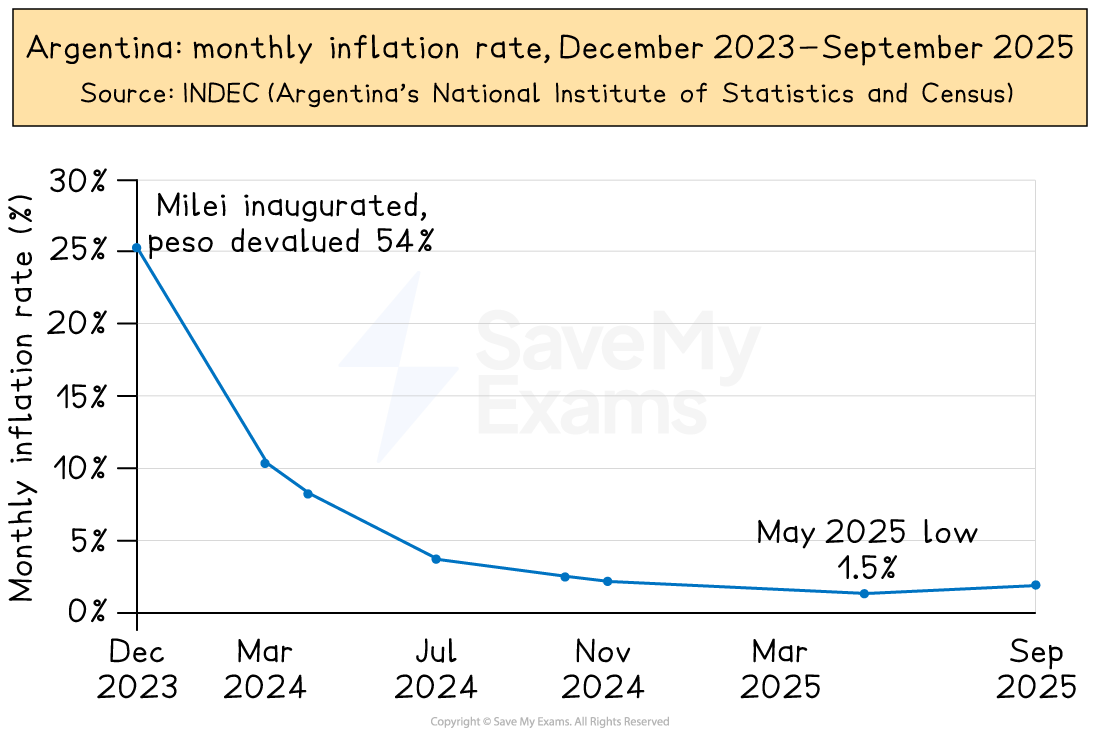
When Javier Milei took office in December 2023, Argentina faced one of the world's highest inflation rates. Monthly inflation had reached 25.5% and annual inflation peaked at nearly 300% in April 2024.
The underlying cause was structural: decades of budget deficits financed by the central bank printing money - the quantity theory of money operating in practice.
The policy mix
The Milei administration combined all three anti-inflation policies
Contractionary fiscal policy - spending cut by 4.5% of GDP through subsidy elimination and public sector workforce reductions; first fiscal surplus in 14 years at 1.8% of GDP in 2024
Contractionary monetary policy - central bank prohibited from printing new pesos to fund government spending; broad money supply frozen; immediate 54% peso devaluation
Supply-side reform - deregulation, rollback of price controls, labour market liberalisation
The results
Monthly inflation fell from 25.5% in December 2023 to 2.1% by September 2025. Annual inflation decreased to 31.8% by November 2025, the lowest level in more than seven years. The current account moved from a 3.2% of GDP deficit to a 1% surplus in 2024.
The costs
Poverty rose from 42% in late 2023 to 53% in the first half of 2024 before recovering. GDP contracted by around 3.8% in 2024.
What this illustrates
The three policies worked together, not separately. Fiscal consolidation removed the root cause; monetary tightening anchored expectations; structural reform addressed long-run cost pressures
Short-term costs were substantial - rising poverty and unemployment confirm that contractionary policies impose unemployment costs, illustrating the conflict with other macroeconomic objectives
Credibility matters - central bank independence and rules-based policy are important for anti-inflation credibility
Limitations remain - Argentina's overnight interest rate was still around 45%, and annual inflation around 32% by late 2025. Even a successful programme has not returned Argentina to target-level inflation
Examiner Tips and Tricks
The highest-value framing for questions on policy responses to inflation, is to match the policy to the cause of inflation.
Demand-pull inflation responds to monetary and fiscal policy; cost-push inflation responds better to supply-side policy. Candidates who list all three policies without distinguishing what each is best against miss the key evaluation move.
For any policy discussed, evaluation should address time lags, side effects and cause-specificity. Monetary policy takes 12 to 24 months to fully transmit; supply-side policy takes years. Contractionary policies raise unemployment. Supply-side policies have uncertain outcomes. Strong answers weigh these costs against the benefit of reduced inflation.

Unlock more, it's free!
Join the 100,000+ Students that ❤️ Save My Exams
the (exam) results speak for themselves:

Was this revision note helpful?
