Tariffs & Export Subsidies (Cambridge (CIE) A Level Economics): Revision Note
Exam code: 9708

Why engage in protectionism?
Protectionism refers to government policies that restrict international trade in order to protect domestic industries from foreign competition
Typical protectionist methods include:
tariffs
import quotas
export subsidies
embargoes
excessive administrative burdens (‘red tape’)
Arguments for and against protectionism
Argument for | Explanation | Argument against |
|---|---|---|
Infant industry |
|
|
Declining industry |
|
|
Strategic industries |
|
|
Prevent dumping |
|
|
Correct a balance of payments deficit |
|
|
Protect employment |
|
|
Terms of trade argument |
|
|
Tariffs
A tariff is a tax imposed on imported goods, raising their price in the domestic market

Diagram analysis
Without a tariff, the world supply curve (Sw) is perfectly elastic at world price Pw
At Pw, domestic producers supply Q1 and domestic consumers demand Q2 - imports = Q1 to Q2
The tariff raises the price from Pw to Pw + tariff, shifting world supply up to Sw + tariff
At the higher price, domestic producers expand output from Q1 to Q3
Domestic consumers reduce demand from Q2 to Q4
Imports fall from (Q1 to Q2) to (Q3 to Q4) - shown by the "imported" bracket
Area 1 = consumer surplus transferred to domestic producers
Area 2 + 4 = deadweight welfare loss - inefficiency created by the tariff
Area 3 = government tax revenue from the tariff
Employment in domestic industries rises as output expands from Q1 to Q3
Impact of a tariff
Stakeholder | Effect |
|---|---|
Domestic producers |
|
Domestic consumers |
|
Government |
|
Foreign producers |
|
Economy |
|
Worked Example
Which type of import control allows a country to develop a potential comparative advantage in a particular good?
A. a quota that protects jobs in a depressed region
B. a short-term tariff that protects an infant industry
C. a tariff that improves an industry's terms of trade
D. an embargo on goods with negative externalities
Answer: B
The key phrase is "develop a potential comparative advantage" - this means the country does not yet have comparative advantage but could develop it over time with protection
This is the infant industry argument - a new domestic industry needs temporary protection from established foreign competitors until it achieves economies of scale and becomes internationally competitive
A short-term tariff provides this protection temporarily while the industry matures - the word "short-term" is critical, as it implies the tariff is removed once competitiveness is achieved
Worked solution
Option A is incorrect - protecting jobs in a depressed region does not develop comparative advantage; it preserves an existing industry rather than building a new one
Option C is incorrect - a terms of trade tariff benefits a large country by reducing world import prices; it does not develop comparative advantage
Option D is incorrect - an embargo on goods with negative externalities is a welfare argument, not a comparative advantage argument
Export subsidies
An export subsidy is a government payment to domestic producers to lower the price at which they can sell goods abroad, making exports more competitive in world markets
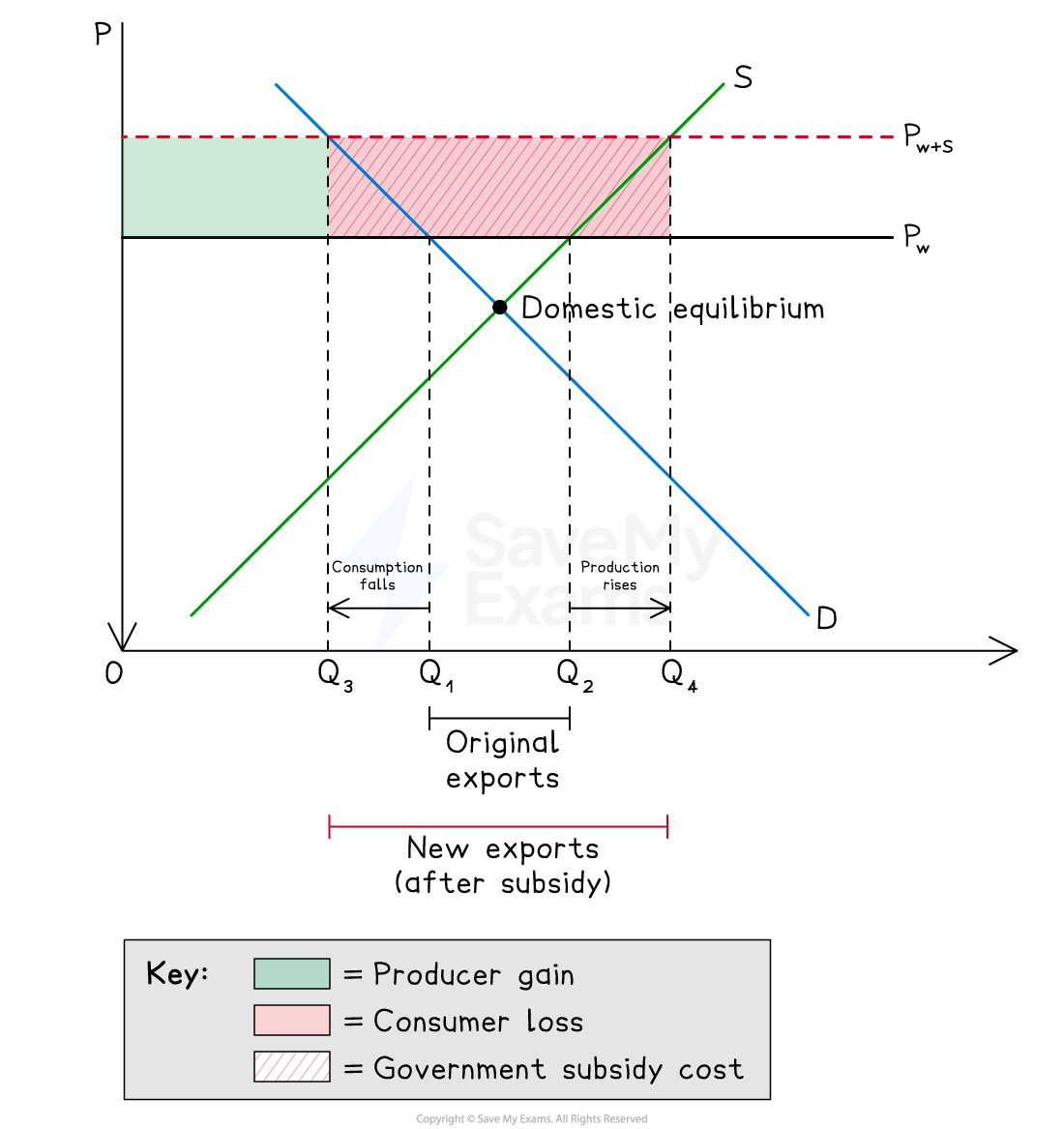
Diagram analysis
Without a subsidy, the domestic equilibrium is below P_w - the country already exports at world price (supply exceeds demand at P_w)
Original exports = Q1 to Q2 at world price P_w
The subsidy raises the price domestic producers receive from P_w to P_w+S
At P_w+S, domestic production rises from Q2 to Q4 - production rises
At P_w+S, domestic consumption falls from Q1 to Q3 - consumption falls
New exports = Q3 to Q4 - a much larger bracket than original exports
Producer gain (coral) = producers receive higher price on all output
Consumer loss (teal) = domestic consumers pay higher prices and consume less
Government subsidy cost = (P_w+S - P_w) × Q4
Employment in the export sector rises as domestic production expands
Impact of an export subsidy
Stakeholder | Effect |
|---|---|
Domestic producers |
|
Domestic consumers |
|
Government |
|
Foreign producers |
|
Economy |
|
Worked Example
A country subsidises domestic production of manufactured goods. What is the most likely outcome?
A. a rise in economic growth
B. a rise in imports of manufactured goods
C. a rise in the rate of inflation
D. a rise in unemployment
Answer: C
A domestic production subsidy raises the price domestic producers receive, increasing domestic output of manufactured goods
Higher domestic output increases demand for factors of production - wages and input costs are bid up across the economy
This feeds through into higher prices across the economy - cost-push inflation rises
Worked solution
Option A is incorrect - a subsidy may boost output temporarily but creates inefficiency and misallocates resources; sustained economic growth requires productivity improvements, not subsidies
Option B is incorrect - a production subsidy makes domestic goods cheaper to produce, so domestic goods substitute for imports; imports fall, not rise
Option D is incorrect - subsidising domestic production incentivises firms to expand output and hire more workers; employment rises, not falls
Examiner Tips and Tricks
A common error is to show an export subsidy as a rightward shift of the supply curve - this is correct for a domestic production subsidy (which lowers costs and increases supply at every price) but not for an export subsidy
An export subsidy works differently - the government pays producers a fixed amount per unit exported, so producers will only sell domestically if they receive the same price as abroad (P_w + subsidy)
The correct diagram therefore shows the domestic price rising to P_w+S as a new horizontal price line - the supply curve itself does not shift
Always check which type of subsidy the question refers to before drawing your diagram

Unlock more, it's free!
Join the 100,000+ Students that ❤️ Save My Exams
the (exam) results speak for themselves:

Was this revision note helpful?