Monetary Policy & Exchange Rate Policy (Cambridge (CIE) A Level Economics): Revision Note
Exam code: 9708

The link between monetary policy and exchange rate policy
Monetary policy uses interest rates and money supply controls to influence aggregate demand and inflation
Exchange rate policy manages the value of a currency to influence trade balance, inflation, and competitiveness
The two are causally linked - interest rate changes drive capital flows that affect the exchange rate, and exchange rate management often relies on monetary policy tools
Recap from AS
The AS syllabus covers the basic tools and effects of both policies
Interest rates as the central bank's main tool
Expansionary vs contractionary monetary policy
Fixed, managed and floating exchange rate regimes
Simple effects of currency appreciation and depreciation
This page builds on that foundation and adds the transmission mechanism in detail, quantitative easing, and the integrated effectiveness analysis of both policies across multiple macroeconomic objectives
The monetary policy transmission mechanism
The transmission mechanism is the chain of cause-and-effect through which a change in the central bank's policy interest rate affects aggregate demand, output, employment and the price level
The diagram below maps the full mechanism
Base rate changes flow through four transmission channels
Channels feed into demand components, which converge into aggregate demand
Aggregate demand drives domestic inflationary pressure, which feeds inflation
The exchange rate channel also affects inflation directly via import prices, separate from the AD route
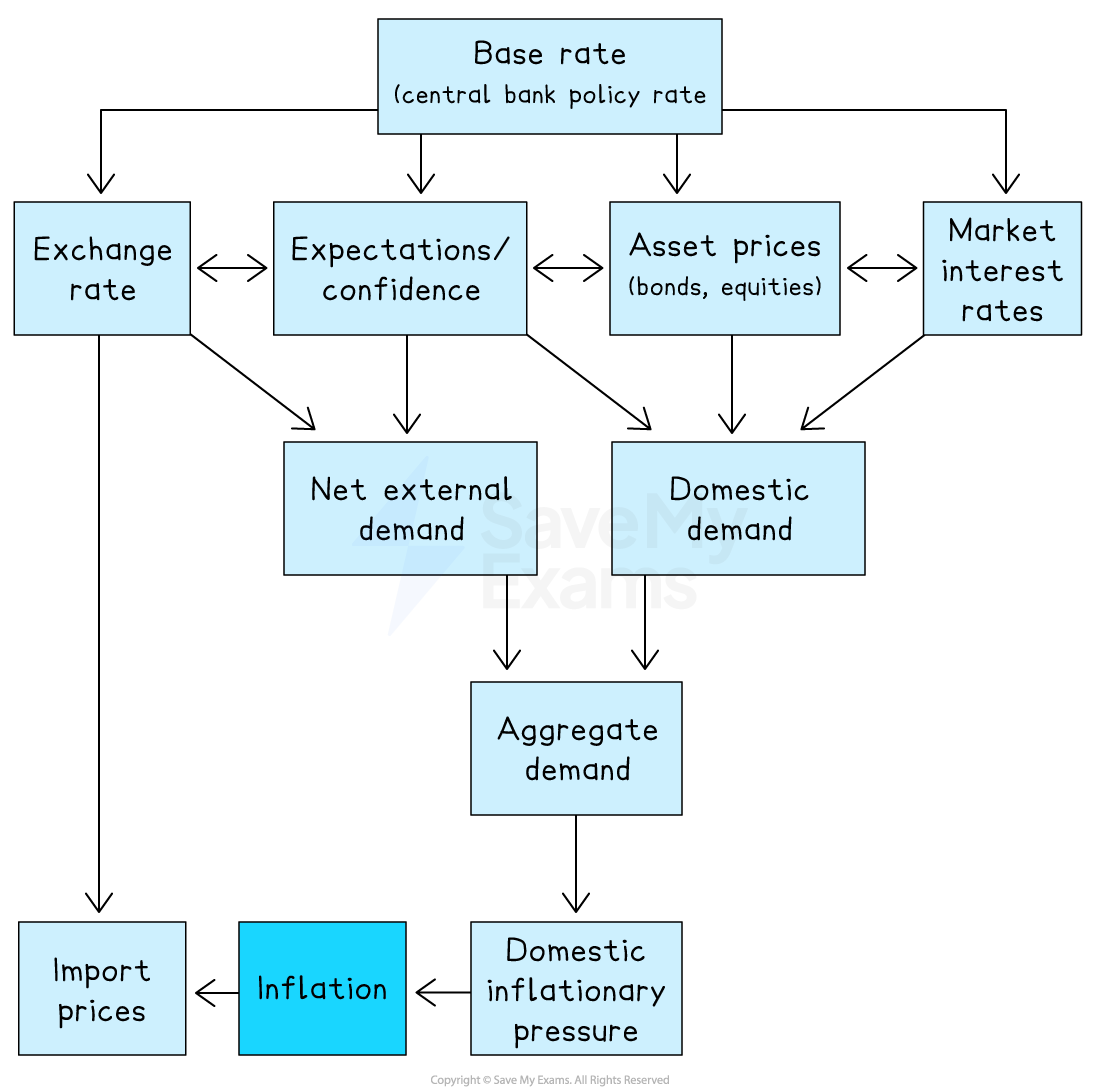
A rise in the base rate transmits through the four channels as follows
Channel | Mechanism |
|---|---|
Market interest rates |
|
Asset prices |
|
Expectations / confidence |
|
Exchange rate |
|
The bidirectional arrows in the diagram show the channels also interact
For example, expectations of higher rates can themselves drive asset prices and the exchange rate before official rate changes occur
The combined effect of a rate rise is a fall in aggregate demand
The reverse applies for a rate cut
Time lags and limitations
The full effect of a rate change typically takes 12 to 24 months to materialise
Channels work at different speeds
Exchange rate effects appear within weeks
Market interest rate effects on consumption build over months as fixed-rate deals expire
The mechanism may break down at the zero lower bound (the liquidity trap, covered in 9.4.7)
Channels can be disrupted when commercial banks are repairing damaged balance sheets and fail to pass on rate changes (a key issue post-2008)
Quantitative easing
Quantitative easing is a monetary policy tool in which the central bank creates new reserves electronically and uses them to buy financial assets (typically government bonds), expanding the money supply and reducing long-term interest rates
QE works through the same transmission mechanism but operates on long-term rates rather than the short-term base rate
Bond purchases push prices up and yields down, feeding into the asset prices channel and indirectly into market interest rates
QE is used when conventional monetary policy reaches its limits - typically at the zero lower bound
It was used extensively after the 2008 financial crisis and during the COVID-19 pandemic by major central banks
Limitation
QE may inflate asset prices (housing, equities) more than it stimulates real activity creating distributional concerns and asset bubble risk
Exchange rate policy
Exchange rate policy is the use of central bank intervention, interest rate adjustments, or capital controls to influence the external value of a currency in pursuit of macroeconomic objectives
It operates on the exchange rate channel of the transmission diagram directly
Three regime types
Regime | Description | Implication |
|---|---|---|
Floating |
|
|
Fixed |
|
|
Managed (dirty float) |
|
|
The link with monetary policy: the impossible trinity
Monetary policy and exchange rate policy are not independent tools
They both operate through the exchange rate channel shown in the transmission diagram
A central bank cannot simultaneously control the interest rate and the exchange rate under free capital mobility - this is the impossible trinity (or trilemma)
Choosing a fixed exchange rate means giving up monetary policy independence
Choosing monetary policy independence means accepting exchange rate volatility
Most major economies operate floating exchange rates to preserve monetary policy independence
Effectiveness across macroeconomic objectives
Monetary policy and exchange rate policy work through different (but overlapping) channels and produce different effects across each objective
Objective | Monetary policy | Exchange rate policy |
|---|---|---|
Low inflation |
|
|
Economic growth |
|
|
Low unemployment |
|
|
Balance of payments |
|
|
Equitable income distribution |
|
|
The key insight is that the same policy serves different objectives through different transmission paths, and these paths often conflict
For example, raising rates to control inflation worsens the BoP through the same exchange rate channel that anchors expectations
Strengths and limitations
Strengths | Limitations | |
|---|---|---|
Monetary policy |
|
|
Exchange rate policy |
|
|
Worked Example
Discuss the transmission mechanism of monetary policy and consider why it might not always be effective in achieving the central bank's objectives.
[13 marks]
Indicative answer structure
AO1 Knowledge: Define monetary policy and the transmission mechanism; identify the central bank's main objectives (typically price stability, often growth and employment as secondary)
AO2 Analysis: Walk through the four channels - market interest rates, asset prices, expectations, exchange rate. Show how a rate rise reduces AD through each. Note that the exchange rate channel also affects inflation directly through import prices
AO3 Evaluation: The mechanism may not work effectively because of
Time lags of 12–24 months
The liquidity trap at the zero lower bound
Cost-push inflation that monetary policy cannot address
Broken transmission channels (e.g. impaired banking systems)
Conflicting policy objectives (fighting inflation may worsen unemployment)
Exchange rate effects that conflict with BoP objectives
Conclude that the transmission mechanism is theoretically clear but empirically conditional
Examiner Tips and Tricks
For monetary policy questions, trace the full transmission mechanism rather than just stating that "higher rates reduce AD." The strongest answers walk through all four channels and note that the exchange rate channel feeds into inflation by two routes (via net external demand and directly via import prices). Drawing or describing the diagram structure earns higher analysis marks.
For exchange rate policy questions, the key insight is the impossible trinity
a country cannot simultaneously have a fixed exchange rate, free capital mobility, and independent monetary policy
The strongest answers use this framework to evaluate exchange rate policy choices, showing why countries that fix their currency must sacrifice monetary policy independence.
Use the post-2021 global inflation episode as an evaluative anchor. Major central banks raised rates aggressively from 2022 onwards. The episode showed monetary policy can transmit through the expected channels but with significant time lags and uneven effects across sectors.

Unlock more, it's free!
Join the 100,000+ Students that ❤️ Save My Exams
the (exam) results speak for themselves:

Was this revision note helpful?
