Conflicts Between Policy Objectives & Government Failure (Cambridge (CIE) A Level Economics): Revision Note
Exam code: 9708

The link between policy objectives and government failure
Government macroeconomic policy faces two persistent challenges
First, the main objectives - growth, low inflation, low unemployment, balance of payments stability, and equitable income distribution - frequently conflict with each other, so achieving one objective often worsens another
Second, even well-designed policies can fail to deliver their intended outcomes due to information gaps, political constraints, time lags, and unintended consequences
This is known as government failure
This page synthesises the policy analysis from earlier sections and applies the relationships framework identified in Links Between Macroeconomic Problems
Why policy objectives conflict
The main macroeconomic objectives are interconnected - covered in detail in Links Between Macroeconomic Problems
The four key conflicts are
Growth vs inflation - demand-led growth raises AD against fixed AS, generating inflationary pressure
Growth vs balance of payments - rising income raises import demand, worsening the current account
Inflation vs unemployment - contractionary policy to reduce inflation raises unemployment in the short run (the SRPC trade-off)
Internal vs external value of money - high inflation reduces the currency's external value, generating imported inflation that further raises domestic prices
Policy aimed at one objective transmits through the same channels that affect the others
There is no policy that improves all five objectives simultaneously
How specific policies conflict in practice
Each policy generates specific conflicts
Policy | Achieves | Worsens |
|---|---|---|
Expansionary fiscal |
|
|
Contractionary monetary |
|
|
Currency devaluation |
|
|
Market-based supply-side |
|
|
Interventionist supply-side |
|
|
Protectionism |
|
|
Examiner Tips and Tricks
Every policy creates winners and losers across objectives. Strong evaluation in Paper 4 essays traces these trade-offs explicitly
The role of policy mix
Because no single policy achieves all objectives, governments combine policies - but combinations themselves create new conflicts
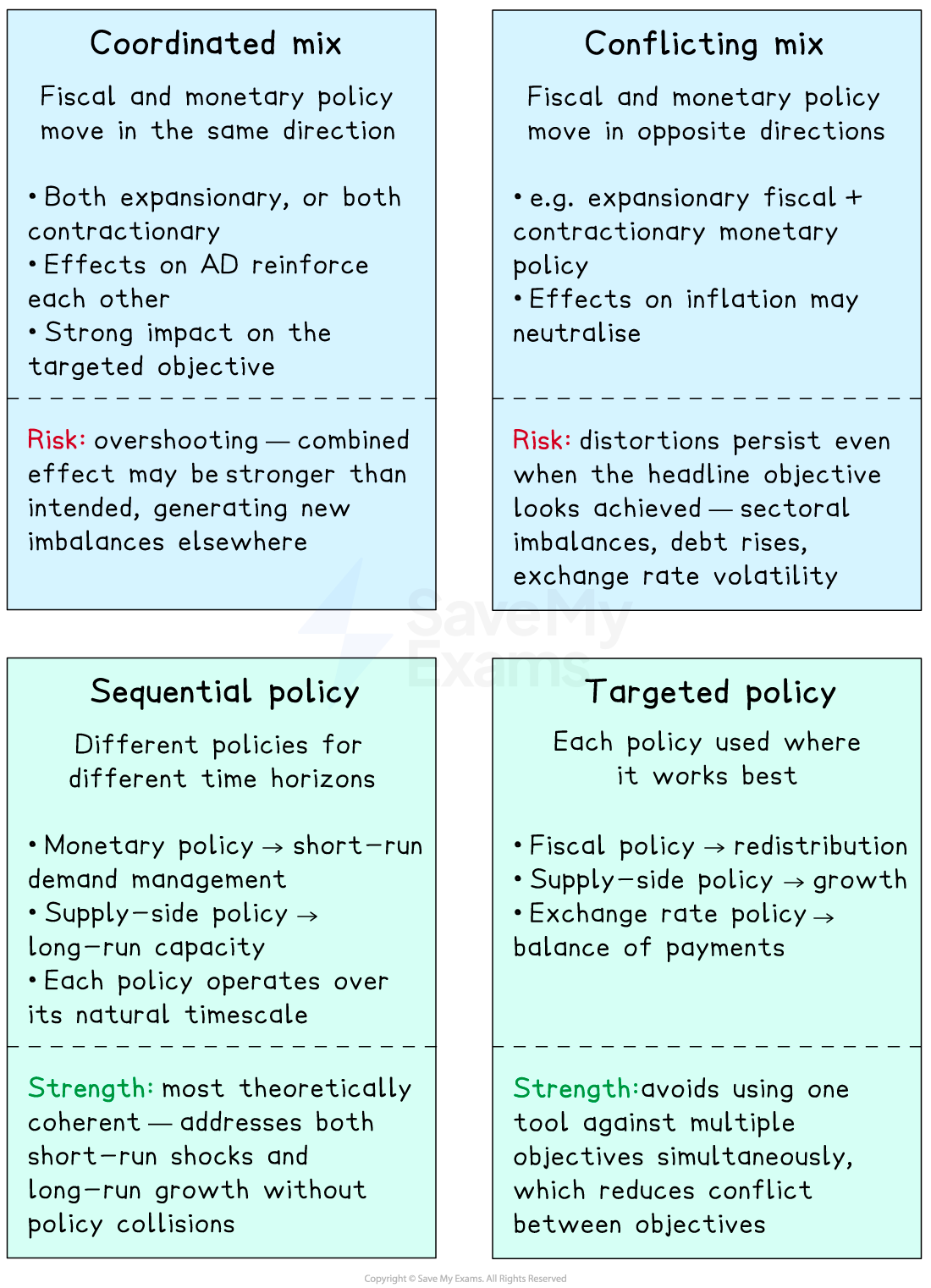
Examiner Tips and Tricks
In essays, a key evaluative insight to communicate is that policy effectiveness depends on coordination and sequencing, not just the choice of individual policies.
Government failure in macroeconomic policies
Government failure occurs when government intervention in the economy produces an outcome that is worse than would have occurred without intervention, or worse than was intended
Government failure in macro policy arises from five main sources
1. Information failure
Governments do not have perfect information about the current state of the economy
Key data (GDP, inflation, unemployment) is reported with delays of weeks or months and is later revised
Acting on incomplete or wrong data leads to badly timed or wrongly sized interventions
For example, central banks raising rates based on backward-looking inflation data may tighten just as inflation is naturally falling, deepening a recession
2. Time lags
Recognition lag - time taken to identify that a problem exists
Decision lag - time taken to agree on a policy response (especially fiscal policy with budget cycles)
Implementation lag - time taken to enact the policy
Effect lag - time taken for the policy to work through the transmission mechanism
Combined lags can mean policy effects materialise after the problem has changed or resolved itself
3.Political constraints
Election cycles encourage short-term policy choices over long-term optimal policy
Politically powerful groups (industries, unions, regional voters) lobby for protection, subsidies or tax breaks that benefit them at general cost
Policy reversals between governments undermine credibility and long-run effectiveness
For example, supply-side investment in education and infrastructure benefits the economy over decades but rarely shows results within an electoral cycle
4. Unintended consequences
Policies designed to achieve one outcome can produce unexpected effects elsewhere
For example, quantitative easing was intended to stimulate lending, but instead inflated asset prices (housing, equities), widening inequality without raising real activity in proportion
For example, protectionist tariffs designed to support domestic industry can trigger retaliation from trading partners that harms exporters
5. Regulatory capture and rent-seeking
Industries subject to regulation may influence regulators to set rules that benefit existing firms over consumers and new entrants
Subsidies and tax breaks become entrenched even when no longer economically justified, because beneficiaries lobby to preserve them
This contributes to chronic inefficiency in protected sectors
When government failure is most likely
Government failure tends to be more severe when
The problem is complex and information is uncertain (e.g. supply shocks, novel crises like COVID-19)
Time pressures force quick decisions without adequate analysis
Political incentives favour short-term over long-term outcomes
Multiple objectives must be balanced, so policy cannot be optimised on any single criterion
Distributional effects are large, generating powerful political resistance to optimal policy
The implications (useful for evaluation)
Government failure does not mean no intervention is the answer
It means that
Policy must be designed with awareness of its own limitations
Independent institutions (e.g. central banks with inflation-targeting mandates) reduce political distortion
Rules-based policy (e.g. fiscal rules, automatic stabilisers) reduces discretionary error
Time-limited interventions with clear exit conditions reduce regulatory capture
The choice is rarely between perfect government and perfect markets
It is between imperfect government and imperfect markets, with each option having different costs
Worked Example
Discuss whether a government can achieve all its key macroeconomic aims simultaneously.
[13 marks]
Indicative answer structure
AO1 Knowledge
Identify the five main macroeconomic aims (growth, low inflation, low unemployment, BoP stability, equitable income distribution); identify the main policy categories (fiscal, monetary, supply-side, exchange rate, trade)
AO2 Analysis
Explain the four key conflicts (growth vs inflation, growth vs BoP, inflation vs unemployment, internal vs external value of money)
Show that each policy
Targets specific objectives through specific transmission channels
Generates side effects on other objectives via the same channels
For example, contractionary monetary policy reduces inflation but raises unemployment and strengthens the currency, worsening BoP
AO3 Evaluation
A government cannot achieve all aims simultaneously through any single policy, but can come close through
Coordinated policy mix — using each policy where it works best
Sequential policy — short-run demand management plus long-run supply-side expansion
Independent institutions — central banks, fiscal councils that reduce political distortion
The limitation is government failure — information gaps, time lags, political constraints, and unintended consequences mean even well-designed policy mixes underperform their theoretical potential
Conclude that simultaneous achievement of all aims is unattainable — but partial success across all aims is achievable through coordinated, evidence-based, institution-anchored policy
Examiner Tips and Tricks
In essays, be sure to name the specific conflict (e.g., "growth vs BoP"), explain the mechanism (rising income raises import demand), and apply it to the policy in question. Vague claims about trade-offs lose evaluation marks.
For government failure questions, show that government failure does not imply non-intervention is better - markets also fail. Use specific examples of policy design that mitigates failure: central bank independence, fiscal rules, automatic stabilisers.
Use the post-2021 inflation episode as an evaluative anchor. Supply shocks, central banks acting on imperfect data with long time lags, and political pressure around cost-of-living support combined to show conflicting objectives and government failure operating together.

Unlock more, it's free!
Join the 100,000+ Students that ❤️ Save My Exams
the (exam) results speak for themselves:

Was this revision note helpful?