Redistributive Policies (Cambridge (CIE) A Level Economics): Revision Note
Exam code: 9708

Redistribution policies
Governments use redistribution policies to reduce inequality and improve equity by transferring income or resources from higher-income to lower-income groups
The central evaluative tension for every policy is the equity-efficiency trade-off: does the policy improve fairness, and at what cost to productive and dynamic efficiency?
There are four key policies to consider: means-tested benefits, universal benefits, negative income tax and universal basic income
1. Means-tested benefits
These are benefits paid only to individuals whose income and/or wealth falls below a specified threshold - recipients must demonstrate financial need to qualify
The government targets support at those who need it most, making this approach cost-effective relative to universal provision
Examples include housing benefit, food assistance, unemployment support and healthcare subsidies for low-income households
Evaluating means-tested benefits
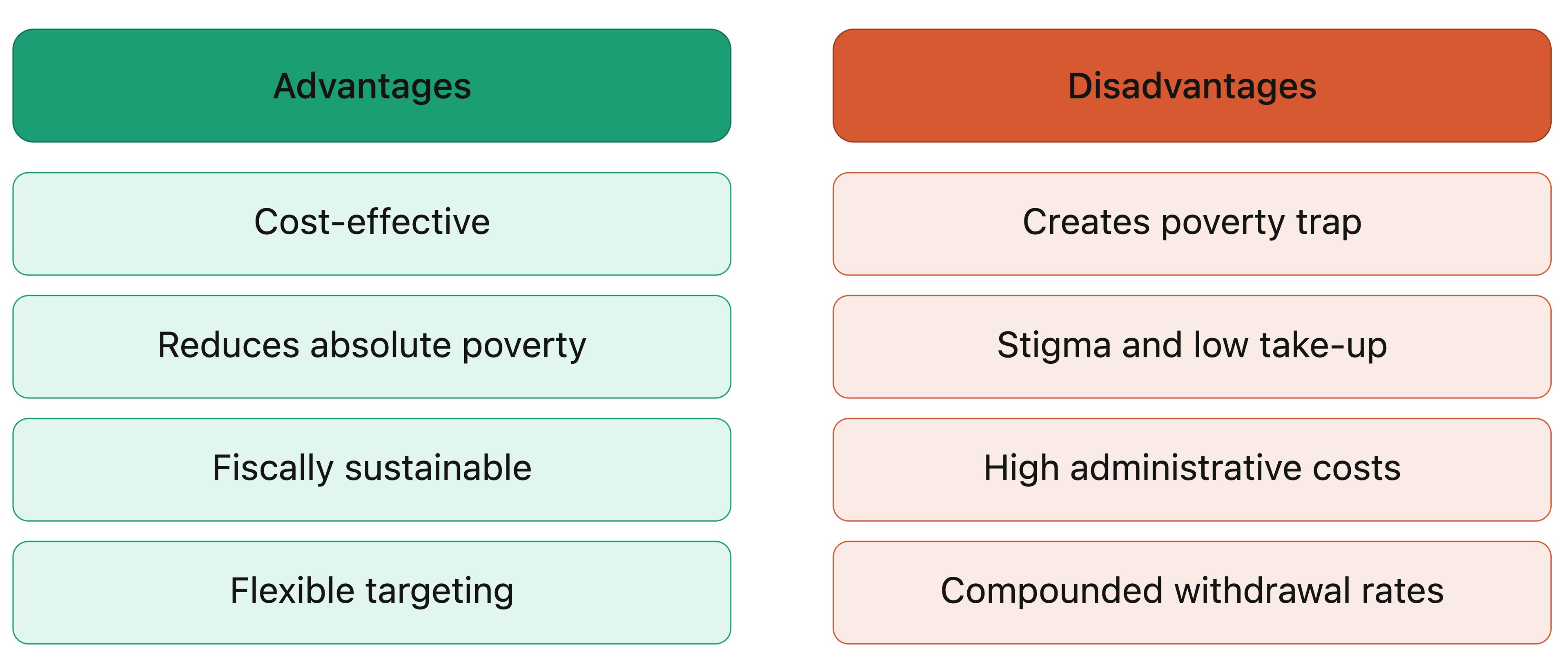
Advantages | Disadvantages |
|---|---|
|
|
|
|
|
|
|
|
Case Study
Universal Credit in the United Kingdom
The context
The UK's legacy benefit system consisted of six separate means-tested benefits including housing benefit, tax credits and income support
Each had different withdrawal rates and eligibility rules, creating a complex system where some low-income workers faced effective marginal tax rates (EMTR) above 90% - a severe poverty trap discouraging progression into work
Actions taken
Universal Credit (UC) was introduced from 2013, merging six benefits into a single payment with a unified taper rate of 55p withdrawn per £1 of earned income
The policy aimed to make work always pay by ensuring the EMTR never exceeded 55% - significantly below the rates in the legacy system
By 2023, approximately 6 million households were receiving Universal Credit
Outcomes
Evidence suggests UC improved work incentives at the margin compared to the legacy system
The unified taper rate reduced the most extreme poverty trap cases
However critics argue a 55% taper rate remains high, and that the interaction with childcare costs pushes effective marginal tax rates above 70% for many families
The five-week wait for first payment also pushed many new claimants into debt, illustrating that poorly designed implementation can undermine a well-intentioned policy - a form of government failure
2. Universal benefits
These are benefits paid to all individuals in a category regardless of income or wealth - no means test is applied
Examples include universal child benefit, state pensions paid to all retirees, and universal healthcare
The defining feature is that entitlement is based on status (being a child, being retired, being a citizen) rather than financial need
Evaluating universal benefits
Advantages | Disadvantages |
|---|---|
|
|
|
|
|
|
|
|
3. Negative income tax
This is a system in which the tax and benefit systems are merged
Individuals above a specified income threshold pay tax in the normal way, while those below it receive a government payment (the negative tax) rather than paying tax
Proposed by economist Milton Friedman as a way to eliminate the poverty trap while maintaining work incentives
The mechanism:
A break-even income is set - above this level individuals pay tax; below it they receive payments
As earned income rises towards the break-even point, the negative tax payment falls at a constant taper rate
Because the taper rate is consistent and moderate, the EMTR never becomes prohibitively high - work always pays at the margin
This replaces the complex array of means-tested benefits with a single, streamlined system
Evaluating negative income tax
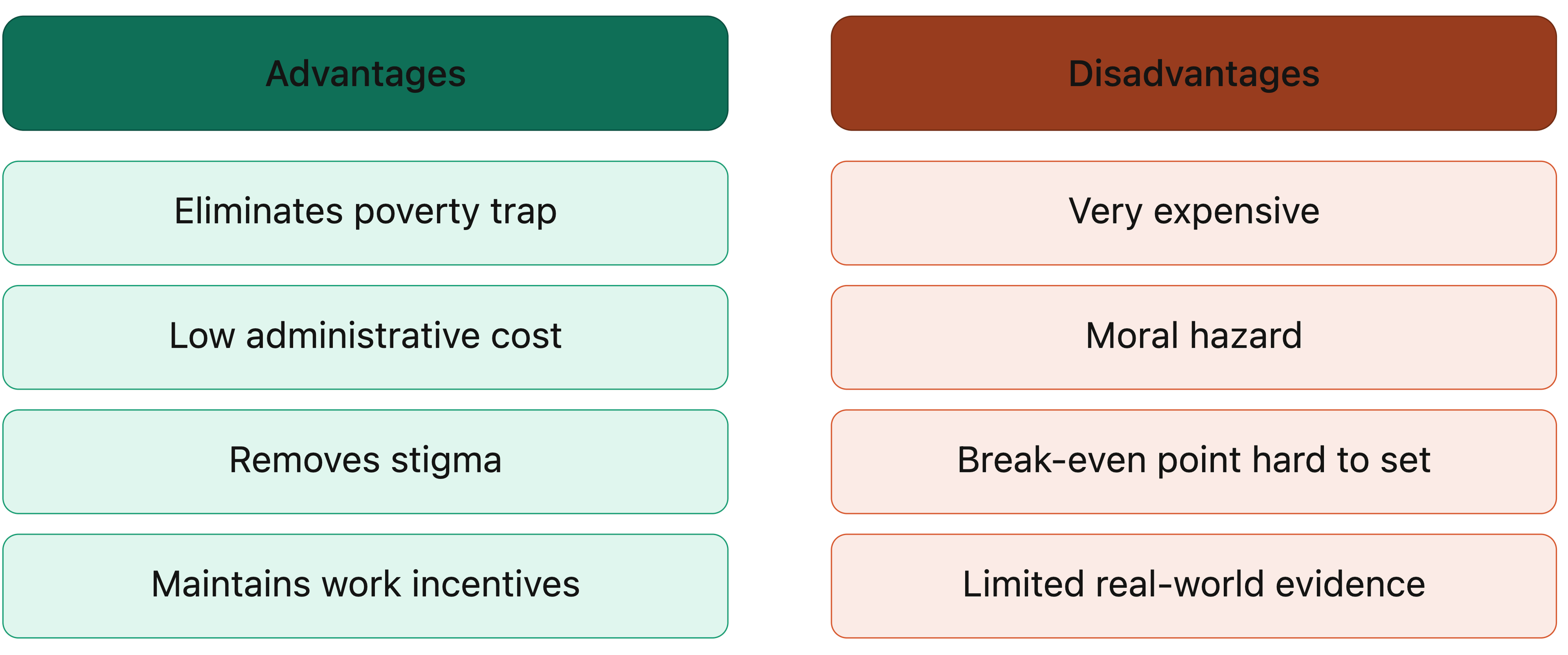
Advantages | Disadvantages |
|---|---|
|
|
|
|
|
|
|
|
4. Universal basic income
Universal basic income (UBI) a regular, unconditional cash payment made to every citizen regardless of income, employment status or need
Unlike negative income tax, UBI is paid to everyone, not just those below a threshold
Unlike means-tested benefits, it is never withdrawn as income rises, eliminating the poverty trap entirely
UBI has gained significant policy attention as a potential response to technological unemployment and the gig economy
Evaluating universal basic income
Advantages | Disadvantages |
|---|---|
|
|
|
|
|
|
|
|
|
|
Case Study
Universal basic income pilot in Kenya
The context
Kenya has high levels of both absolute and relative poverty, with significant rural populations engaged in subsistence agriculture and informal work
GiveDirectly, an NGO working with the Kenyan government, launched the world's largest and longest-running UBI experiment in 2017, providing unconditional cash transfers to over 20,000 recipients in rural villages in Siaya County
Actions taken
Long-term recipients received approximately $0.75 per day - roughly 75% of the average consumption level in recipient villages - for a guaranteed period of 12 years
Short-term recipients received the same total amount as a lump sum over two years
A control group of villages received no payments, allowing rigorous comparison of outcomes
Outcomes
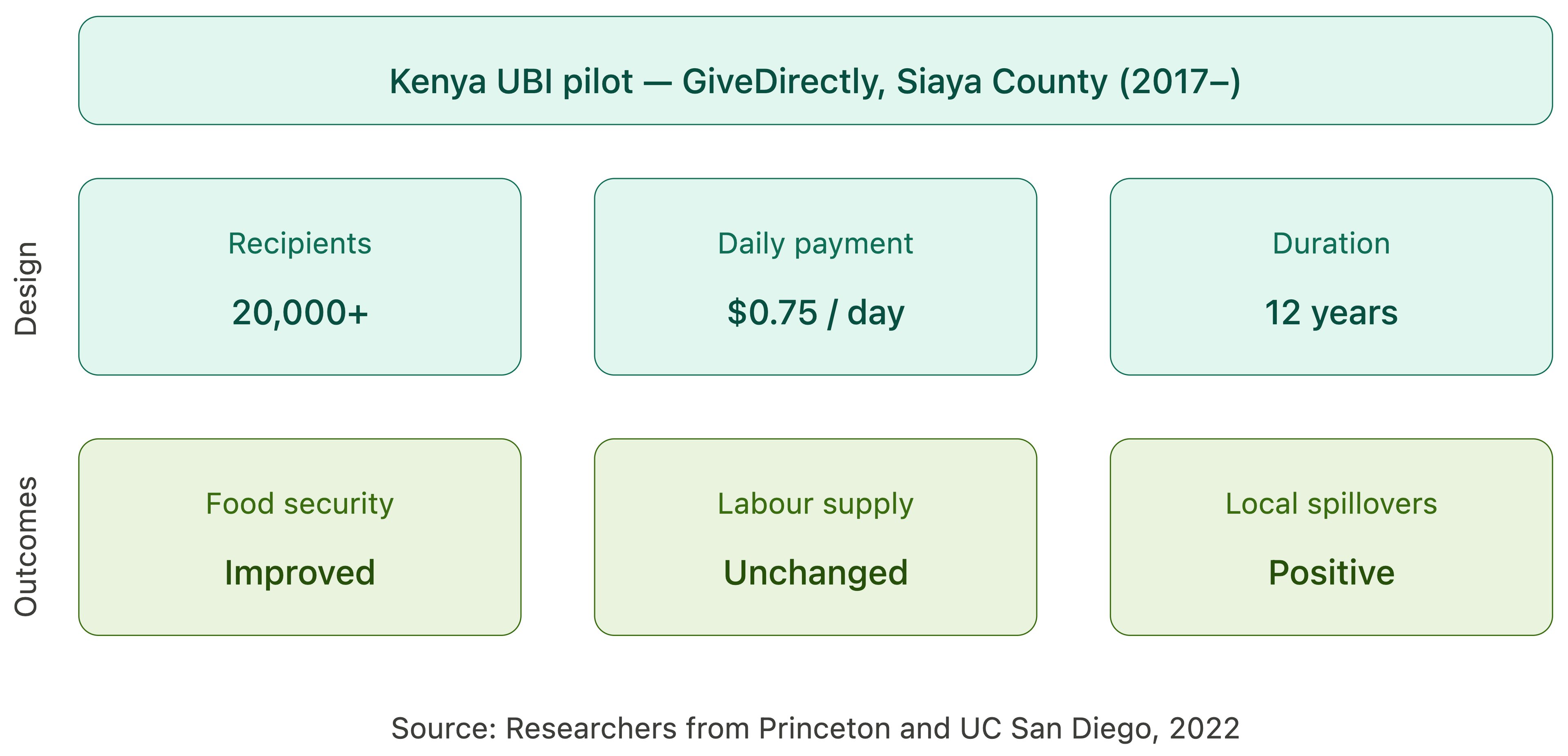
Early results published by researchers from Princeton and UC San Diego found significant positive effects
Recipient households increased assets, food security and psychological wellbeing
There was evidence of positive spillover effects to non-recipient households in the same villages through increased local economic activity
Crucially, there was no significant reduction in labour supply - recipients worked as much as control group households, challenging the moral hazard concern
However critics note that a donor-funded pilot with a guaranteed end date cannot replicate the fiscal and behavioural dynamics of a permanent government-funded UBI at national scale
Comparing the four policies
Policy | Poverty trap? | Targets the poorest? | Administrative cost | Fiscal cost |
|---|---|---|---|---|
Means-tested benefits |
|
|
|
|
Universal benefits |
|
|
|
|
Negative income tax |
|
|
|
|
Universal basic income |
|
|
|
|
Examiner Tips and Tricks
The poverty trap is the central weakness of means-tested benefits - benefit withdrawal combined with income tax creates a high EMTR, so work does not pay at the margin.
NIT and UBI both solve the poverty trap but at significant fiscal cost - the key distinction is that NIT targets those below a threshold; UBI is paid to everyone.
Structure evaluation using the equity-efficiency trade-off: means-tested benefits are fiscally efficient but damage work incentives; UBI preserves incentives but is poorly targeted and very expensive.
The Kenya pilot challenges the moral hazard assumption - but pilot evidence may not generalise to permanent national-scale implementation.

Unlock more, it's free!
Join the 100,000+ Students that ❤️ Save My Exams
the (exam) results speak for themselves:

Was this revision note helpful?