Causes & Effects of Government Failure (Cambridge (CIE) A Level Economics): Revision Note
Exam code: 9708

Government failure
Government failure occurs when government intervention in a market creates a net welfare loss - moving output further from the socially optimal level rather than closer to it
It does not mean the intervention has no effect
It means the costs of intervention exceed its benefits, leaving society worse off than without intervention
Government failure is a critical evaluative concept: every policy used to correct market failure carries the risk of creating government failure if poorly designed or implemented
Causes of government failure
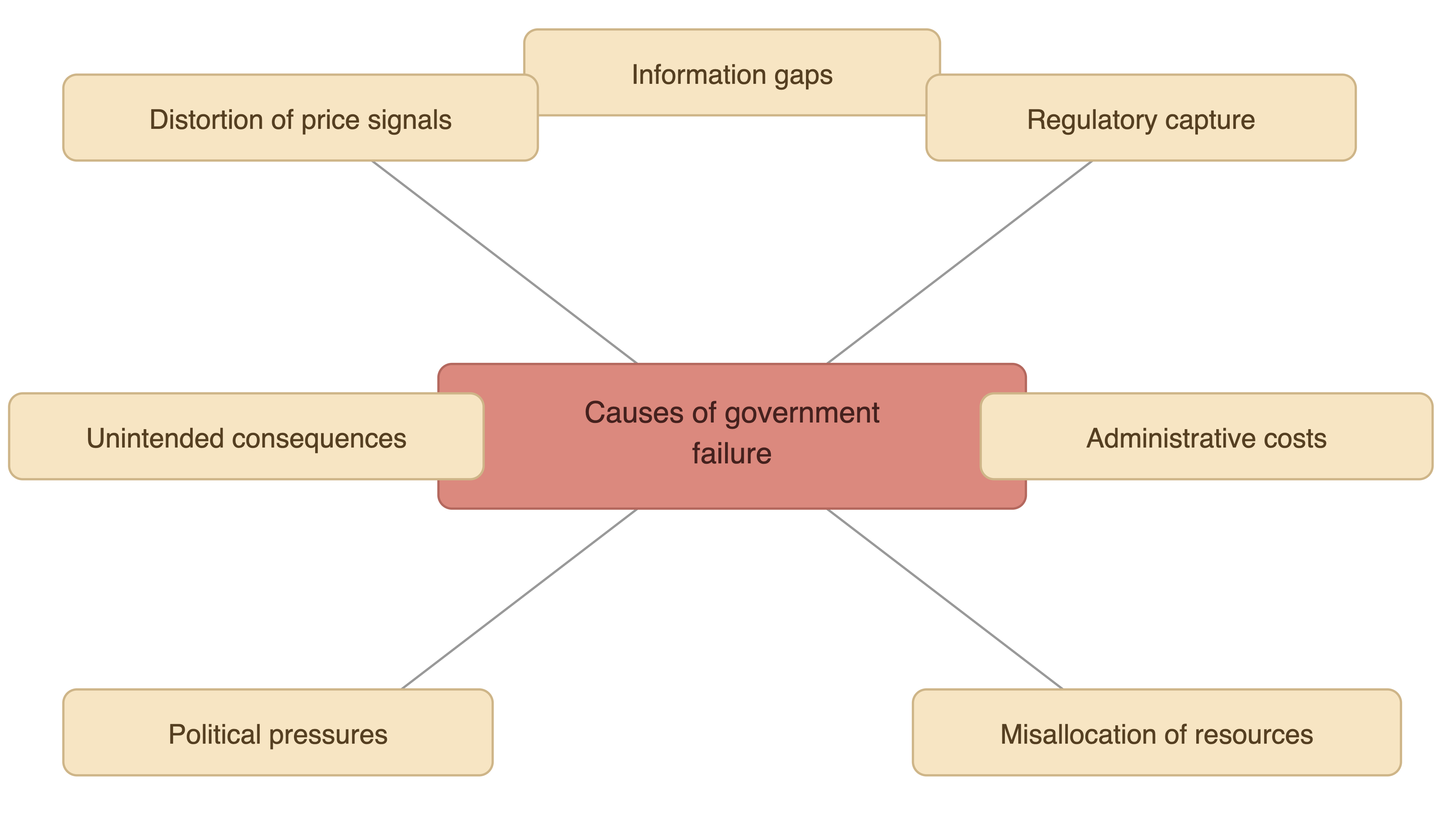
Cause | Explanation | International example |
|---|---|---|
Information gaps |
|
|
Distortion of price signals |
|
|
Unintended consequences |
|
|
Regulatory capture |
|
|
Administrative and compliance costs |
|
|
Political pressures |
|
|
Consequences of government failure
There are many possible consequences of government failure
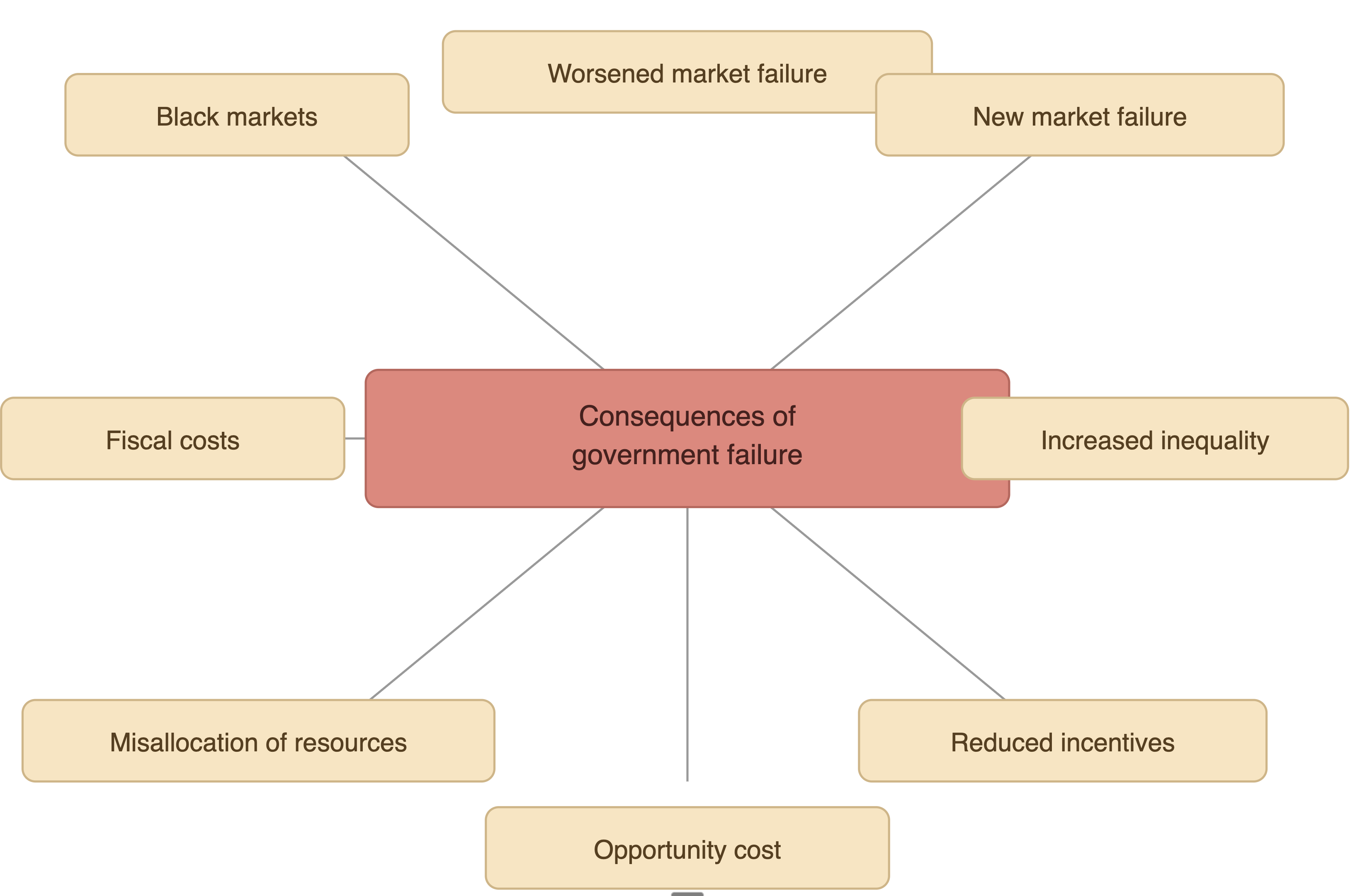
Worsening of the original market failure
Intervention set at the wrong level may increase rather than decrease the deadweight welfare loss
For example, a subsidy set too high leads to over-consumption beyond Qopt, creating a new welfare loss on the other side of the social optimum
Creation of a new market failure
Intervention in one market generates distortions in related markets
For example, agricultural price floors create excess supply that depresses prices in related markets and distorts international trade flows, as seen with EU agricultural policy
Black markets
Price controls and prohibitions push activity into illegal markets where consumer protections, quality standards and tax collection are absent
For example, rent controls in New York, Stockholm and Mumbai have generated significant informal rental markets operating outside the legal framework
Misallocation of resources
Government intervention keeps resources in declining or inefficient sectors rather than allowing them to shift to higher-value uses
For example, long-term coal subsidies in Poland and India have slowed the transition to renewable energy by artificially sustaining uncompetitive production
Fiscal costs and opportunity cost
Poorly designed interventions impose ongoing costs on government budgets, crowding out spending on other public goods
For example, fuel subsidies consumed over 20% of government spending in Nigeria at their peak, representing a massive opportunity cost relative to investment in healthcare, education and infrastructure
Increased inequality
Some interventions disproportionately benefit wealthier groups despite being designed to improve equity
For example, university education subsidies in many countries disproportionately benefit higher-income students who are more likely to access higher education, worsening rather than improving income distribution
Case Study
Fuel subsidies in Nigeria
The context
Nigeria introduced fuel subsidies to make petrol affordable for its population, the majority of whom live on low incomes.
At their peak the subsidies consumed a vast share of government revenue, making them one of the most significant examples of government failure through fiscal cost and misallocation in any developing economy.
Actions taken
The Nigerian government subsidised petrol prices for decades, keeping pump prices well below market rates
Multiple attempts to remove subsidies were reversed following public protests - illustrating how political pressure perpetuates economically inefficient intervention
In May 2023, newly elected President Bola Tinubu abruptly ended the subsidy, causing fuel prices to triple overnight
Outcomes
Removal of the subsidy caused significant short-term inflation and hardship for low-income households - the very group the subsidy was meant to protect
This illustrates a central paradox of government failure: poorly designed interventions can become so embedded that their removal also causes harm
Critics note that wealthier Nigerians, who own more vehicles, captured a disproportionate share of the subsidy benefit, making the policy both fiscally costly and regressive
Examiner Tips and Tricks
Government failure is not a reason to avoid intervention — it is a reason to design intervention carefully. Strong answers acknowledge that both market failure and government failure exist and evaluate which is likely to be greater in context.
The most examinable causes are information gaps and unintended consequences - always support each with a specific international example.
Connect government failure to allocative efficiency: it occurs when intervention moves output away from Qopt, increasing rather than reducing the deadweight welfare loss.
For higher-mark responses, show that every policy carries its own specific risk of government failure, demonstrating sophisticated understanding of the intervention trade-offs.

Unlock more, it's free!
Join the 100,000+ Students that ❤️ Save My Exams
the (exam) results speak for themselves:

Was this revision note helpful?
