Subsidies & Direct Provision (Cambridge (CIE) A Level Economics): Revision Note
Exam code: 9708

Subsidies and direct provision
Governments use subsidies and direct provision to correct under-consumption of merit goods and under-provision of public goods - where the free market produces less than the socially optimal level of output
Both policies work by reducing the cost of consuming or producing a good, shifting output closer to where MSB = MSC
Subsidies
A subsidy is a payment from the government to producers or consumers to reduce the cost of production or consumption
Subsidies can be targeted at:
Producers: shifting the supply curve rightward, reducing the market price and increasing quantity supplied
Consumers: shifting the demand curve rightward, increasing willingness to pay and quantity demanded
The most common form is a producer subsidy, which reduces marginal private costs and is shown as a rightward shift of the supply curve
International examples of subsidies
India: heavily subsidises fertilisers and food staples to support agricultural production and food security for low-income households
Germany and South Korea: have provided substantial subsidies for electric vehicle (EV) production and purchase to correct the positive externality of reduced carbon emissions
Brazil: subsidises ethanol fuel production from sugarcane, internalising the positive externality of lower carbon emissions relative to fossil fuels
Kenya and Rwanda: governments subsidise primary and secondary education to correct under-consumption caused by imperfect information about the private and external benefits of schooling
Subsidy on a merit good
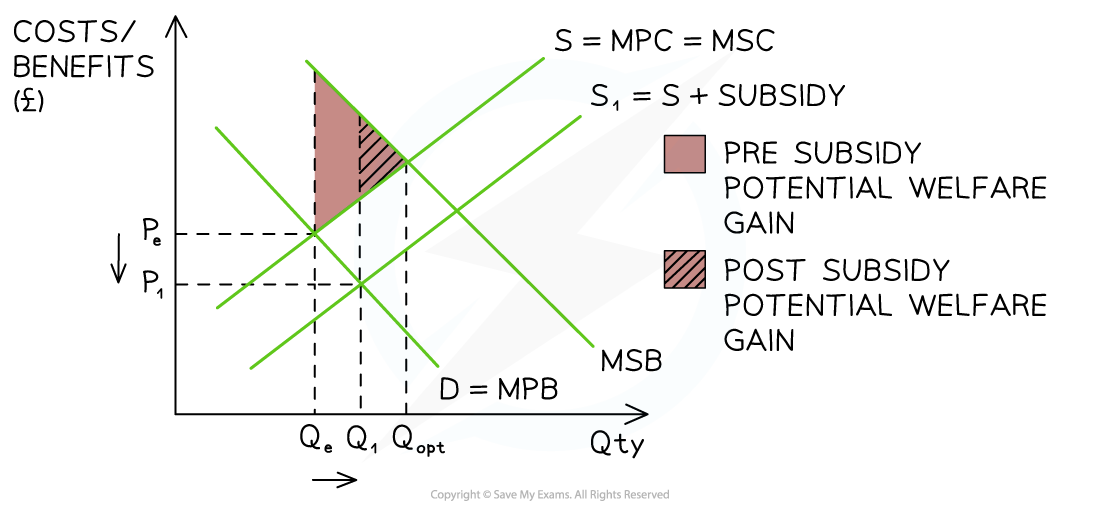
Diagram analysis
The free-market equilibrium is at PeQe, where MPB = MPC
As MSB > MPB, consumers undervalue the external benefits of consumption
Output is below the socially optimal level (Qopt) - there is under-consumption
There is a pre-subsidy welfare loss shown by the shaded triangle between Qe and Qopt
A producer subsidy shifts supply right from S → S₁, where S₁ = MPC − subsidy
The market price falls from Pe → P₁ and output rises from Qe → Q₁
Output moves closer to Qopt, reducing the welfare loss
The post-subsidy welfare loss is smaller than the pre-subsidy welfare loss
The subsidy only fully eliminates the welfare loss if it is set exactly equal to the marginal external benefit (MEB) at Qopt
Subsidy incidence
As with taxation, the benefit of a subsidy is shared between consumers and producers, and the split depends on PED and PES
If demand is price inelastic, consumers benefit less from the lower price — producers capture more of the subsidy as higher profit margins
If demand is price elastic, the price fall is larger and consumers capture more of the benefit - output increases more significantly, which is more effective at correcting under-consumption
This means subsidies on goods with inelastic demand may be less effective at increasing consumption to the socially optimal level
Evaluating the effectiveness of subsidies
Setting the correct subsidy rate
To fully correct under-consumption, the subsidy must equal the MEB at Qopt
In practice this is very difficult to calculate accurately, meaning the subsidy is likely to be set too high or too low
A subsidy set too high leads to over-consumption beyond Qopt, creating a new welfare loss and wasting government resources
Opportunity cost of government spending
Subsidies represent a significant fiscal cost to the government
In lower-income economies this is particularly constraining — for example, India's fertiliser subsidy programme consumes a large share of the government budget, limiting spending on other public goods
There is always an opportunity cost: resources spent on subsidies cannot be used for healthcare, infrastructure or debt reduction
Effectiveness depends on PED
If demand is price inelastic, even a large subsidy produces only a small increase in consumption - the policy may be costly but ineffective at reaching Qopt
Subsidies are most effective when demand is price elastic, so that the fall in price generates a proportionally larger increase in quantity demanded
Risk of government failure
Subsidies can become politically difficult to remove even when no longer needed, creating long-term fiscal burdens
They may also be captured by producers rather than passed on to consumers as lower prices, particularly where markets are uncompetitive
Example: agricultural subsidies in many economies have historically benefited large agribusinesses more than smallholder farmers, failing to achieve their equity objectives
Equity considerations
Subsidies on merit goods such as education and healthcare can reduce inequality by improving access for lower-income groups
However, if subsidies are poorly targeted, wealthier households may capture a disproportionate share of the benefit - a common criticism of university education subsidies in many countries
Direct provision
Direct provision occurs when the government itself supplies a good or service, either free at the point of use or below the market price
It is used when:
The market completely fails to provide a good, as with public goods (non-excludable, non-rivalrous) where the free rider problem prevents private supply
The market under-provides a merit good to such a degree that subsidising private suppliers is insufficient
Unlike a subsidy, direct provision removes the price mechanism entirely for that good - quantity is determined by government rather than market forces
International examples of direct provision
Public goods: national defence is directly provided by governments in virtually every country. Private firms cannot profitably supply it due to non-excludability
Healthcare: in Canada, Cuba, and many European countries, core healthcare services are directly provided by the state, correcting under-consumption caused by imperfect information and income inequality
Education: South Korea and Finland provide free state education through to upper secondary level, ensuring consumption closer to the socially optimal level
Infrastructure: many governments in Sub-Saharan Africa and South Asia directly provide roads, water supply and sanitation where private markets fail due to low incomes and high fixed costs
Evaluating the effectiveness of direct provision
Allocative efficiency
Direct provision can move output to the socially optimal level if the government correctly identifies Qopt
However, without the price mechanism to signal consumer preferences, governments may produce the wrong quantity or quality of the good
X-inefficiency
State-provided goods and services face no competitive pressure, which can lead to X-inefficiency — costs are higher than the minimum necessary because there is no profit motive to minimise them
This is a key argument for privatisation and contracting out public services to private providers
Equity
Direct provision, particularly of healthcare and education, is often strongly pro-equity — it ensures access regardless of income
This is especially important in economies with high income inequality, where a pure market would exclude large portions of the population from consuming socially beneficial goods
Subsidies vs direct provision: key comparison
Feature | Subsidy | Direct Provision |
|---|---|---|
Mechanism |
|
|
Best suited to |
|
|
Consumer choice |
|
|
Government cost |
|
|
Risk of inefficiency |
|
|
Examiner Tips and Tricks
Always distinguish between the size of the welfare loss reduction and full correction: a subsidy reduces the welfare loss but only eliminates it entirely if set equal to the MEB at Qopt. Examiners reward this precision.
When evaluating subsidies, the two strongest points at A Level are:
The difficulty of measuring MEB accurately, and
The opportunity cost of government expenditure - always try to support the latter with a country-specific example.
For direct provision, the key evaluative tension is equity vs efficiency: direct provision tends to score well on equity but poorly on productive efficiency due to X-inefficiency

Unlock more, it's free!
Join the 100,000+ Students that ❤️ Save My Exams
the (exam) results speak for themselves:

Was this revision note helpful?
