Experimental Design (OCR A Level Physics): Exam Questions

Exam code: H556

1 hour15 questions
1
6 marks

A resistance wire is coiled around a thermistor. The coil of wire will warm the thermistor.

It is suggested that the relationship between the power P dissipated in the coiled wire and the stable resistance R of the thermistor is given by the expression P = kRn, where k and n are constants.

Describe how an experiment can be conducted to assess the validity of this expression and how the data collected can be analysed to determine k and n.

Use the space below for a circuit diagram.

2a
3 marks

A metal strip has thickness t, as shown below.

q17a-paper-1-nov-2021-ocr-a-level-physics

Five measurements of the thickness t at different positions along the length of the strip are shown below.    

1.86mm

1.88mm

1.85mm 

1.89mm

1.88mm

Determine the percentage uncertainty in the thickness t.

percentage uncertainty = ..................................................... %

2b
6 marks

A student wants to determine the Young modulus E of the metal of the strip in (a).

The student clamps the metal strip to the edge of a table using a G-clamp. A mass is permanently fixed to the end of the strip as shown.

q17b-paper-1-nov-2021-ocr-a-level-physics

The mass oscillates freely when it is moved away from its equilibrium position and then released.

The Young modulus E of the metal can be determined using the equation

E space equals space fraction numerator 16 space pi squared m L cubed over denominator w t cubed T squared end fraction

where m is the mass fixed to the end of the strip, L is the length of the strip from the end of the table to the centre of the mass, w is the width of the strip, t is the thickness of the strip, and T is the period of oscillations.

Describe how an experiment may be safely conducted, and how the data can be analysed to determine an accurate value for E.

3a
3 marks

This question is about a light-dependent resistor (LDR).

A student connects a potential divider circuit as shown below. It contains an LDR.

q2a-paper-3-nov-2021-ocr-a-level-physics

The fixed resistor has resistance 1500 Ω. The battery has electromotive force (e.m.f.) 12 V and negligible internal resistance. The voltmeter has extremely high resistance.

i) When the LDR is covered, its resistance is 3000 Ω.

Calculate the voltmeter reading.

voltmeter reading = ..................................................... V[2]

ii) When fully illuminated, the resistance of the LDR is 100 Ω.

Show that the voltmeter reading changes by more than 7 V.

[1]

3b
6 marks

The current in an LDR depends on the intensity of light incident on it.

A student decides to alter the intensity of light incident on an LDR by using sheets of tracing paper and a light source.

The diagram below shows part of an arrangement suggested by the student.

q2b-paper-3-nov-2021-ocr-a-level-physics

It is suggested that the current I in the LDR is given by the expression

I = ke–nx

where x is the total thickness of the sheets of tracing paper, and k and n are constants.

Describe how the student could carry out an experiment to verify the validity of this expression and determine k and n. Include in your answer

  • a circuit diagram

  • a possible table for the results, including the headings

  • the graph plotted to determine k and n

  • any precautions taken to improve the quality of the results.

4a
1 mark

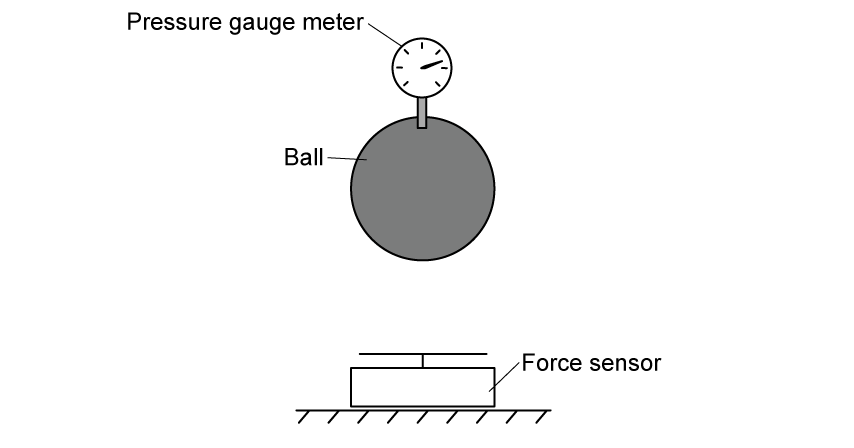
A group of students investigates how the maximum force F subscript max exerted by a rebounding ball depends on its internal gauge pressure increment p.

They use a pressure gauge to measure the difference between the atmospheric pressure and the ball's internal pressure. The ball is dropped from a fixed height onto a force sensor that records the maximum force exerted on it during impact.

The equipment used is shown in Fig. 2.1.

Fig. 2.1

A ball positioned above a force sensor with a pressure gauge attached to measure internal pressure.

Describe one consideration that must be made when dropping the ball on the force sensor to ensure that the maximum force is measured accurately.

4b
Sme Calculator
4 marks

The students systematically increase the gauge pressure and measure F subscript max from a force-time graph displayed on a computer connected to the sensor.

Gauge pressure ∆p / kPa

Maximum force Fmax / N

20

130

40

171

60

189

80

218

100

234

120

250

(i) State one variable that needs to be controlled when collecting the data.

[1]

(ii) Suggest how the students determined the value of F subscript max from a force-time graph.

[1]

(iii) Use the data to show that a graph of F subscript m a x end subscriptagainst increment p would not be a straight line through the origin.

[2]

4c
5 marks

The students suggest the following relationship between F subscript max and increment p:

F subscript max superscript 3 space equals space k increment p

where k is a constant.

To verify the relationship, the variation of F subscript max superscript 3 with increment p is plotted.

One data point is missing.

Scatter plot showing a positive correlation between maximum force on the y-axis and gauge pressure on the x-axis, with five data points plotted.

(i) Determine the coordinates of the missing point using the original data set and plot it on the graph.

[1]

(ii) The percentage uncertainty in F subscript max is ±3%.

Determine the uncertainty in F subscript max superscript 3 when increment p = 60 kPa and draw the uncertainty bar for this data point on the graph.

[3]

(iii) The SI units of k can be expressed as kg to the power of x space straight m to the power of y space straight s to the power of z.

Determine the values of x, y and z.

[1]

4d
2 marks

The students collect only one value of F subscript max for each value of increment p.

Suggest why this is a poor method in terms of reliability.

1a
2 marks

A group of students are conducting an experiment in the laboratory to determine the value of absolute zero by heating a fixed mass of gas. The volume of the gas is kept constant. Fig. 17.1 shows the arrangement used by the students.

q17-paper-1-june-2017-ocr-a-level-physics

Fig. 17.1

The gas is heated using a water bath. The temperature θ of the water is increased from 5 °C to 70 °C. The temperature of the water bath is assumed to be the same as the temperature of the gas. The pressure p of the gas is measured using a pressure gauge.

The results from the students are shown in a table.

θ / °C

p / kPa

5 ± 1

224 ± 3

13 ± 1

231 ± 3

22 ± 1

238 ± 3

35 ± 1

248 ± 3

44 ± 1


53 ± 1

262 ± 3

62 ± 1

269 ± 3

70 ± 1

276 ± 3

Describe and explain how the students may have made accurate measurements of the temperature θ.

1b
3 marks

Fig. 17.2 shows the pressure gauge. Measurements of p can be made using the kPa scale or the psi (pounds per square inch) scale. The students used the psi scale to measure pressure and then converted the reading to pressure in kPa.

q17b-paper-1-june-2017-ocr-a-level-physics

Fig. 17.2

i) Suggest why it was sensible to use the psi scale to measure p.

[1]

ii) The students made a reading of p of 37.0 ± 0.5 psi when θ was 44 ± 1°C.

Convert this value of p from psi to kPa. Complete the table for the missing value of p.

Include the absolute uncertainty in p.

1 pound of force = 4.448 N

1 inch = 0.0254 m

[2]

1c
7 marks

Fig. 17.3 shows the graph of p against θ.

q17c-paper-1-june-2017-ocr-a-level-physics

Fig. 17.3

i) Plot the missing data point and the error bars on Fig. 17.3.

[1]

*ii) Explain what is meant by absolute zero. Describe how Fig. 17.3 can be used to determine the value of absolute zero.

Determine the value of absolute zero. You may assume that the gas behaves as an ideal gas.

[6]

1d
2 marks

Describe, without doing any calculations, how you could use Fig. 17.3 to determine the actual uncertainty in the value of absolute zero in (c)(ii).

1e
4 marks

The experiment is repeated as the water bath quickly cools from 70 °C to 5 °C. Absolute zero was found to be −390 °C.

Compare this value with your value from (c)(ii) and explain why the values may differ. Describe an experimental approach that could be taken to avoid systematic error in the determination of absolute zero.

2
6 marks

A student makes a pendulum using a length of string with a ball of adhesive putty which acts as a bob. The mass of this bob is M.

A similar second pendulum is constructed with the same length of string but with a bob of a smaller mass. The mass of this bob is m.

The arrangement of the pendulums is shown below.

q19-paper-1-nov-2020-ocr-a-level-physics

The bob of mass M is pulled back to a vertical height of H from its rest position. It is released and collides with the bob of mass m. The two bobs then stick together and reach a maximum vertical height h from the rest position.

The height h is given by the equation h equals open parentheses fraction numerator M over denominator M plus m end fraction close parentheses squared H

Describe how to perform an experiment to test the validity of this equation and how the data can be analysed.