Electromagnetic Induction (OCR A Level Physics): Structured Questions

Exam code: H556

1 hour10 questions
1a
3 marks

The diagram below shows two long vertical current-carrying wires X and Y.

q22a-paper-2-nov-2020-ocr-a-level-physics

The direction of the current in each wire is the same.

Explain why wire Y experiences a force and deduce the direction of this force.

[3]

1b
4 marks

i) State Faraday’s law of electromagnetic induction.

[1]

ii) The diagram below shows a simple transformer constructed by a student.

q22b-ii-paper-2-nov-2020-ocr-a-level-physics

Describe how the student can do an experiment in the laboratory to show that the maximum electromotive force (e.m.f.) E induced in the secondary coil is directly proportional to the number of turns N on the secondary coil.

[3]

1a
6 marks

A student conducts an experiment to confirm that the uniform magnetic flux density B between the poles of a magnet is 30 mT.

A current-carrying wire of length 5.0 cm is placed perpendicular to the magnetic field.

The current I in the wire is changed and the force F experienced by the wire is measured. Fig. 22.1 shows the graph plotted by the student.

Graph of force F in units of 10^−3^ N, from 0 to 6.0 on the vertical axis, against current I in A, from 1.0 to 3.5 on the horizontal axis. Five points are plotted, at currents of 1.25 A, 1.8 A, 2.0 A, 2.25 A and 3.0 A, with forces of about 2.2, 2.4, 3.0, 4.0 and 4.2 × 10^−3^ N. Each point has a vertical error bar of ±0.4 × 10^−3^ N. A straight line is drawn from 1.4 × 10^−3^ N at 1.0 A to 5.4 × 10^−3^ N at 3.5 A. A dashed right-angled triangle on the line runs horizontally from (2.0 A, 3.0 × 10^−3^ N) to 2.5 A and then vertically up to 3.8 × 10^−3^ N.

Fig. 22.1

The student’s analysis is shown on the graph of Fig. 22.1 and in the space below.

F = BIL

gradient = BL = \frac{\left(3.8 - 3.0\right) \times 10^{-3}}{2.5 - 2.0} = 0.0016

B = \frac{0.0016}{0.05} = 0.032 T = 32 mT

This is just 2 mT out from the 30 mT value given by the manufacturer, so the experiment is very accurate.

Evaluate the information from Fig. 22.1 and the analysis of the data from the experiment. No further calculations are necessary.

1b
7 marks

Fig. 22.2 shows a transformer circuit.

Diagram of a transformer: a square soft-iron core with a primary coil wound on its left side and a secondary coil wound on its right side. The primary coil's two leads end in terminals labelled alternating supply. The secondary coil's two leads are connected to a filament lamp.

Fig. 22.2

The primary coil is connected to an alternating voltage supply. A filament lamp is connected to the output of the secondary coil.

(i) Use Faraday’s law of electromagnetic induction to explain why the filament lamp is lit.

[3]

(ii) The primary coil has 400 turns and the secondary coil has 20 turns. The potential difference across the lamp is 12 V and it dissipates 24 W. The transformer is 100% efficient.

1. Calculate the current in the primary coil.

current = ................................. A [2]

2. The alternating voltage supply is replaced by a battery and an open switch in series. The switch is closed. The lamp is lit for a short period of time and then remains off.

Explain this observation.

[2]

2a
4 marks

Fig. 21.1 shows a coil of a simple generator rotating in a uniform magnetic field.

q21-paper-2-june-2018-ocr-a-level-physics

Fig. 21.1

The coil has 85 turns of insulated wire. The cross-sectional area of the coil is 14cm2. Fig. 21.2 shows the variation of magnetic flux density B through the plane of the coil with time t as it rotates.

screenshot-2022-12-30-at-12-03-18

Fig. 21.2

i) Explain why the electromotive force (e.m.f.) induced across the ends of the coil is a maximum at the times when B = 0.

 [1]

ii) Draw a tangent to the curve in Fig. 21.2 when B = 0, and hence determine the maximum e.m.f. induced across the ends of the coil.

maximum e.m.f. = ...................................................... V [3]

2b
2 marks

Fig. 21.3 shows the variation of the e.m.f. induced across the ends of the coil with time t.

q21b-paper-2-june-2018-ocr-a-level-physics

Fig. 21.3

The magnitude of the magnetic flux density of the uniform field is now halved and the coil is rotated at twice its previous frequency. On Fig. 21.3 sketch the new variation of the e.m.f. induced with time t.

[2]

3a
1 mark

State Faraday’s law of electromagnetic induction.

3b
2 marks

A rectangular coil of wire has 50 turns and a cross-sectional area of 4.0 \times 10^{-3} \text{ m}^2.

The coil is placed in a uniform magnetic field of flux density 0.060 \text{ T}.

The coil rotates about an axis perpendicular to the magnetic field.

Calculate the maximum magnetic flux linkage through the coil.

3c
5 marks

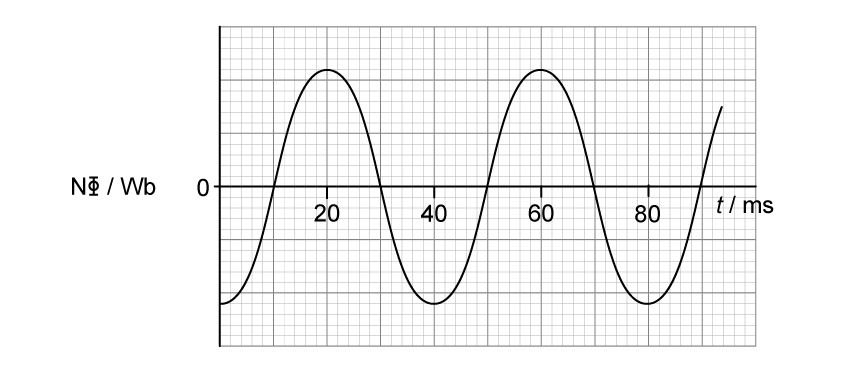
Fig. 21.1 shows the variation of magnetic flux linkage N capital phi with time t for the rotating coil.

Fig. 21.1

A graph showing two complete cycles of a cosine wave, starting at maximum negative flux linkage at t = 0, then first crosses zero at t = 10 ms, then first positive maximum at t = 20 ms.

(i) Determine the maximum electromotive force (e.m.f.) induced in the coil.

[2]

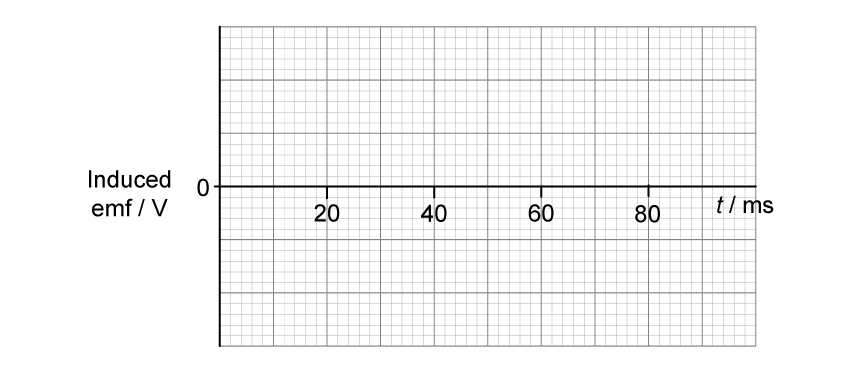
(ii) On the axes provided in Fig. 21.2, sketch the corresponding variation of the induced e.m.f. \epsilon with time t.

Fig. 21.2

Blank axes labeled Induced e.m.f. / V on y-axis and Time / s on x-axis, with the same time scales as Fig 21.1.

[3]

1a
5 marks

A magnet rotates inside a shaped soft iron core. A coil is wrapped around the iron core as shown in Fig. 5.1. The coil is connected to an oscilloscope.

Left, Fig. 5.1: a soft iron core shaped like a squared-off horseshoe, with a circular gap at the bottom in which a bar magnet, N and S, spins about its centre, shown by a curved arrow. A coil is wound around the narrow top section of the core and its two leads are labelled "to oscilloscope". Right, Fig. 5.2: a grid with e.m.f. on the vertical axis (+, 0 and −) and time on the horizontal axis. A sine curve starts at zero, rises to a positive peak and shows one and a half cycles across the grid.

Fig. 5.1

Fig. 5.2

The spinning magnet induces an e.m.f. in the coil. A graph of the e.m.f. displayed on the oscilloscope screen is shown in Fig. 5.2.

(i) Explain the shape of the graph in terms of the magnetic flux linking the coil.

[2]

(ii) On Fig. 5.3 sketch a graph of the magnetic flux linkage of the coil against time. The variation of the induced e.m.f. across the coil is shown as a dotted line.

[1]

A grid with magnetic flux linkage on the vertical axis, marked +, 0 and −, and time on the horizontal axis. A dotted sine curve labelled e.m.f. starts at zero, rises to a positive peak and shows one and a half cycles across the grid.

Fig. 5.3

(iii) The coil shown in Fig. 5.1 has 150 turns. The maximum induced e.m.f. V0 across the coil is 1.2 V when the magnet is rotating at 24 revolutions per second.

Calculate the maximum magnetic flux through the coil using the equation

V_{0} = 2\pi \times \left(\text{frequency}\right) \times \left(\text{maximum magnetic flux linkage}\right)

Give a unit with your answer.

maximum flux = ..................................... unit ..............

[2]

1b
6 marks

A student is given a transformer with coils X and Y, as shown in Fig. 5.4.

Diagram of a transformer: a square soft iron core, shaded grey, with a square hole in the middle. Coil X, with fewer turns, is wound on the left side of the core and coil Y, with many more turns, on the right side. Each coil has two leads ending in terminals.

Fig. 5.4

The student is intending to investigate how the maximum induced e.m.f. V0 in coil Y depends on the frequency f of the alternating current in coil X.

The changing magnetic flux density in coil X induces an e.m.f. in coil Y. Faraday’s law indicates that the maximum induced e.m.f. V0 should be directly proportional to f.

Describe how you would investigate the suggested relationship between V0 and f in the laboratory using these coils. In your description include all of the equipment used and how you would analyse the data collected.

Use the space below to draw a suitable diagram.

2a
3 marks

Fig. 3.1 shows the design of a ‘mechanical’ torch.

Cut-away diagram of a torch drawn with dashed outline. Inside is a horizontal tube with a coil of wire wrapped around its middle and a cylindrical magnet inside the tube at one end; a double-headed arrow shows the magnet can move along the tube. The distance h is marked from the closed end of the tube to the near face of the magnet. Two wires from the coil lead to a label reading "To capacitor and LED".

Fig. 3.1

There is no battery in the torch. Instead, when the torch is inverted, the magnet falls a short vertical distance h through the coil of wire, as shown in Fig. 3.2. This induces an electromotive force (e.m.f.) across the ends of the coil. The e.m.f. is used to store charge in a capacitor, which lights a light-emitting diode (LED) when it discharges.

Two drawings of the torch held vertically, one the right way up and one upside down, with curved arrows between them showing it being inverted. In each, the magnet falls a vertical distance h down the tube, passing through the coil around the tube.

Fig. 3.2

Fig. 3.3 shows the variation with time of the e.m.f. generated as the magnet falls the distance h.

Graph of e.m.f. against time from 0 to 0.2 s. The e.m.f. rises from zero to a broad positive peak at about 0.08 s, falls through zero at about 0.11 s, then drops to a larger and narrower negative peak at about 0.13 s before returning to zero at about 0.18 s.

Fig. 3.3

Explain the shape of the curve in Fig. 3.3.

2b
4 marks

When the torch is inverted, the pulses of e.m.f. shown in Fig. 3.3 cause a capacitor of capacitance 0.12 F to become charged.

Each positive and each negative pulse adds 9.0 × 10⁻³ C to the charge stored in the capacitor.

(i) The torch is inverted 80 times.

Calculate the total energy stored in the capacitor.

total energy = ...................................................... J

[3]

(ii) When the torch is switched on, the energy stored in the capacitor lights a 50 mW LED.

Estimate the time for which the LED lights.

time = ...................................................... s

[1]

2c
6 marks

In the torch, the gravitational potential energy of the magnet is converted into electrical energy supplied to the 50 mW LED.

You are asked to investigate whether the efficiency of this energy conversion depends on the number of inversions of the torch.

  • Describe how you will make accurate measurements to collect your data. Assume that both the torch and the tube can be opened.

  • Explain how you will use the data to reach a conclusion.