Festivals and Traditions: Exam Skills (AQA GCSE Spanish): Revision Note
Exam code: 8692

Festivals and traditions: listening
This task focuses on quickly retrieving details related to dates, locations, and traditions using a matching question format, common in both Foundation and Higher Tier.
Worked Example
Listen to three students discussing traditional celebrations. Match each student (1-3) to the event they are describing (A-E).
Alberto
Julia
Marcos
Options:
A. La Tomatina
B. Una fiesta privada
C. El Día de Reyes
D. Una procesión
E. La Nochevieja
[3 marks]
Answer
E (come doce uvas)
A (tradición en Valencia)
C (6 de enero)
Festivals and traditions: speaking
This task focuses on Part 1 (Role-play), requiring multiple details to achieve full marks. It tests the productive use of grammar like adjective position and indefinite adjectives.
Worked Example
Foundation Tier
Prepare a presentation where you are talking to a friend about a traditional cultural event you plan to attend.
In order to score full marks, you must include at least one verb in your response to each task
Say which festival you want to visit. (Give one detail.)
Give one opinion about the atmosphere or the people. (Give one opinion.)
Say one thing you usually do to prepare for a festival. (Give one detail.)
Say one specific activity you are going to do at the festival. (Give one detail.)
Ask a question about celebrations/traditions.
[10 marks]
Possible teacher’s script (Friend's role)
¿Qué fiesta tradicional quieres visitar y por qué?
What traditional festivity do you want to visit and why?
¿Qué piensas del ambiente de la fiesta o de la gente?
What do you think about the celebration's or the people's atmosphere?
¿Qué sueles hacer para prepararte para ir a una fiesta tradicional?
What do you usually do to prepare for a festival?
¿Qué vas a hacer en ese festival?
What are you going to do at that festival?
?
Answer:
This response uses vocabulary and tenses appropriate for the Foundation curriculum, relying primarily on the Present tense and the Immediate Future (ir a + infinitive), which would be enough to achieve high marks.
Quiero visitar Las Fallas en Valencia. (I want to visit Las Fallas in Valencia.)
Present Tense (Quiero) and one details (name).
Pienso que es una gran fiesta. (I think that it is a great festivity.)
Adjective position (gran before fiesta) and Present Tense (es).
Normalmente ayudo a mi madre a cocinar. (I normally help my mum cook.)
Present Tense (Ayudo) used for habitual actions/preparation.
Voy a ver el desfile con mi amigo. (I'm going to watch the parade with my friend.)
Immediate Future (Voy a ver) and one detail.
¿Qué tradiciones celebras en tu familia? (What traditions do you celebrate in your family?)
Worked Example
Higher Tier
Prepare a presentation where you are talking to a friend about a traditional cultural event you plan to attend.
In order to score full marks, you must include at least one verb in your response to each task
Say what traditional festival you attended last year. (Give two details.)
Give two characteristics of Sanfermines. (Give two details.)
Say what your favourite celebration is and why. (Give one opinion and one reason.)
Give two disadvantages of going to big public festivals. (Give two details.)
Ask your friend a question about festivals.
[10 marks]
Possible Teacher’s Script (Friend's Role)
¿Qué dos festivales tradicionales visitaste el año pasado?
What two traditional festivals did you visit last year?
Describe las características de los Sanfermines.
Describe the characteristics of Sanfermines.
¿Cuál es tu celebración favorita y por qué?
What is your favourite celebration and why?
¿Cuáles son dos desventajas de asistir a festivales públicos grandes?
What are two disadvantages of attending large public festivals?
?
Answer:
El año pasado, fui a las Fallas en Valencia. Vi muchísimos fuegos artificiales y hacía demasiado viento esa noche.
Last year, I went to Las Fallas in Valencia. I saw lots of fireworks and it was too windy that night.
Past tense (fui, vi, hacía), superlative (muchísimos), quantity (demasiado).
Los Sanfermines son un espectáculo muy popular que consiste en correr delante de los toros. Los extranjeros pueden participar, pero es peligroso.
Sanfermines are a very popular spectacle which consists of running in front of the bulls. Foreigners can participate, but it is dangerous.
Complexity (e.g., consiste en + infinitive), Higher Tier vocabulary (espectáculo, extranjeros).
Mi celebración favorita es el Día de Muertos porque me gustaría ver los altares y aprender más de su cultura.
My favourite celebration is the Day of the Dead because I would like to see the altars and learn more about its culture.
Conditional tense (me gustaría) to express desire, opinion followed by reason (porque).
Una desventaja es que los costes son altos, y además, suele haber mucha contaminación acústica de la música.
One disadvantage is that the costs are high, and furthermore, there is usually a lot of noise pollution from the music.
Variety of structures (es que), linking phrase (y además), high-level vocabulary (costes/gastos, contaminación).
¿Qué fiesta sueñas con visitar el año que viene?
What festival do you dream of visiting next year?
Effective use of interrogative, verb construction soñar con (to dream of), and future time reference.
Examiner Tips and Tricks
In the role-play, you must provide the exact number of details specified (two details in Tasks 1, 2, and 3; one detail in Task 4) to score full marks. This ensures you demonstrate a wide variety of vocabulary.
Festivals and traditions: reading
In this reading-style task you will get asked, both at Foundation and Higher Tier, to use context to guess the meaning of an unfamiliar word, often a cultural or technical term.
Worked Example
Read this extract describing a traditional festival.
A pesar de que los Sanfermines son una tradición muy antigua en Pamplona, todavía atraen a muchísimos turistas cada julio. Se permite tanto a los extranjeros como a los españoles correr con los toros en la calle. Sin embargo, un inconveniente es que es una actividad extremadamente peligrosa y cada año hay varios accidentes. Los habitantes locales nos dijeron que la policía debe controlar a la gente.
Now answer the following questions in English.
When does this traditional festival take place?
What two groups of people are permitted to run with the bulls?
What is the one major disadvantage (inconveniente) mentioned about the activity
How is the police involved?
Read the fourth sentence again. Which statement accurately reflects the situation regarding accidents? Choose the correct statement.
A: Accidents happen to people only rarely.
B: It is extremely dangerous, but no one ever gets hurt.
C: Several people suffer accidents every year.
[5 marks]
Answer
Every July / Each July (cada julio)
Foreigners and Spanish people (tanto a los extranjeros como a los españoles)
It is extremely dangerous / It is a dangerous activity. (es que es una actividad extremadamente peligrosa)
The police must control the people/crowd. (la policía debe controlar a la gente)
C (cada año hay varios accidentes)
Examiner Tips and Tricks
You can probably identify the meaning of more words than you think! Use your existing knowledge of surrounding Spanish vocabulary and grammar to guess the meaning of the unknown word
Use your knowledge of vocabulary. If you know the verb habitar (to inhabit/live in) or the noun habitación (room), you can connect this root to habitantes (inhabitants/locals).
Festivals and traditions: writing
Here you will find a Foundation Tier-only task: Photo description, as well as a short structured writing at Higher Tier.
Worked Example
Foundation Tier
Describe five elements of the photo below in Spanish, writing a short sentence for each element.
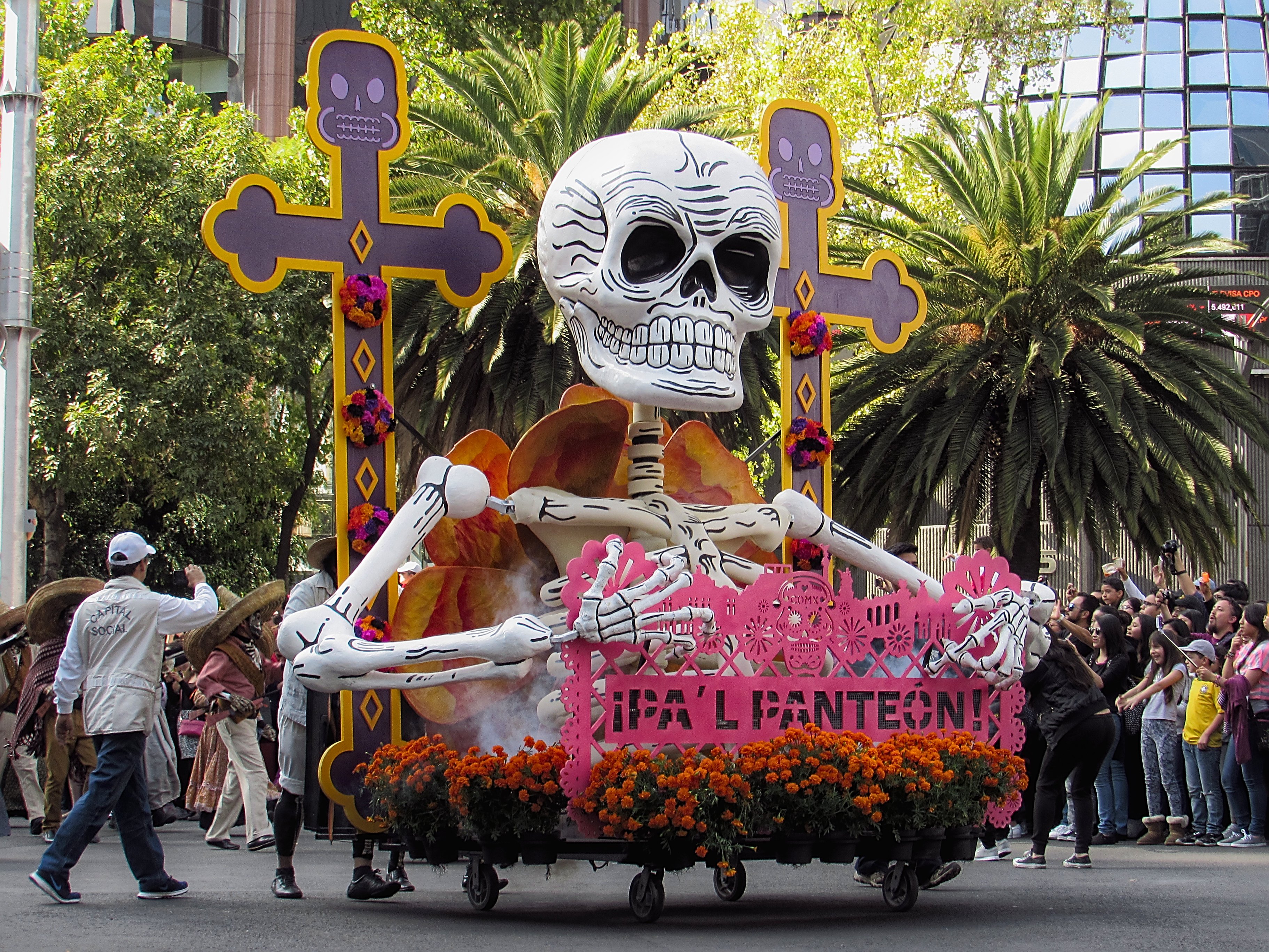
[10 marks]
Answer:
Veo un gran desfile cultural. (I see a great cultural parade / procession.)
Uses the pre-nominal adjective gran.
Hay mucha gente en la plaza central. (There is a lot of people in the main square.)
Adjective (mucha) agrees with the noun (gente - feminine singular).
Hay unas figuras esqueléticas y grandes. (There are some skeletal and large figures.)
Adjective agreement (esqueléticas and grandes - feminine plural).
Pienso que es un buen espectáculo. (I think that it is a good show / spectacle.)
Uses the pre-nominal adjective buen.La atmósfera parece muy alegre. (The atmosphere seems very cheerful / happy.)
Adjective (alegre) follows the noun / verb structure (atmósfera / parece).
Worked Example
Higher Tier
Write a short post for an online blog about customs and festivals. Write approximately 90 words in Spanish. You must write something about each bullet point.
Mention:
A celebration or tradition your family usually follows now.
What you did to celebrate your last birthday or New Year's Eve.
Which Spanish festival you would like to visit in the future and why.
[15 marks]
Answer:
Actualmente, mi familia y yo tenemos la costumbre de comer tapas el sábado por la noche. Nos llevamos muy bien. Es una tradición divertida y toda la gente disfruta mucho de la música tradicional.
El mes pasado, para celebrar mi último cumpleaños, organicé una fiesta temática en mi casa. Invité a mis amigos, bailamos y comimos mucha paella que mi tío preparó. Lo pasamos fenomenal.
Me gustaría ir a ver La Tomatina el próximo agosto. Sería una experiencia única y fantástica, ya que podría participar en la batalla de tomates y experimentar la cultura española de una manera activa y divertida.
English translation:
Currently, my family and I have the custom of eating tapas on Saturday nights. We get along very well. It is a fun tradition and all the people really enjoy traditional music.
Last month, to celebrate my last birthday, I organised a theme party at my house. I invited my friends; we danced and ate a lot of paella that my uncle prepared. We had a phenomenal time.
I would like to go see La Tomatina next August. It would be a unique and fantastic experience, as I could participate in the tomato battle and experience Spanish culture in an active and fun way.
The phrase "...experiencia única y fantástica, ya que podría participar..." effectively links the two ideas using a subordinate clause marker
Examiner Tips and Tricks
Explicitly signal when you are changing time frames using adverbs like actualmente (currently), el mes pasado (last month), and el próximo agosto (next August) to make it easy for the examiner to spot your grammatical range.

Unlock more, it's free!
Join the 100,000+ Students that ❤️ Save My Exams
the (exam) results speak for themselves:

Was this revision note helpful?
