Tourist Attractions: Exam Skills (AQA GCSE Spanish): Revision Note
Exam code: 8692

Tourist attractions: listening
Here you will see a highly demanding short answer comprehension in English task for both Foundation and Higher Tier.
Worked Example
Listen to a local guide describing his city. Answer the questions in English.
How long has the building been open to the public?
What is the key difference between what the guide and the young people like?
What are you not permitted to do inside the castle?
How much is the entrance fee for a 17-year-old?
[4 marks]
Answer:
50 years
The guide likes the architecture / Young people like the garden
Buy souvenirs
Ten euros
Audio script:
"Trabajo de guía en el castillo (castle) de Segovia. El edificio abrió (opened) sus puertas al público hace cincuenta años (50 years)."
"Para mí, la arquitectura es lo más interesante (interesting), pero a la gente joven le gusta más el jardín. La visita al jardín dura (lasts) unos cuarenta minutos."
"Si tienes mucha hambre, puedes comer una tapa en la plaza central (central square), pero no puedes (you cannot) comprar recuerdos dentro (inside) del castillo."
"La entrada (ticket) cuesta diez euros para los adultos, y es gratis (free) para los menores (minors) de dieciséis años."
Examiner Tips and Tricks
When asked for a difference in opinion (Q2), ensure both elements of the contrast are clearly communicated (e.g., Guide likes X, young people like Y)
Questions often target numerical details (time, cost, duration) or restrictions (using poder / no poder or hay que / no hay que) related to the visitor experience
Tourist attractions: speaking
Here you will see a task that models a Foundation Tier role-play, requiring five prescriptive tasks, and a reading aloud task and the following unprepared conversation for Higher Tier.
Worked Example
Foundation Tier
Prepare the answers to the following questions in Spanish for a conversation with a tourist guide about a sightseeing tour. Address the guide formally (Usted).
Say which historical building you want to visit and why. (Give one detail and one reason)
Say who you are traveling with. (Give one detail)
Give your opinion of the tourist attractions in this city. (Give one opinion)
Say what you would do if the museum were closed. (Give one detail)
Ask a question about tickets.
[10 marks]
Answer:
Quiero visitar el castillo porque me interesa la historia. (I want to visit the castle because history interests me.)
Present tense, use of interesar-type verb
Viajo con mi familia y mis amigos. (I am traveling with my family and friends.)
Present tense
Pienso que son maravillosas. (I think they are wonderful.)
Present tense, adjective agreement
Buscaría un hotel para descansar. (I would look for a hotel to rest.)
Simple conditional tense (buscaría) for a hypothetical situation
¿Cuánto cuesta una entrada, por favor? (How much does a ticket cost, please?)
Interrogative ¿Cuánto? and present tense (cuesta)
Examiner Tips and Tricks
If instructed to use the formal address (usted), ensure your verbs and possessive adjectives are conjugated/used accordingly (quiere, viaja, piensa).
Worked Example
Higher Tier
Read aloud the following text in Spanish.
Viajaría por todo el mundo. Me encanta visitar monumentos antiguos y ver la arquitectura histórica. Mi amigo trabaja de guía turístico en una torre de la capital. Dice que es peligroso en la cima a causa del viento. Sin embargo, es un lugar que merece la pena visitar.
Now, answer four questions in Spanish that relate to the topic of Travel and tourism and places of interest.
¿Qué harías si la torre está cerrada?
¿Qué piensas de los guías turísticos?
¿Cuál es tu edificio favorito y por qué?
¿Qué harás para el próximo puente (long weekend)?
[15 marks]
Answer:
Si está cerrada, iría al museo más cercano e investigaría el patrimonio local. (If it's closed, I would go to the nearest museum and I would investigate the local heritage/patrimony.)
Conditional (iría, investigaría).
Pienso que son útiles porque pueden explicar la historia y el ambiente del lugar.(I think that they are useful because they can explain the history and the atmosphere of the place.)
Opinion + justification, showing complex vocabulary (útiles, ambiente).
Mi edificio favorito es el puente antiguo porque es muy bonito y es importante para la ciudad. (My favourite building is the old bridge because it is very pretty and it is important for the city.)
Developed present tense answer using descriptors and justifications.
Alquilaré un coche y viajaré a la costa para descansar. (I will hire a car and I will travel to the coast in order to rest/relax.)
Use of the simple future tense (alquilaré, viajaré) for plans.
Examiner Tips and Tricks
Practice reading the text aloud, paying close attention to words with antepenultimate stress (like histórica) and the strong 'r' sound in words like torre.
Tourist attractions: reading
Here you will find a multiple choice comprehension in English task, which assesses your ability to quickly retrieve specific information and understand basic statements from a written Spanish text at Foundation Tier, and a time frame identification (P/N/F) task, which requires identifying whether a statement refers to the Past (P), Now (N), or Future/Hypothetical (F).
Worked Example
Foundation Tier
Read the descriptions of the two tourist attractions below. Choose the correct option (A, B, or C) to complete the sentences in English.
A. El Museo de Historia es el edificio más antiguo del pueblo. Abrimos todos los días, pero cerramos a las cuatro. Muchos turistas dicen que el ambiente es fantástico.
B. El Puente de la Reina es nuevo. Terminaron la construcción en julio. Los visitantes toman fotos del río. Pienso que merece la pena visitarlo.
The Museum of History closes at...
A. four o'clock. B. seven o'clock. C. nine o'clock.
The tourists' opinion of the museum is that...
A. it has bad architecture. B. the atmosphere is fantastic. C. it is very expensive.
The people who visit the bridge mainly want to...
A. take photos of the river. B. see a historical construction. C. pay for the entrance ticket.
[3 marks]
Answer:
A - cerramos a las cuatro (we close at four)
B - el ambiente es fantástico (the atmosphere is fantastic)
A - toman fotos del río (they take photos of the river)
Examiner Tips and Tricks
Be careful of options that use related vocabulary but state the opposite opinion (e.g., saying the architecture is bad when the atmosphere is fantastic).
Worked Example
Higher Tier
This is demanding at Higher Tier as it requires distinguishing between completed actions (preterite), habitual actions (imperfect), and conditional aspirations.
Read the tourist blog post. Write P for past, N for now, or F for future/hypothetical next to each statement.
El año pasado, fui a mi ciudad natal donde solía visitar un monumento antiguo. Ahora, la entrada cuesta quince euros, pero me gustaría volver en verano. Cuando tenga la oportunidad, visitaré el castillo real de la reina porque dicen que es maravilloso. Aunque las torres estén cerradas actualmente, yo recomendaría el viaje a todos.
Visiting a place of interest habitually.
The cost of a ticket is now high.
A hypothetical plan to visit the royal castle.
The current state of the towers.
[4 marks]
Answer:
P - Use of the Imperfect tense (solía visitar = used to visit).
N - Use of the Present tense (cuesta = costs) and time indicator Ahora (Now).
F - Use of the Future tense (visitaré = will visit), signalling future.
N - Use of the Present subjunctive tense (estén cerradas = are closed), signalled by actualmente (currently).
Examiner Tips and Tricks
If you see the conditional tense (recomendaría), or the irregular conditional stems (e.g., haría, tendríamos), classify the statement as future (F), as it expresses a desire or action that might happen.
Tourist attractions: writing
Here you will see a task that models the Foundation Tier photo description, requiring five short, clear sentences based on a photo prompt, and the open-ended writing task (150 words) at Higher Tier.
Worked Example
Foundation Tier
Look at the photo provided. Write five short sentences in Spanish describing the scene.
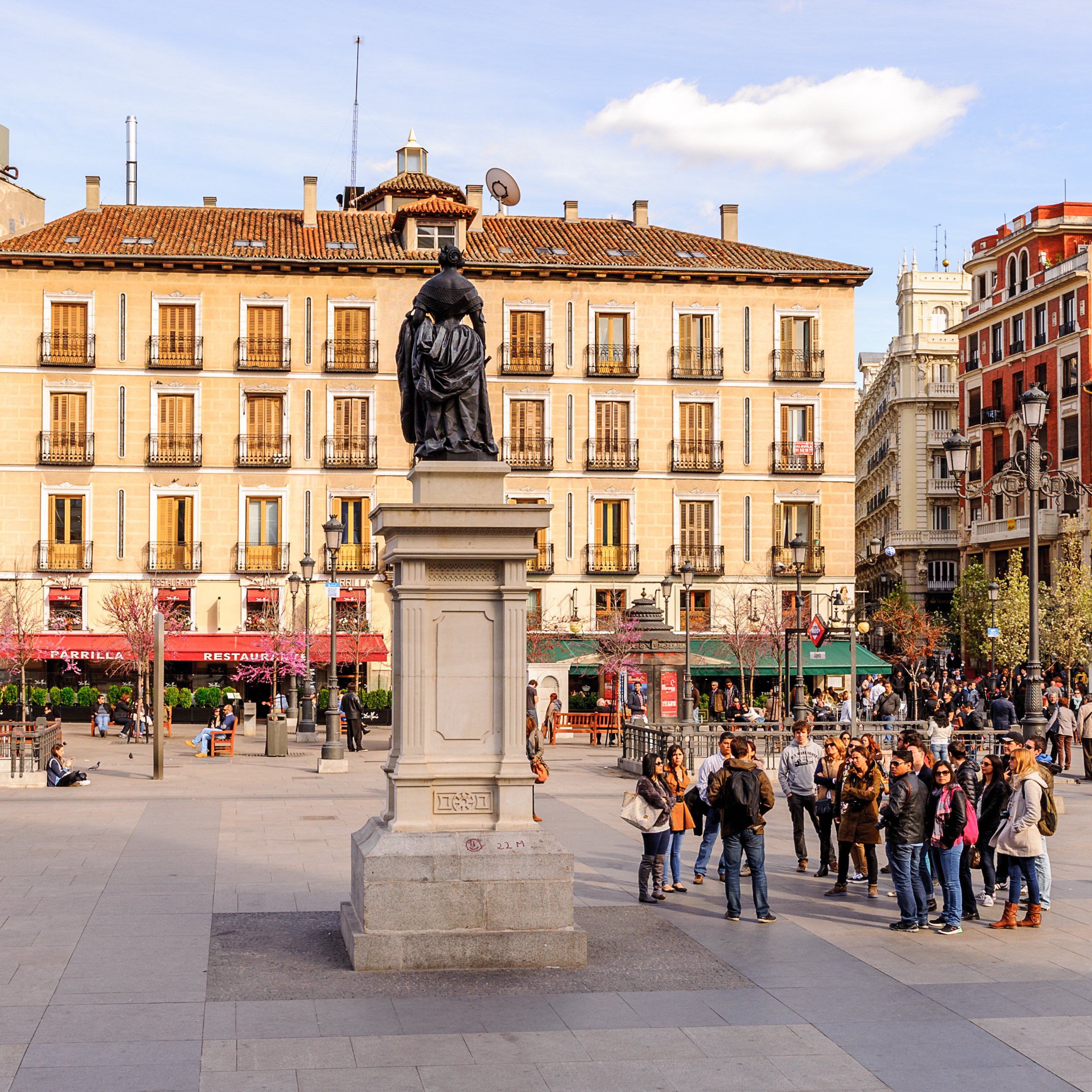
What's in the photo?
[10 marks]
Answer:
Veo una plaza muy grande. (I see a very big square.)
Hay un monumento antiguo en el centro. (There is an ancient monument in the center.)
Muchas personas están de vacaciones. (Many people are on holiday.)
Las personas miran el edificio histórico. (The people are looking at the historical building.)
Pienso que la arquitectura es muy bonita. (I think that the architecture is very pretty.)
Examiner Tips and Tricks
Each sentence should contain a single, unambiguous idea. Use simple starter phrases like Veo (I see), Hay (There is/are), or Pienso que (I think that)
This task relies heavily on the present tense (es, hay, están) or the present continuous (están mirando) to describe what is happening now in the picture
Remember that most descriptive adjectives (like grande, histórico, antiguo) must go after the noun they describe
Worked Example
Higher Tier
Write an opinion article for a travel magazine. Write approximately 150 words in Spanish. You must write something about both bullet points.
Mention:
The positive and negative effects of tourism on a famous place to visit that you know
What major improvements you would make to the area to help tourists and locals
[25 marks]
Answer:
En mi opinión, el turismo en las grandes ciudades, como Barcelona, es un tema muy complicado. Lo bueno es que trae mucho dinero a la economía local y crea muchos empleos para la comunidad. Esto ayuda a las personas a tener un mejor nivel de vida. Sin embargo, la consecuencia negativa es que causa mucho ruido y es malo para el medio ambiente. Además, el turismo masivo destruye la arquitectura histórica y hace la vida más difícil para los locales a largo plazo.
Como director del ayuntamiento, haría muchos cambios. Para los turistas, mejoraría la seguridad para que puedan visitar la famosa Sagrada Familia sin riesgo. También, construiría más espacios verdes y jardines porque los monumentos necesitan protección del calor y la gente necesita relajarse. Quisiera también prohibir el tráfico en todo el centro histórico para reducir las emisiones.
English: In my opinion, tourism in big cities, like Barcelona, is a very complicated issue. The good thing is that it brings a lot of money to the local economy and creates many jobs for the community. This helps residents have a better standard of living. However, the negative consequence is that it causes a lot of noise and is bad for the environment. Furthermore, mass tourism destroys historic architecture and makes life more difficult for locals in the long term.
As the city council director, I would make [Conditional] many changes. For tourists, I would improve security so that they can [Present Subjunctive] visit the famous Sagrada Familia without risk. I would also build [Conditional] more green spaces and gardens because monuments need protection from the heat and people need to relax. I would also like [Conditional] to prohibit traffic in the entire historic centre to reduce emissions.
Examiner Tips and Tricks
To achieve regular successful development of ideas, avoid simple statements. Use connectors like sin embargo, por eso, and porque to build multi-clause units, explaining the consequences or reasons for your opinions.

Unlock more, it's free!
Join the 100,000+ Students that ❤️ Save My Exams
the (exam) results speak for themselves:

Was this revision note helpful?
